

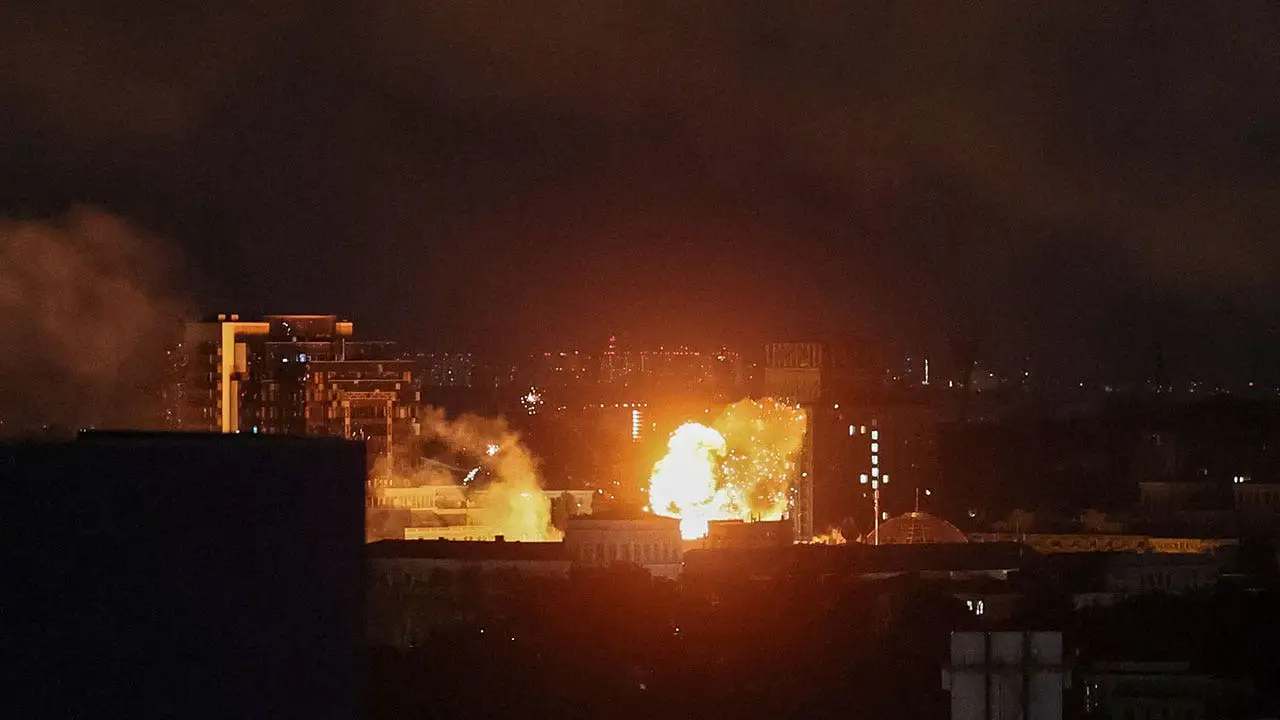
In the quiet, pre-dawn hours of Thursday, the residents of Kyiv were abruptly jolted from their sleep by the terrifyingly familiar wail of air raid sirens, a haunting sound that has become the grim soundtrack of their daily existence. Before the morning sun could pierce the horizon, Russia launched a barrage of highly destructive ballistic missiles directly targeting Ukraine’s capital, turning the peaceful night sky into a chaotic arena of blinding flashes and deafening explosions. Kyiv’s Mayor, Vitali Klitschko, immediately took to social media and public channels, his voice laced with urgency as he pleaded with citizens to ignore the temptation to watch from their windows and instead seek immediate shelter in Metro stations, basements, and concrete bunkers. For the ordinary people of Kyiv—parents clutching sleeping children, elderly residents navigating dark stairwells, and pets trembling from the vibrations—the attack was another reminder of the fragile line between life and death. Reuters witnesses in the city reported that the ground itself shook as multiple explosions detonated across metropolitan areas, illustrating the terrifying precision and speed of modern ballistic weaponry. This was not merely a military operation reported on a map; it was a deeply personal, terrifying crisis for millions of civilians who had to wait in breathless silence, praying that the air defense systems would hold and that their homes would not be the next to crumble into ash.
As the smoke began to clear and the immediate threat receded into a tense morning daylight, emergency services rushed to the scenes of destruction to assess the damage and extinguish the resulting blazes. Mayor Klitschko later confirmed that several non-residential sites had caught fire due to falling missile debris and direct impacts, sending thick plumes of black smoke into the Ukrainian sky. Miraculously, in the immediate aftermath of the strike, authorities reported that there were no civilian casualties, a testament to both the quick reactions of the populace and the heroic, tireless efforts of the Ukrainian air defense crews who intercept these deadly threats daily. Yet, the lack of physical casualties does not mean there was no harm done; the psychological toll of surviving such near-misses leaves deep, invisible scars on the community. Every explosion chips away at the collective sense of safety, reinforcing a state of constant, exhausting vigilance for a population that has already endured years of relentless bombardment. This recent offensive is part of a broader, devastating pattern, coming on the heels of previous campaigns where Russia unleashed nearly 600 missiles and drones on the capital in landmark escalation efforts, proving that the threat to civilian life remains a daily, existential reality.
The terrifying onslaught did not catch the Ukrainian leadership off guard, as President Volodymyr Zelenskyy had issued an explicit, somber warning to the nation just hours before the missiles were detected. Zelenskyy disclosed that he had received a detailed intelligence briefing from Air Force Commander Anatolii Kryvonozhko, which indicated with high probability that Russia had finalized preparations for a massive, multi-pronged overnight assault several days prior. Taking to his official account on X, formerly Twitter, the president sought to prepare his people for the incoming danger, illustrating the heavy burden of leadership in a time of total war, where a leader must balance the need to prevent mass panic with the duty to save lives through timely warnings. For Zelenskyy, these warnings are not just tactical updates but emotional appeals to the conscience of the global community, showcasing the agonizing reality of knowing an attack is imminent while harboring limited resources to completely neutralize it. His message underscored a painful truth: while Ukrainian soldiers and air defense teams are extraordinarily skilled and determined, they are constantly fighting against a mathematical deficit of equipment, making every overnight raid a high-stakes lottery where human lives are the ultimate currency.
This latest escalation occurred at a highly critical diplomatic juncture, happening almost immediately after President Zelenskyy returned from a high-stakes diplomatic mission to the United States. During his visit, the Ukrainian leader engaged in intense, pivotal discussions with U.S. President Donald Trump, aiming to secure the robust, uninterrupted military and financial support necessary to sustain Ukraine’s defense. Zelenskyy’s public statements after the attack were directly aimed at Washington and other Western capitals, emphasizing that the physical protection of Ukrainian children, families, and infrastructure relies entirely on the political will of its global partners. He argued that the willingness—or hesitation—of international allies to provide advanced air defense missiles is the single most deciding factor in whether Ukrainian civilians live to see the next day. The stark contrast between the air-conditioned, secure diplomatic meeting rooms of America and the cold, damp bomb shelters of Kyiv highlights the challenging reality of Zelenskyy’s job, as he must continuously translate the academic language of geopolitics into the urgent, human language of survival to convince foreign leaders that their domestic political debates have real-world, life-or-death consequences on the ground in Eastern Europe.
A potential beacon of hope emerged from these high-level diplomatic discussions, particularly regarding the future of Ukraine’s domestic defense capabilities and long-term security architecture. During the recent NATO summit held in Turkey, Donald Trump announced a significant policy shift, stating that the United States would officially license Ukraine to manufacture the highly sophisticated Patriot air defense systems within its own borders. This announcement represents a major structural development, as the Patriot system is widely regarded as one of the most effective shields against ballistic and cruise missiles in the world. Zelenskyy seized upon this development in his post-strike address, noting that while long-term domestic manufacturing licenses are invaluable for future stability, the immediate survival of his country depends on those partners who currently possess active Patriot missiles and can dispatch them without delay. The logistical and engineering feat of setting up high-tech military manufacturing facilities inside a country actively undergoing daily missile strikes is an unprecedented challenge, meaning that while the license offers a path toward self-reliance, it cannot replace the immediate, desperate need for structural military aid from current allied stockpiles.
Ultimately, the early Thursday morning attack on Kyiv serves as a stark, uncompromising reminder of the human cost of political hesitation, a theme that Zelenskyy emphasized with profound frustration. In his concluding remarks, the Ukrainian president warned that every single global partner is fully aware of the specific defense assets Ukraine requires and intimately understands the devastating consequences of “marking time” or delaying decisions. For the families in Kyiv who spent their night huddled on cold concrete floors listening to the thunder of ballistic impacts, international diplomacy is not an abstract chess game played by politicians, but a literal shield that determines whether their homes remain standing. As the residents of the capital sweep away broken glass, repair damaged structures, and prepare themselves for the inevitable next alarm, the message from Ukraine remains clear and deeply human: solidarity must be measured not in speeches or promises of future manufacturing, but in the immediate delivery of life-saving defense systems that can keep the skies safe. The resilience of the Ukrainian people is undeniable, but it is a resource that should not be endlessly tested by the world’s delay, especially when the tools to prevent further tragedy are readily available in warehouses across the democratic world.