





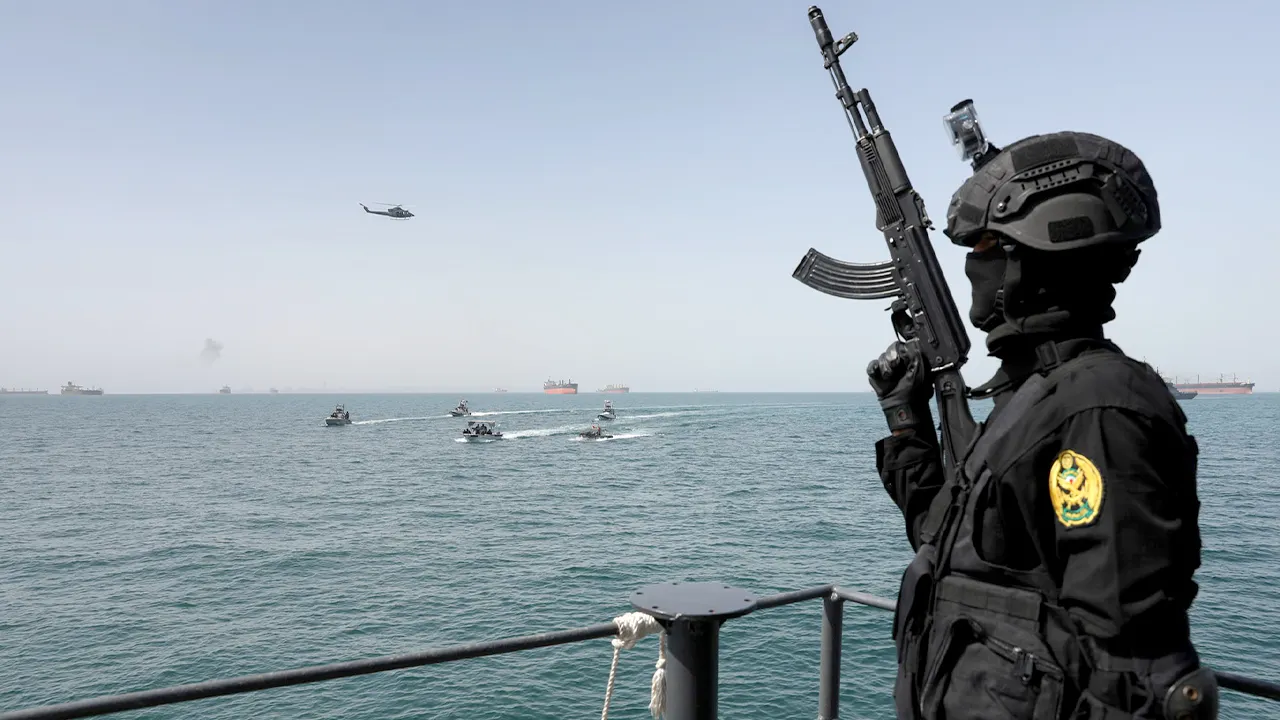
Picture the Strait of Hormuz on any given morning: murky green water, heat shimmering off the deck of a naval vessel, oil tankers moving slowly like steel elephants through one of the most strategically important shipping lanes on Earth. It is not a place where most people would expect a battle over secrets, but in recent weeks it has become exactly that. U.S. Navy ships and drones patrol these waters alongside commercial traffic, watching for threats and keeping the sea lanes open. Yet Iran is playing a different game. According to drone experts, Tehran is deliberately targeting American naval drones in the strait, not simply to destroy them but to capture them, study them, and learn how the United States sees the region. Every attempted seizure is part of a coordinated effort to gather intelligence on American surveillance capabilities and to figure out how to evade U.S. defenses. This is not about stealing one piece of hardware. It is about understanding how the U.S. military operates in one of the world’s most vulnerable maritime choke points, where even a small incident can ripple through global oil prices and international security. The warning from experts landed with particular urgency after a Sept. 14 confrontation in which U.S. forces destroyed two Iranian fast boats that were trying to take an American unmanned surface vessel. The attempt failed, and the drone remained under U.S. control, but the message from Tehran was clear: the watching never stops, and neither does the trying.
Iran’s approach is not random or opportunistic. Cameron Chell, the CEO of the American drone manufacturer Draganfly, describes it as a “very coordinated, absolutely deliberate” series of intelligence-gathering missions. That might sound like an overstatement, but the pattern is hard to ignore. When Iranian forces try to seize a U.S. reconnaissance drone, they are not interested in the machine itself as much as what it represents. A drone carries sensors, cameras, communications gear, and software that reveal how America watches the world. Even a short period of physical access can allow Iranian engineers to examine the hardware, identify frequencies, understand detection ranges, and learn how the drone is controlled. It does not necessarily expose classified data, but it reveals the operational habits of the U.S. Navy: how patrols are structured, where drones linger, what kind of information they gather, and how quickly a response arrives. As Chell put it, even “little tidbits of intel start to paint a picture.” Each captured drone, or even a brief glimpse at one, is a piece of a larger puzzle. Over time, those pieces can help Iran develop countermeasures, design similar systems, or plan attacks that avoid American detection. That is why experts are concerned. Iran is not just testing the boundaries of international waters; it is testing American readiness, patience, and security in real time. And every time the Islamic Revolutionary Guard Corps sends out its fast boats, the Strait of Hormuz becomes a little less stable.
The latest clash began with an attempted seizure of an American unmanned surface vessel patrolling the area. U.S. Central Command spokesperson Capt. Tim Hawkins confirmed that Iranian small boats “recently attempted to take possession” of the U.S. drone, but they were unsuccessful after CENTCOM “forcefully responded.” The surface drone remained under U.S. operational control. In a region where information is almost as important as ammunition, that forceful response was necessary, but it also carried risk. Iranian state media immediately spun the event in its own way, claiming that the U.S. military had attacked civilian fishing vessels and that search-and-rescue operations were underway near Larak Island. Iranian officials spoke of missing fishermen, and the air filled with competing narratives. This is the fog of war, modernized and mediated in real time. For the American sailors and commanders involved, the incident was a reminder that every interaction in the strait is potentially lethal. The unmanned surface vessel that Iran tried to grab is relatively small, but its disappearance would have been a significant intelligence victory for Tehran. The fact that it was defended successfully does not erase the broader concern: Iran has tried this before, and it will try again. The attempted capture was not an isolated moment of aggression but another chapter in a long-running struggle over who controls the information environment in one of the planet’s most important waterways.
History makes that strategy unmistakable. In 2011, Iran seized an American RQ-170 Sentinel stealth drone that had gone down near the Afghan border. Then-President Barack Obama publicly asked Tehran to return it, and Iran refused. Instead, Iranian engineers studied the aircraft, claimed to have extracted valuable technology, and eventually displayed what appeared to be their own copies. Iranian drones soon began to look suspiciously similar to the RQ line, a fact that experts say was no coincidence. That was not the only incident. In 2022, a U.S. Navy patrol ship and an MH-60S Seahawk helicopter intercepted an Iranian vessel attempting to tow away a Saildrone surface vessel in the Gulf. More recently, Iran managed to capture an Anduril Dive-LD autonomous underwater drone. Palmer Luckey, the CEO of Anduril, acknowledged that the drone was built to operate in dangerous environments where capture was an expected possibility. He said it provided significant value for months before it was taken. Iranian social media even celebrated the capture with a post teasing an “unboxing ceremony” by reverse engineers. U.S. Navy representatives countered that the recovered drone was an older model that had malfunctioned and gone dead in the water. But the larger point remains: Iran is actively harvesting American technology whenever it can. Each incident gives Tehran a chance to study the tools of modern warfare up close. It is like losing a notebook to an enemy who does not need to read every page to understand how you think.
The stakes go far beyond individual drones. The Strait of Hormuz is a lifeline for global energy supplies, and its security affects economies around the world. Commercial transit through the strait has already fallen below historic levels as tensions have grown. Shipping companies are nervous. Insurers are wary. And Iran knows that its ability to disrupt the strait is one of its strongest cards. If Tehran can capture U.S. drones, it can better understand how the Navy detects and tracks submarines, surface ships, and small boats. That knowledge could enable more effective swarming tactics, better torpedo targeting, or more successful missile attacks. It could also allow Iran to use captured designs to build its own unmanned systems, a process that is already visible in the drones Tehran has showcased in recent years. The U.S. military understands this vulnerability and has adjusted. As Chell noted, when American forces know a drone has been captured, they change their tactics and operational overview accordingly. They know these are high-value targets, and they treat them as such. But there is tension at the heart of this new form of warfare: drones are meant to be deployed, pushed forward, and used. The more they are used, the greater the risk of capture. The more they are protected, the less intelligence they can gather. Iran is exploiting that dilemma, forcing the U.S. to choose between aggressive surveillance and operational security. That is precisely why experts describe the situation as escalating. Each drone lost or nearly lost teaches the U.S. something even as it teaches Iran, and the cycle continues.
For better or worse, autonomy and unmanned systems are now the new standard in warfare. The U.S. is spending billions of dollars on drones, from small surface vessels to high-altitude aircraft, and the Pentagon’s budget has jumped from hundreds of millions to tens of billions in pursuit of these capabilities. But that investment comes with new vulnerabilities. Cheap, disposable attacks can overwhelm expensive defenses, and even the most advanced drone is only as secure as the network that controls it. Iran’s campaigns in and around the Strait of Hormuz are a reminder that the future of conflict is not always measured in missile explosions and territorial gains. Sometimes it is measured in quiet moments: a small boat slipping alongside an unmanned vessel, a hook catching a rail, a team of engineers working late into the night in a laboratory, reverse-engineering someone else’s technology. The struggle for the Strait of Hormuz is not just about oil or naval power. It is about who gets to see, who gets to know, and who gets to keep the secrets that define modern warfare. And as the U.S. Navy continues its patrols, with drones humming overhead and drifting beneath the waves, the human element remains at the center of it all. Men and women in uniform are watching screens, making split-second decisions, and worrying about what might be out there. They know that the next attempt could come at any moment, in any form, and that the world’s attention may be focused elsewhere when it happens. The threat is not always dramatic. Sometimes it is a boat approaching too quickly, a signal lost, or a drone that simply does not answer. In the strait, the cold war of intelligence and autonomy is being fought in real time, and the only certainty is that the watching will continue.