





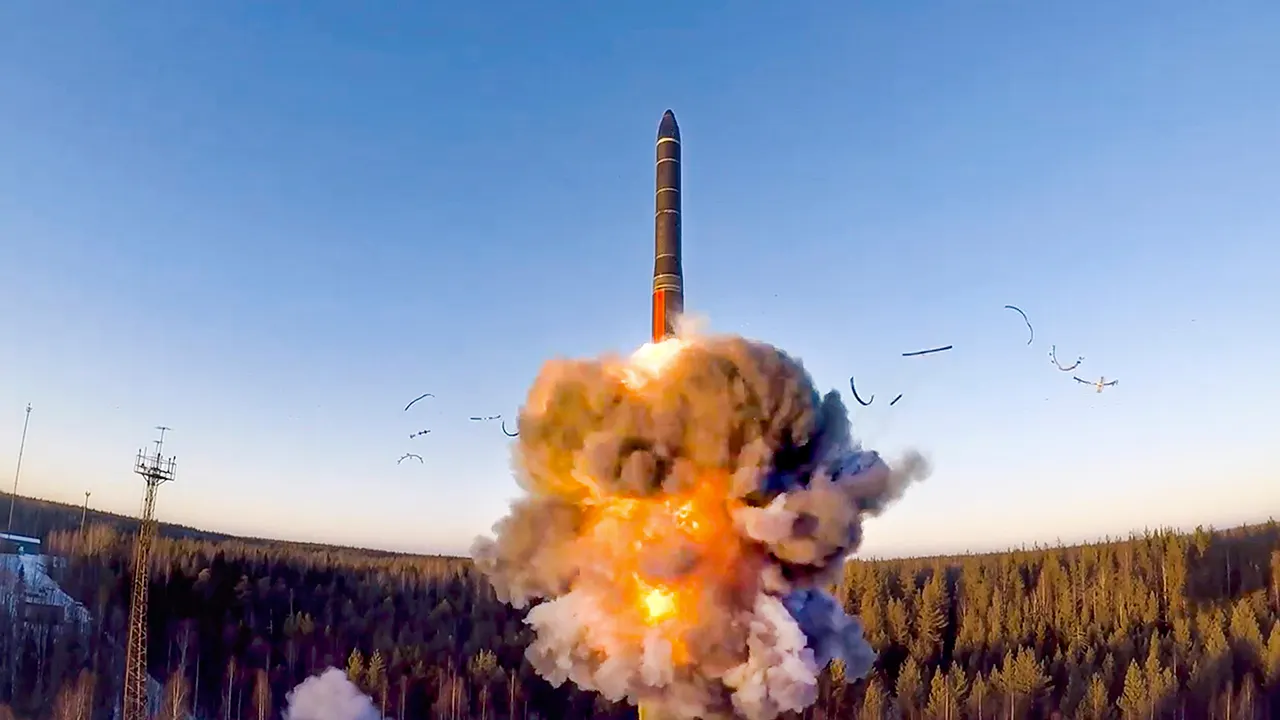
For months, the war in Ukraine has been defined not only by brutal front-line combat but by a relentless, industrial-scale campaign of missiles and drones that has turned entire cities into testing grounds for Russian military innovation. Now, Western and Ukrainian defense officials are warning that Moscow is on the verge of a significant escalation: the final test of a new ballistic missile capable of striking targets at distances of up to 800 kilometers—roughly 500 miles—while potentially performing evasive maneuvers designed to outwit even the most modern air defenses. The warning, delivered by Vadym Skibitskyi, deputy head of Ukraine’s Defence Intelligence, suggests that Russia plans to conclude these final tests by the end of the year, possibly not in a remote testing range but in live-fire strikes against Ukrainian territory. It is a sobering reminder that the Kremlin is not merely fighting a war of attrition; it is also racing to develop next-generation weapons in the heat of conflict, using the Ukrainian battlefield as a proving ground for systems that could redefine how modern warfare is waged.
At the heart of the concern is not just the missile’s range but its behavior in flight. Tom Karako, director of the Missile Defense Project at the Center for Strategic and International Studies, explained to Fox News Digital that the new system could feature advanced maneuverability that would place an enormous burden on Ukraine’s already strained air-defense network. Traditional ballistic missiles follow a predictable, arcing trajectory, allowing defenders to calculate where they are going and intercept them with relative confidence. But if this new weapon is designed to “weave a little bit” at the terminal stage, as Karako described, it could make the defender’s job far harder, requiring more sophisticated interceptors that Ukraine does not currently possess in sufficient numbers. He also suggested that Russia might simply be looking for a way to mass-produce a cheaper, simpler 800-kilometer missile, flooding the battlefield with weapons that are difficult to stop and impossible to ignore. Either way, the arrival of such a system would intensify the pressure on Ukraine’s air defenses, which have already been forced to contend with nearly 600 missiles and drones unleashed on Kyiv in recent months.
This evolution in missile technology is part of a broader global shift, one in which the old distinctions between ballistic and cruise missiles, between guided and unguided weapons, are beginning to blur. Karako noted that even the United States and other advanced militaries are increasingly equipping nearly every weapon with some form of terminal guidance, making them more precise and more difficult to intercept. “Just about every gravity bomb that we have has some kind of terminal guidance for precision,” he said, pointing to a near future in which “you don’t really have that many purely ballistic missiles.” Instead, the next generation of weapons may be “ballistic for a good part of their path” but then surprise the defender with maneuvering reentry vehicles or other “terminal end game surprises.” The Russian missile under development appears to fit that pattern, and its deployment would mark another step in a quieter but equally consequential arms race—one that is being fought not in headlines alone but in the physics of flight, the speed of computers, and the sharpness of sensors.
The timing of the test, according to Ukrainian intelligence, could also turn it into a grim demonstration of power. Rather than being fired into some empty expanse, the missile might be used against military targets in western Ukraine, far from the front lines, in what Karako described as “a business-as-usual arrangement” for developing and fielding new weapons during wartime. He acknowledged that “all kinds of norms are being broken” because of the war, and that some of the missile’s early tests could be conducted directly in Ukraine, merging developmental testing with live combat operations. If that happens, it would not be entirely surprising, given how deeply Russia has integrated its defense industry into its war effort. Reports from Ukrainian intelligence indicate that Russian production of its primary missile types has been running at 110 to 120 percent of monthly targets, and Ukraine has recorded more than 1,858 missile launches of various kinds from the start of the year through late August. As Karako put it, Russia is truly “on a wartime footing,” with its defense industrial base “cranking these things out like sausages.”
There is also a broader geopolitical shadow hanging over this new missile. Its range—800 kilometers—places it squarely in a category that was once banned by the Intermediate-Range Nuclear Forces Treaty, signed by President Ronald Reagan and Soviet leader Mikhail Gorbachev in 1987. That landmark arms-control agreement prohibited ground-launched ballistic and cruise missiles with ranges between 500 and 5,500 kilometers, a category that the new Russian weapon would violate. The United States withdrew from the INF Treaty in 2019, citing years of alleged Russian violations, and now it seems Russia is openly filling that gap. Karako called the development “understandable and reasonable” from a purely military perspective, but also noted that it was precisely the kind of cheating that led Washington to abandon the treaty in the first place. The return of intermediate-range missiles, once consigned to the dustbin of Cold War history, adds yet another layer of instability to a world already struggling to manage the consequences of Russia’s aggression in Ukraine.
For Ukraine’s leaders, the stakes could not be higher. President Volodymyr Zelenskyy has spoken openly about the severe strain on his country’s air defenses, especially with winter approaching. In a recent interview, he said he wanted 100 to 120 interceptors to carry Ukraine through the cold months, acknowledging that no one knows how long the brutal season will last. “This is truly a major challenge,” he said. The introduction of a new, more maneuverable Russian missile would make that challenge even more daunting, requiring not only more interceptor missiles but better ones—systems that many allies are reluctant to send or simply do not have to spare. There is also a wider anxiety rippling through Eastern Europe. As Karako noted, countries like Poland, Romania, and the Baltic states are watching closely, because a missile that can reach Ukraine’s western border can also reach them. The war in Ukraine, once seen by some as a distant regional conflict, has become a laboratory for the future of European defense. And if that laboratory produces weapons that are faster, smarter, and harder to stop, the entire continent—not just Ukraine—will have to live with the consequences.