





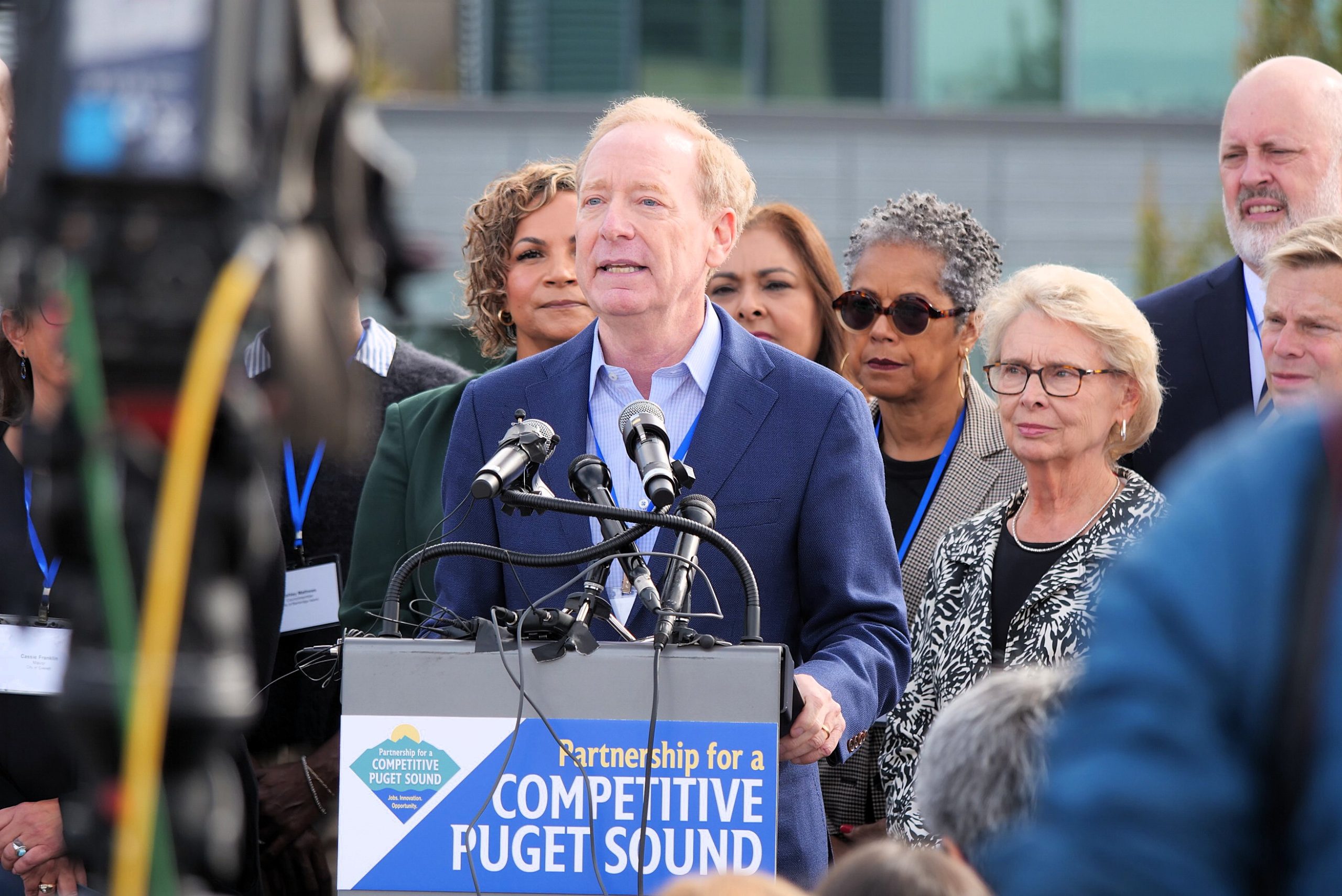
On a gray Monday morning in Seattle, with the downtown skyline as a backdrop, Brad Smith did not sugarcoat the moment. A century ago, he reminded the crowd, Detroit, Cleveland and Pittsburgh each had their time in the sun. Then came the warning lights, and their leaders failed to heed them. “Well, here we are. It is 2026,” said Smith, Microsoft’s vice chair and president. “And the warning signs are flashing on our economy.” Standing at his left was former Washington Gov. Chris Gregoire, now CEO of Challenge Seattle, with dozens of regional leaders behind them. The occasion was the launch of the Partnership for a Competitive Puget Sound, a Challenge Seattle initiative that brought together roughly 50 elected officials from King, Kitsap, Pierce and Snohomish counties — two county executives, around 20 mayors, port commissioners and about a dozen state legislators — along with labor leaders and business executives. They came with a 20-point plan to reverse the region’s slide, and with a new report that supplied the hard numbers. The Seattle area lost nearly 7,000 jobs in 2025, the first time in two decades outside a recession or the pandemic that regional employment growth trailed the nation’s. Washington has fallen from 32nd to 47th in CNBC’s ranking of states by cost of doing business since 2017. The report also noted that more than 32% of the office space in Seattle’s central business district sits vacant. For a region that spent the past two decades watching cranes rise and new campuses multiply, these numbers landed like a cold shower. The mood was urgent but not panicked; no one was predicting an overnight collapse. But Smith’s history lesson was the deeper point: economic dominance is not permanent, and the choices leaders make when the warning lights flash determine whether a region becomes a comeback story or a cautionary tale. It was hard to miss the symbolism: the people who shape employment, policy and labor standing in front of the skyline, publicly acknowledging that the future is not something they can take for granted.
The report’s most pointed observation involved technology. Aerospace has a coordinated regional agenda; technology, despite being one of Puget Sound’s defining economic anchors, does not. The asymmetry is striking because tech now accounts for nearly one in ten regional jobs and about 24% of total payroll. Aerospace knows what it’s working on: the next airplane, the space industry, sustainable fuels, supplier diversification. Technology, the report says, “despite being one of Puget Sound’s defining economic anchors, does not yet have an equally intentional regional strategy.” The comparison matters because aerospace has spent decades aligning companies, unions and government around shared priorities. Tech never had to; its growth felt effortless. That era is over. Without an intentional strategy, the region risks losing jobs, technology investment, headquarters, talent and company growth to the Bay Area, New York, Boston and Austin. The goal, the report is careful to say, is “not simply to promote growth, but to protect and strengthen the region’s position as a leading technology center.” Challenge Seattle says it will write that strategy with the Puget Sound Regional Council, built around two priorities: keeping the big tech companies investing here, and making it easier for startups to scale. Related recommendations target industrial space for AI hardware startups, commercial space, and the region’s fusion cluster. The report sets no budget, no precise measure of success, and no deadline beyond the general goal of progress within three years. That may be intentional; the first test is whether the region can agree on a direction at all. Many of the recommendations are deliberately process-oriented, not expensive new programs: deadlines for permit decisions, a designated business contact in every city and county, and a strategy for dealing with the way taxes stack across state, county and city. In other words, this is less about writing checks and more about changing the default behaviors that make the region harder to do business in. The hope is that a shared tech strategy will give companies a reason to stay, grow and expand here rather than treating Seattle as just another branch office in a global economy.
Chris Gregoire framed the moment as a regional wake-up call. “This is, for us, a wake-up call,” said the former governor, who now leads Challenge Seattle. “We cannot resort to relying on yesterday’s success while tomorrow’s jobs go somewhere else.” It was a line that resonated across the room, in part because the people standing behind her represented every corner of the region. April Sims, president of the Washington State Labor Council, added a blue-collar perspective: businesses need predictability and enough margin to invest, innovate and take risks, but “working people need margins, too.” King County Executive Girmay Zahilay said his office has already hired an economic development team and is beginning an internal permitting audit. “AI is transforming our economy seemingly overnight,” he said, calling the 7,000 lost jobs “quite alarming.” The group also released a playbook for Puget Sound mayors, drawn from interviews and surveys with local leaders, on building what it calls a culture of partnership with business. Many of the recommendations in the main report are changes to how local government operates rather than new spending: binding deadlines for permit decisions, a designated business contact in every city and county, and a strategy for rationalizing taxes that stack across state, county and city. The underlying message was that government can either be a partner in growth or a friction point, and the region’s leaders want to become the former. The roster of elected officials standing alongside Smith signaled that this was not just another tech industry complaint. It was an attempt to form a united front across city, county and labor lines — and to acknowledge that no single mayor or executive can solve the problem alone. The near-unanimous language of partnership, from both business and labor, was deliberate; in a region that has often seen them at odds, the sight of a Microsoft executive and a labor council president sharing the same stage was itself a small measure of progress.
Then Smith waded into the tax debate, and the conversation got sharper. Asked by GeekWire what it would take for Microsoft to return and grow in Seattle proper, where it previously had offices in South Lake Union, Smith first pointed out that he was standing in front of Redmond Mayor Angela Birney. “We have a great mayor, and every day we get up and we’re excited to go to work in Redmond, Washington,” he said, drawing laughter from the assembled officials. He also pushed back on the premise: Microsoft moved to the Eastside from Albuquerque in 1979 and never had a large presence in Seattle, so Seattle wasn’t the right point of comparison. Then he turned to Seattle’s JumpStart payroll expense tax. As structured, he said, “it is really a tax on tech jobs,” and that is why more tech jobs are moving from Seattle to Bellevue and the Eastside. He noted that San Francisco abolished its payroll tax the same year Seattle adopted one, in 2021. Then came the line that captured the day: “You should tax things you want to discourage, like cigarettes, not jobs.” Smith connected the tax to the broader anxiety about artificial intelligence. “We need people to succeed to some degree in a world of AI,” he said. “And you don’t want to make the cost of employing people more expensive, at the same time that AI is increasingly adding its own new form of competition.” He called a statewide replication of JumpStart one of the fastest possible ways to accelerate job losses, and said Seattle could do one thing to increase jobs in Seattle: revisit whether a payroll tax makes any sense. Then he added a caveat that reminded everyone in the room of the tax’s actual weight: “That’s probably something that would impact other companies more than Microsoft.” Amazon, which has been reported to be the largest payer of the tax, did not have a speaker at the event. A handful of Amazon executives are listed in the report’s acknowledgments, though the report notes participation doesn’t imply endorsement. The silence from Amazon, the company most exposed to JumpStart, was perhaps the most telling detail of the day.
The state level offers its own mixed picture. Senate Majority Leader Jamie Pedersen, D-Seattle, was asked whether Washington risks becoming an outlier among states on taxes. The Legislature has been correcting course, he said, pointing to two moves from this year’s session. One was the estate tax. Lawmakers raised the top rate to 35% in 2025, the highest in the country, then reversed themselves this March and returned it to 20% as of July. The other was the so-called millionaires tax, a 9.9% tax on household income above $1 million, signed by Gov. Bob Ferguson and projected to raise roughly $3 billion a year. It doesn’t take effect until 2028, and Seattle tech leaders warned it would push founders and investors out of the state. Pedersen cast it as the fix for a different kind of outlier status: Washington’s business and sales taxes are high because it is one of the few states with no personal income tax at all. The new tax, he argued, would let Washington “join 41 other states that have a personal income tax.” That framing does not end the debate. Voters get the last word in November: Initiative 645, backed by Let’s Go Washington, qualified for the ballot in July and would repeal the tax. If it survives, Pedersen said, a statewide payroll tax is “vanishingly unlikely” in the next session. In other words, the tax conversation in Olympia is far from settled. The tension between the tech industry’s concerns and the state’s progressive tax structure is not going away; it is simply moving to the ballot box. For the business leaders in the room, the stakes were clear: the state is trying to rewrite its tax code in real time, and the outcome will shape whether the Puget Sound region remains a magnet for talent and investment or becomes a place where growth is taxed, regulated and discouraged.
Seattle Mayor Katie Wilson, who was an architect of the JumpStart tax before she ran for office, was not among the speakers at the press conference. She opened the regional action session that followed and offered a different kind of message. “There are some forces and interests that are pushing a narrative that does not want Seattle or our region to succeed,” Wilson said, “and we must counter that with a new commitment to a shared sense of destiny, because Seattle’s success is Bellevue’s success, Pierce County’s success is Snohomish County’s success.” She called this a fragile moment and said the time to act is now, pointing to the economic actions she announced last week alongside an independent report commissioned by the city and released by Seattle’s Office of Economic Development. That report, “Seawall: Building a Resilient Seattle Economy,” found that Seattle’s tax structure is unique among peer cities in the way it “specifically penalizes the hiring of senior, high-compensation workers,” with the burden falling overwhelmingly on large tech employers. The researchers calculated that hiring a software engineer at $650,000 in total compensation costs about $17,000 more a year in Seattle than in Bellevue at JumpStart’s top rate. The city report also argued that Seattle should bet on cleantech, the sector where the city owns the utility, writes the building codes and controls permitting and land use — one place where Seattle has real leverage over its own economy. Wilson stressed the common ground across labor, business and government: “It’s striking how much agreement we share across labor, businesses, and government. This is not a call to ignore our challenges, but to tackle them with a shared sense of possibility.” She did not address the payroll tax directly in her remarks. But her appearance, and her choice to focus on shared destiny rather than specific policy fights, underlined the event’s central theme: the region has been here before, the warning lights are flashing, and the leaders standing together in front of the skyline are determined not to be the ones who ignore them. The final takeaway was a mix of humility and resolve: the moment is not about one company or one city, but about whether an entire region can learn from its own history before it repeats it.