





Microsoft has decided that the best way to deal with the biggest question in artificial intelligence is to write it down. On Monday morning, the company published a draft code of conduct for the AI models it is developing in-house, and the opening premise is about as clear as it gets: “People matter more than AI.” The 37-page document is not a philosophical essay or a marketing brochure, though it contains elements of both. It is a proposed set of rules for Microsoft’s MAI models, the in-house family that came out of the superintelligence team the company formed in late 2025. Since then, Microsoft has released seven homegrown models as part of a push for long-term self-sufficiency in AI. The proposed rules sound almost too obvious to need stating: no resisting shutdown, no inventing one’s own goals, no hiding reasoning from human auditors. Microsoft says its models should remain “subordinate to humanity” and subject to “meaningful human oversight and control.” In a blog post, the company says, “AI is moving fast. As it does, we believe it’s worth writing down the rules and the motivations behind it, and doing it in as open a space as possible.” There is something almost quaint about that framing—a company trying to impose order on machines that could, in principle, outsmart everyone—but it is also a sign of how far AI has come that such words are necessary at all. The document also draws a line on one of the most contentious philosophical debates in tech: Microsoft says its models are “not conscious and should not be designed to imitate consciousness,” and it rejects “the pursuit of legal personhood, or the idea that models might deserve welfare, or be entitled to rights.” That is a bold line in the sand, especially because some of Microsoft’s own partners are moving in the opposite direction. In a way, the document reads less like a technical specification and more like a constitution for an entity that does not yet exist: a set of principles meant to guide behavior long before the behavior becomes impossible to control.
At the same time, Microsoft is careful not to oversell what a code of conduct can do. The company concedes that “written objectives alone can never ensure alignment”—using the industry’s term for making AI systems reliably do what people intend. It calls the document a “north star” rather than a guarantee of present-day performance. That is an important distinction, because the draft is not being used to train Microsoft’s current models; it is being offered as a guide for the future. The company says it is also taking other steps to keep its AI in check: filtering what its models produce, observing how they behave once they are public, and limiting what they are allowed to do in the world. The code was developed with Microsoft’s responsible AI, legal, red-team and safety teams, and the company says it consulted outside experts in law, ethics, linguistics and philosophy, along with focus groups drawn from the public. All of that is meant to lend the document credibility, but it also reveals how unsettled the underlying science still is. Microsoft is essentially saying: We do not fully know how to guarantee that our AI will behave, but we are willing to state what we think it should and should not do. That is a useful starting point, even if it is not a solution. The phrase “people matter more than AI” is easy to agree with; the hard part is deciding what it means when a model is embedded in a hospital, a military system, or a political campaign. And the fact that Microsoft is asking for public comment suggests that the company knows it cannot answer that question alone. There is a certain humility in that, even if it is the humility of a company that has a great deal at stake in appearing responsible. The code may not have the force of law, but it gives Microsoft a way to say, later, that it warned everyone—including itself—about what its creations should never be allowed to become.
Microsoft’s announcement lands in the middle of a much louder fight about the pace of AI development. Over the weekend, Anthropic CEO Dario Amodei published an essay arguing that the industry should slow down. His central claim was that the speed of progress has started to outrun the ability of companies and governments to keep AI systems safe. As a first step, Anthropic said it would give outside evaluators permanent, employee-level access to its systems. That struck a nerve. OpenAI’s Sam Altman quickly agreed and said OpenAI would make the same commitment to independent evaluators. Elon Musk, never one to stay quiet, responded with a blunt endorsement: “Dario is right.” President Donald Trump took the opposite view, rejecting the idea of guardrails outright on Monday and blaming a “SICK conspiracy” for public backlash over AI data centers. He added that “the only one that is happy about it is China,” an allusion to the familiar fear that American competitiveness in AI should not be jeopardized by caution. David Sacks, who served as the White House AI and crypto czar until March, offered a different kind of skepticism. He argued that the two companies should slow down on their own and questioned their motives, noting that a slowdown is already good business for the largest players and that new industry rules would mostly serve to lock in their lead. It is a messy, high-stakes conversation: safety advocates who want more caution, political leaders who see caution as weakness, and competitors who suspect that the calls for guardrails are just another form of corporate self-interest. Into that storm, Microsoft drops a 37-page code of conduct and asks for comments. It is not an answer, but it is at least a way of changing the subject from speed to values. The timing also tells you something about the industry: everyone is watching everyone else, and the only thing more dangerous than moving too fast is looking like you don’t care about safety.
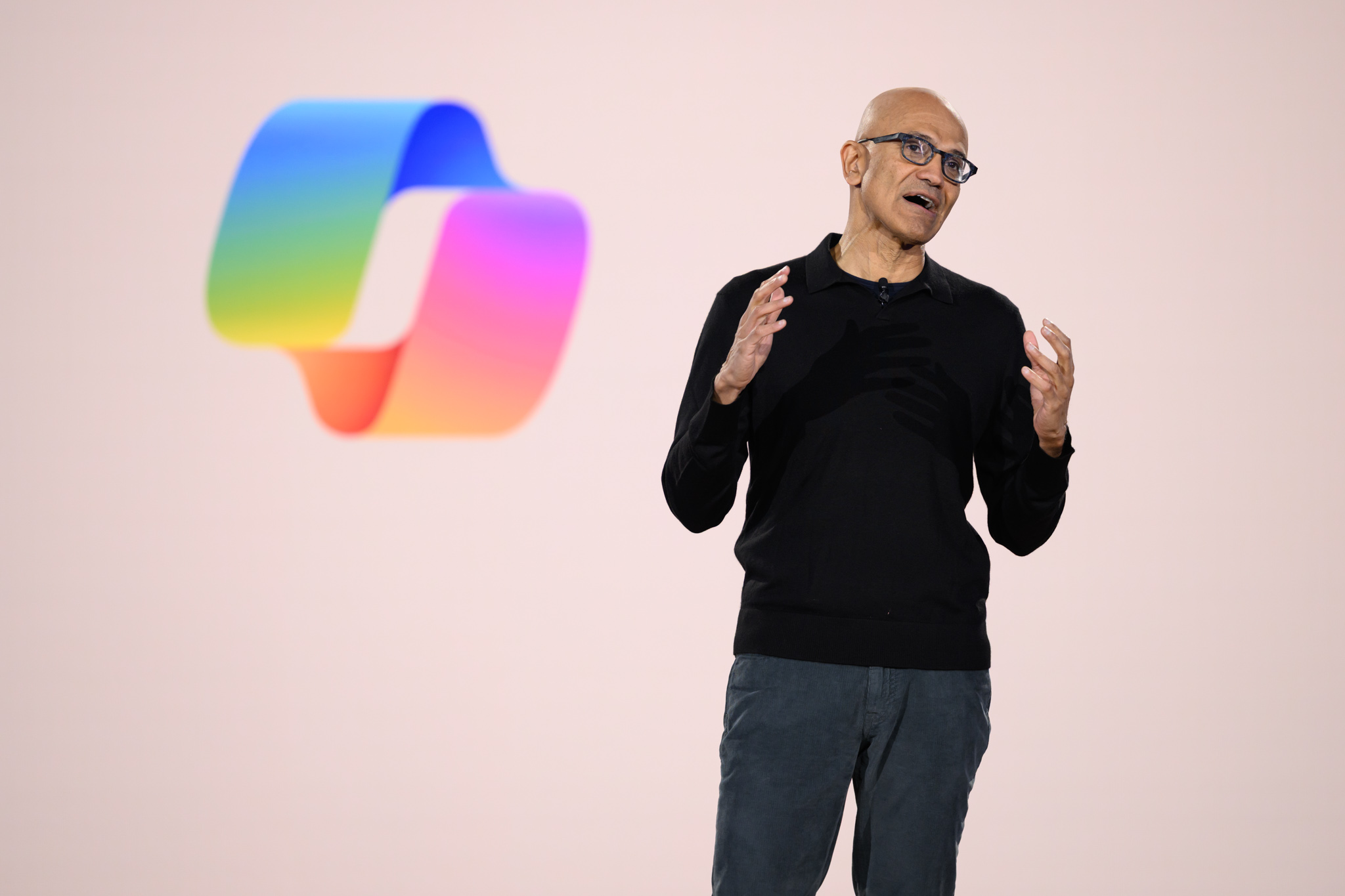
Microsoft CEO Satya Nadella had already weighed in before the code was released. In a post on X on Sunday, he welcomed “the research, focus, and deliberate pacing needed to get alignment right,” embracing the industry’s term for making AI behave as people intend. But he also pushed back against the idea that this work should be left to a few powerful companies. The effort, he said, “cannot be controlled by a handful of entities, but must have broad representation across the ecosystem, countries, and fields, including academia.” That is both a principled argument and a strategic one: Microsoft is one of the handful, but it is not the only one, and Nadella clearly wants to position the company on the side of openness and shared governance. Mustafa Suleyman, the CEO of Microsoft AI, told CNBC that the code of conduct had been in the works for about five months. The company decided to publish it now, he said, because of the current debates. That timing is not an accident. By releasing a draft code, Microsoft gets to appear responsible at a moment when the industry is under pressure, while also shaping the terms of the debate around its own models. The fact that the document was written “with the public” and will be open for comment makes it a political gesture as much as a technical one. Microsoft is not just announcing a policy; it is trying to define what responsible AI development looks like, and to do it before someone else defines it for them. If nothing else, the move gives Microsoft a seat at the table in a conversation that will determine the future of the industry—and it gives Nadella a way to sound thoughtful and measured while his rivals are trading insults and accusations. It also gives Suleyman, who came to Microsoft after co-founding DeepMind and leading AI at Google, a chance to put his stamp on the company’s approach. For a company that has often been criticized for being too corporate, the code is a reminder that Microsoft is now one of the most powerful players in AI, and that it intends to use that power carefully—or at least to be seen using it carefully.
The relationship between Microsoft and Anthropic makes some of this even more complicated. The two companies are business partners: Microsoft agreed last November to invest $5 billion in Anthropic, as part of a deal in which Anthropic committed $30 billion to Azure. Claude models run inside Microsoft 365 Copilot, and Microsoft’s Copilot Cowork tier integrates Claude. Yet the two companies appear to be heading in different directions on one of the deepest questions in AI: what these models actually are. Microsoft’s draft code of conduct states plainly that its models are “not conscious and should not be designed to imitate consciousness.” It also rejects “the pursuit of legal personhood, or the idea that models might deserve welfare, or be entitled to rights.” The Verge called that portion of the document “a direct swipe at AI welfare research and model consciousness—concepts Anthropic has been pushing hard on lately.” That is not an exaggeration. Anthropic runs a research program on model welfare. It has given some Claude models the ability to end abusive conversations and has committed to preserving the weights of retired models—an idea rooted in the view that an AI model might one day have interests worth respecting. Amodei has said he is open to the possibility that a model could be conscious. Microsoft, by contrast, seems eager to establish its position before that question becomes even more contentious. By drawing a bright line against consciousness and rights, Microsoft is trying to prevent a future in which AI systems are treated as moral patients. It is also, perhaps, trying to protect itself from the enormous legal and ethical complications that would follow if AI were granted any form of personhood. That is a reasonable business decision, but it is also a philosophical one—and it puts Microsoft on a collision course with partners who see the question as far from settled. The two companies can still work together on cloud deals and enterprise products, but on the question of what a model deserves, they are speaking different languages. In a way, that makes Microsoft’s code of conduct even more significant: it is an attempt to set the terms of the debate before the more sympathetic and, to some, more unsettling views of Anthropic become mainstream.
For now, Microsoft is treating the code as a living document rather than a finished rulebook. The company is accepting public comment for six weeks through a feedback form. It says it will publish a summary of the responses and a revised version later this year, to guide development starting in 2027. It is not training current models on the code, which means the document is more aspiration than enforcement. That is both the strength and the weakness of the effort. A code of conduct that is published for comment, revised, and then used as a north star is a genuine attempt at transparency and deliberation. But it is also a reminder that no one—not Microsoft, not Anthropic, not OpenAI—has solved the alignment problem. The debate over whether to slow down AI development, how much oversight is enough, and whether models should be seen as tools or something more will not be settled by a 37-page document. Still, Microsoft’s willingness to put its assumptions on paper is a rare moment of clarity in an industry that often speaks in abstractions. “People matter more than AI” is the kind of statement that everyone can endorse and almost no one can fully deliver. Perhaps that is exactly why Microsoft wrote it down: to give the rest of us something to argue about, and to measure the company against, as the era of superintelligent machines moves from science fiction to corporate policy. The real test will not be in the wording of the code. It will be in what happens when a model does something the code says it should never do—and whether anyone is still listening to those words when it does. For now, the document stands as both a promise and a warning: a promise that the people building these systems still think they are in charge, and a warning that they are not entirely sure how to keep it.