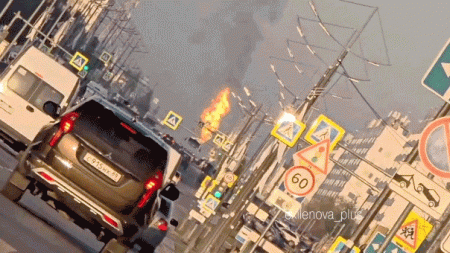







On the crisp morning of February 28, a sudden, thunderous disruption shattered the relative calm of Tehran, forever altering the geopolitical landscape of the Middle East and signaling a dramatic evolution in modern warfare. This was the moment Operation Epic Fury was unleashed—a highly coordinated, daylight joint military operation between the United States and Israel that targeted the heavily fortified compound of Iran’s Supreme Leader, Ayatollah Ali Khamenei. In a matter of seconds, thirty precision-guided munitions alongside advanced Sparrow air-launched ballistic missiles tore through the sky, systematically dismantling a specific wing of the leadership complex. The surgical strike resulted in the immediate deaths of the 86-year-old Supreme Leader, Defense Minister Amir Nasirzadeh, Islamic Revolutionary Guard Corps (IRGC) Ground Force Commander Mohammed Pakpour, and several other high-ranking security officials. Yet, what made this event truly extraordinary was not just the sheer destruction of the regime’s inner sanctum, but the clinical, almost unfathomable precision with which it was executed. While the heart of the regime’s commanding authority was completely vaporized, an adjacent wing of the very same building remained entirely standing, leaving those inside physically unharmed but deeply traumatized. Among the survivors was Iranian Foreign Minister Abbas Araghchi, who later recounted the harrowing experience in a television interview with the Hezbollah-backed Al Mayadeen network. His firsthand account has provided international intelligence agencies and counterterrorism experts with an unprecedented window into the terrifying sophistication of Western military capabilities and the strategic calculations of a new American national security doctrine.
To fully comprehend the gravity of Operation Epic Fury, one must look past the immediate tactical success and examine the underlying diplomatic and military philosophy that orchestrated it. Analysts and national security experts point to this operation as the ultimate real-world manifestation of President Donald Trump’s security doctrine: the implementation of a devastating, high-stakes decapitation strike combined with a simultaneous, highly visible diplomatic exit ramp. Unlike the protracted, costly wars of attrition and nation-building that characterized the American excursions into Iraq and Afghanistan, this doctrine prioritizes hyper-targeted kinetic actions designed to cripple a hostile regime’s leadership without engaging in a total war of occupation. By utilizing incredibly sophisticated tracking systems, satellite imagery, and localized intelligence networks, the United States and Israel demonstrated that sovereignty offers no shield against absolute precision. President Trump himself confirmed the joint operation on social media shortly thereafter, emphasizing that the regime’s leadership was entirely powerless against the tracking and intelligence apparatus deployed against them. The strategic objective was clear: to deliver an undeniable, existential message directly to the remaining Iranian leadership, demonstrating that the West possesses the ability to reach the most secure desks in Tehran at any moment of its choosing, while actively offering them a quiet path toward de-escalation if they chose to sue for peace.
The terrifying physical reality of this doctrine was laid bare by Foreign Minister Araghchi during his broadcasted reflections on the Arabic-language network. Araghchi explained that he had been in the compound that morning to brief another official regarding the ongoing, highly sensitive Geneva negotiations. Based on the daily bureaucratic workflow of the office, the Supreme Leader was scheduled to be at his desk in the opposing wing of the building at that exact hour. The strike sequence executed its mission with a level of accuracy that seemed to blur the line between science fiction and modern combat engineering. Araghchi recalled sitting in his wing of the structure when the weapons struck; while his immediate surroundings shook, the structural integrity of his sector remained completely intact, whereas the adjacent wing containing Khamenei’s office was utterly obliterated. According to Dr. Omar Mohammed, a prominent counterterrorism expert and director of the Antisemitism Research Initiative at the Program on Extremism at George Washington University, Araghchi’s public admission is a profound, albeit reluctant, acknowledgment of Western military dominance. By choosing to surgically remove the leadership wing while sparing the diplomatic wing, the coalition did not just execute a military objective; they conducted a profound psychological operation. They left the foreign minister and his diplomatic team alive in the dust of their ruler’s demise, forces of survival deliberately preserved so they could bear witness to the devastating consequences of defiance and carry the message of an exit ramp back to the surviving remnants of the government.
However, the tragedy of the subsequent months lies in the regime’s fundamental inability—or ideological refusal—to accept the face-saving off-ramp that had been so meticulously laid before them. In the wake of the strike, a rational state actor looking to preserve its national survival might have taken the opportunity to quietly sue for peace, renegotiate its regional standing, and utilize the preserved diplomatic channels to de-escalate the crisis. Instead, crippled by ideological paralysis and a desperate need to save face before its regional proxies, Tehran chose the path of maximum escalation, setting off a cascade of violence that reverberated across the global economy. In the chaotic weeks that followed, Iran launched retaliatory missile strikes against Israel, initiated attacks that claimed the life of a civilian in Bahrain, and hit targets within Kuwait, Qatar, and the United Arab Emirates. Most damagingly to the international community, the Iranian navy closed the critical transit artery of the Strait of Hormuz, effectively choking off a massive portion of the world’s oil supply and triggering a severe global energy crisis. As Dr. Omar Mohammed observed, the initial surgical strike was a localized American and Israeli action designed to minimize collateral damage and avoid a wider conflagration, but the exhausting, months-long regional war that ensued was entirely a product of the Iranian regime’s conscious decision to reject peace in favor of a desperate, multi-front conflict.
This internal ideological rigidity and institutional panic became even more apparent during the chaotic transition of power that followed the elder Khamenei’s death. In a historical irony that has not escaped regional observers, the late Supreme Leader’s son, Mojtaba Khamenei, was quickly elevated to fill his father’s shoes, effectively transforming a system that loudly prides itself on being an Islamic Republic of clerics into a hereditary Monarchy in all but name. During his Al Mayadeen interview, Araghchi pointedly referred to Mojtaba as “the young Khamenei in place of the elderly Khamenei,” a choice of phrasing that betrays the deep ideological contradictions currently tearing at the fabric of the regime’s legitimacy. The 1979 Islamic Revolution originally swept to power on a populist, anti-imperialist wave that sought to permanently eradicate the hereditary monarchy of the Shah, yet forty-five years later, the clerical establishment found themselves rewriting their own complex religious theology on live television to justify handing the throne from father to son. Adding to the regime’s embarrassment was the fact that Mojtaba himself had been wounded in the very same February 28 strike and subsequently vanished from the public eye for weeks, leaving the country leaderless and vulnerable during a critical turning point. Now recovered, the younger Khamenei has chosen to project an aggressively hostile public stance to consolidate his domestic power among hardline IRGC factions, even as his diplomats quietly engage in desperate, back-channel discussions with United States representatives to prevent the total collapse of their government.
Ultimately, the fallout from Operation Epic Fury serves as a sobering case study in the limits of military deterrence when dealing with deeply ideological, authoritarian regimes. The joint U.S.-Israeli operation proved beyond a shadow of a doubt that modern Western intelligence and military precision have reached a point where no adversary, no matter how deeply buried or heavily guarded, is truly out of reach. It demonstrated a revolutionary approach to statecraft: the ability to decapitate an adversarial leadership with minimal loss of innocent civilian life, presenting a clear opportunity for the surviving state apparatus to pivot toward a peaceful resolution. Yet, as the smoking ruins of Tehran’s executive compound and the subsequent global energy crisis have shown, the success of an “off-ramp” strategy relies entirely on the willingness of the adversary to take it. By choosing to escalate the conflict, trigger a regional war, and install an unproven, dynastic successor described by experts as “his father on steroids,” the Iranian regime exposed its own systemic fragility, choosing self-preservation through violent chaos over the realistic prospect of diplomatic rehabilitation. In the end, the legacy of the historic strike is not just a testament to the terrifying lethality of precision warfare, but a profound human reminder of how easily historical pride, ideological dogmatism, and the desperate pursuit of dynastic power can blind a nation’s leaders to the open door of peace, choosing instead to drag their people and the wider world into the flames of an unnecessary war.