


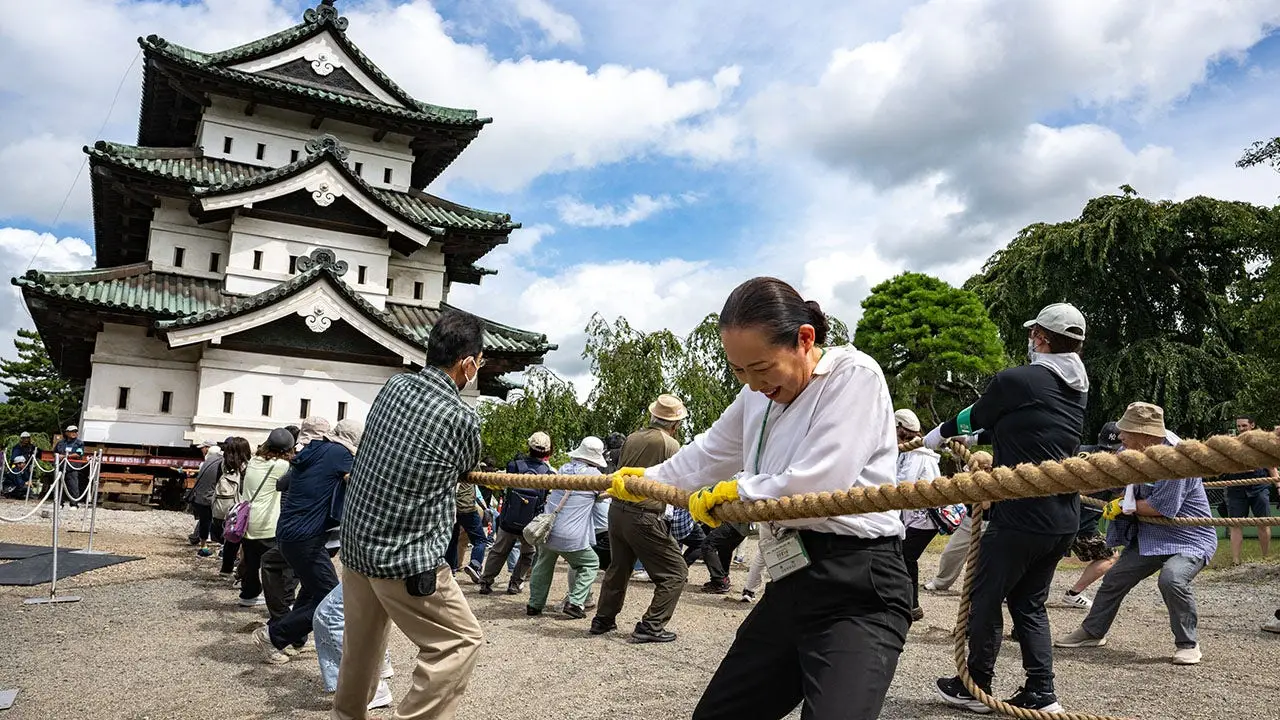
In the crisp, early morning air of Hirosaki City, a palpable sense of anticipation hums through a sprawling plaza. It is a weekend that will transform ordinary citizens into living instruments of history. Nearly two thousand individuals, ranging from spry septuagenarians to curious children, have gathered with a single, staggering purpose: to physically drag a 360-tonne stone and timber fortress across the ground. This is not a scene from a historical drama, but a meticulously orchestrated real-life spectacle. The structure in question is the iconic Hirosaki Castle keep, a majestic three-story tower that has silently surveyed the landscape of Aomori Prefecture for over two centuries. The task ahead is daunting—moving this giant a total of more than six feet today, and eventually over sixteen feet, to correct its position after recent wall repairs. As the command is given, the massive crowd leans back, their hands tightening on thick, rope strands that radiate out from the castle’s base like the spokes of a colossal wheel. There is a collective groan, a symphony of strained muscles and held breath, followed by a triumphant cheer as the ancient edifice shifts—not by inches, but by the width of a finger. This meticulously slow process, repeated hundreds of times, marks the beginning of an extraordinary engineering feat that is as much a test of physical endurance as it is a profound act of cultural reverence.
The reason behind this Herculean effort lies in the seismic fragility of the Japanese archipelago. A few years prior, a major earthquake rattled the region, causing significant damage to the imposing stone walls, or ishigaki, that support the castle keep. The 360-tonne structure had to be temporarily moved aside so that engineers and stonemasons could painstakingly rebuild the base wall from the ground up. Remarkably, all 2,185 original stones were catalogued, numbered, and returned to their exact original positions, ensuring that the castle’s foundation remained historically authentic. With the wall restored to its former glory, the castle needed to be guided back to its rightful resting place. Rather than opting for modern, mechanical machinery, the city of Hirosaki chose a profoundly traditional approach: an ancient technique known as hikiya. This practice involves carefully placing the entire building on a series of wooden rollers or greased rails, allowing the structure to be towed intact, without ever being dismantled. The hikiya method is a marvel of pre-industrial engineering, historically used to move shrines, gates, and even entire houses. It is a delicate procedure that requires perfect coordination and immense force, but its value lies in its non-destructive nature, preserving the structural integrity and historical soul of the building, avoiding the trauma of taking apart a monument that has survived centuries of weather, war, and time. By moving it whole, they are treating the castle not as a machine to be disassembled, but as a living entity to be gently guided home.
The human interest in this project has exploded far beyond local boundaries, becoming a global phenomenon that speaks to a universal longing to connect with heritage. When the city announced it needed volunteers to pull the ropes, the response was staggering, to say the least. According to Kensuke Hayasaka, the head of the parks and green spaces division in Hirosaki City, they received roughly 8,000 applications for just 1,800 available slots over the two-day weekend, meaning the project was oversubscribed by a factor of four. This overwhelming demand highlights a deep-seated public fascination with tangible history—a chance to physically touch a piece of the past. The volunteers who were lucky enough to secure a spot came from far and wide. While a large contingent hailed from Hirosaki and other prefectures across Japan, a significant and heartening number traveled from overseas. “Not only from the city, but from across Japan and overseas; a fair number from Southeast Asia, Europe and North America,” Hayasaka noted with evident pride. For these international visitors, pulling the rope is more than a tourist activity; it is an immersive experience in Japanese culture, a rare opportunity to participate in a living tradition. For the Japanese locals, it takes on an almost spiritual quality—a means of giving back to the ancestors who built the castle, and a way to ensure that future generations will have the same chance to stand in awe of its enduring beauty. This is a pilgrimage of sorts, where the destination isn’t a shrine, but the very act of communal labor itself.
To witness the event is to see a magnificent, sweaty ballet unfold. The pulling is not a continuous sprint but a series of synchronized, strategic tugs, followed by moments of tense anticipation. Rotating teams of participants take their turns, ensuring that no single group is exhausted. The ropes strain taut against the creaking timbers, and the air is thick with the scent of hemp, damp earth, and determination. Each command from the overseers triggers a ripple of effort across the plaza. As the castle creeps forward, albeit by mere millimeters at a time, a profound emotional crescendo builds. Strangers become teammates, locking arms, calling out encouragement, and celebrating each micro-inch of progress with exuberant applause. The sheer physicality of the task connects them to the builders of the past in a way that reading a history book never could. They feel the resistance of the massive keep, they feel the strain in their own tendons, and they understand, on a visceral level, the immense difficulty of constructing such a marvel without modern machinery. There is a profound joy in the shared exhaustion, a communal sense of accomplishment that transcends age, nationality, and language. For the participants, this is not just moving a building; it is an act of collective memory, a physical declaration that they will not let time erode the monuments that define their identity.
While the first weekend’s efforts are a monumental success, the journey is far from over. The process of moving the Hirosaki Castle keep is a marathon, not a sprint. The pulling by hand will continue through the end of August, with a total of approximately 4,100 people scheduled to participate in the rotating shifts. Their combined efforts are intended to relocate the castle a total of more than sixteen feet from its temporary position back to its permanent, precise home atop the restored walls. This extended timeline allows for the meticulous, unhurried pace required by the hikiya technique. It ensures that every step is measured, every angle checked, and every structural stress carefully mitigated. The extended schedule also allows for a broader community involvement, spreading the honor and the labor across months. As the summer progresses, thousands more will filter through Hirosaki to leave their mark on this historic endeavor. Each weekend will bring new faces, new muscles, and renewed energy, all bound together by the single, unifying goal of restoring a treasure to its rightful place. The logistics of this operation are staggering, managed with the precision of a military campaign, yet executed with the warmth and shared spirit of a village festival.
The deeper significance of this endeavor is rooted in the tragic and resilient history of Japanese castles themselves. Hirosaki Castle’s story is one of phoenix-like rebirth. The original structure was a grand, five-story tower, proudly crowned against the sky. However, in 1627, a devastating lightning strike ignited a fire that consumed the keep entirely. It remained a shell for nearly two centuries before a new, three-story structure was rebuilt in 1811. This current keep is a survivor. It outlasted the turbulent end of the Samurai era in 1868, a period when many castles were systematically dismantled as symbolic rejections of the feudal past. It escaped the catastrophic bombings of World War II that razed so many similar fortresses across Japan, leaving Hirosaki as one of the few surviving original castles in the entire country. To move it now, inch by inch, with the collective muscle of the people, is a powerful defiance of decay and history’s wreckage. It is a testament to the belief that heritage is not merely to be preserved in museums behind glass, but to be lived, touched, and struggled over. In a modern world of rapid technological advancement, this ancient hikiya technique reminds us that the most profound connections to our past often come from the simplest acts of human labor. As the castle settles back onto its ancient stones, it does so cradled not only by wooden rollers, but by the hopes and arms of thousands of people, bridging centuries with a single, united pull.