



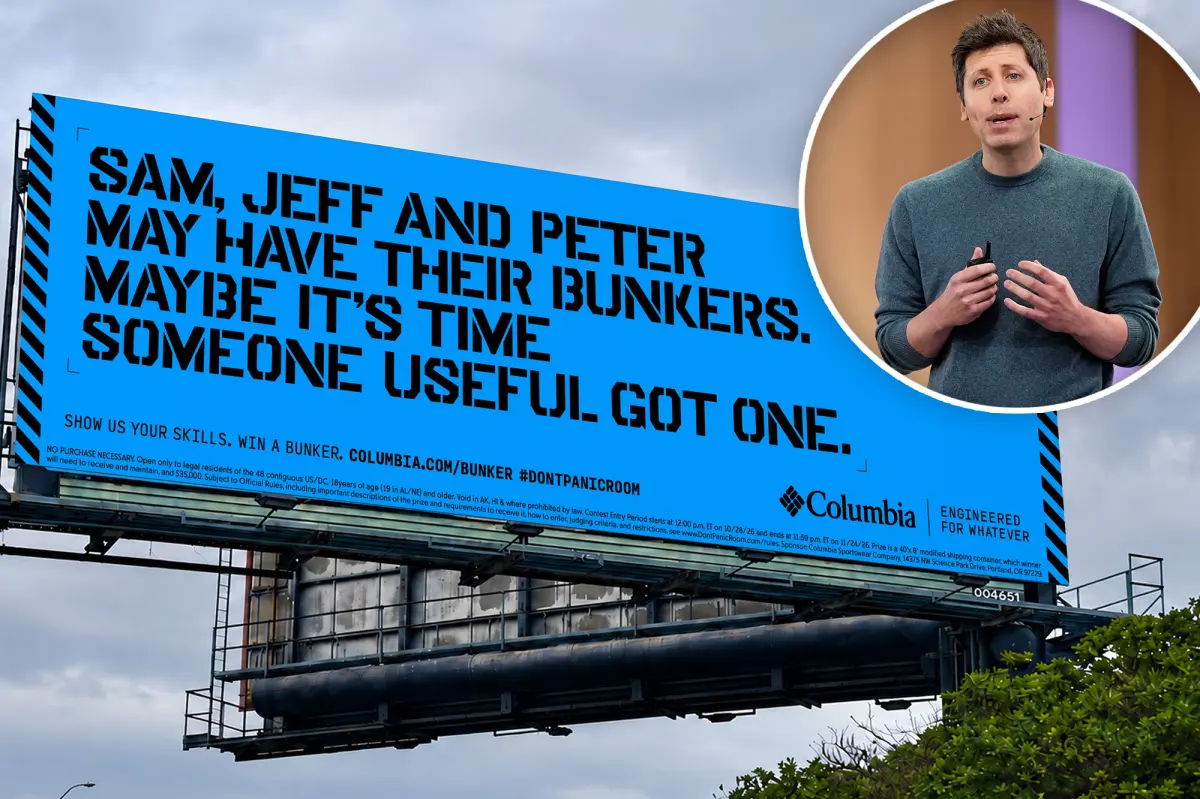
There’s something wonderfully petty about a billboard that tells the world’s most powerful men to sit down and shut up. Columbia Sportswear, the Oregon-based outdoor gear company, has decided to use the Bay Area as its canvas for a new ad campaign that roasts the so-called tech bros who think they can buy their way out of the apocalypse. The billboards, seven in total, began appearing across the San Francisco Bay Area this week, and they deliver a message that is equal parts sarcastic and sincere: “Sam, Jeff and Peter may have their bunkers. Maybe it’s time someone useful got one.” In one swift, brutal sentence, the campaign drags three of the most famous billionaire preppers in America into the spotlight. Sam is OpenAI’s Sam Altman. Jeff is Amazon’s Jeff Bezos. Peter is Palantir co-founder Peter Thiel. All three are known to have invested enormous amounts of money in private doomsday bunkers, the kind of underground fortresses that sound like something out of a movie but are apparently very real. The ads are not just a clever marketing stunt; they tap into a deep vein of public frustration. While ordinary people worry about rent, healthcare, and whether their roof will survive the next storm, a handful of tech elites are busy constructing secret shelters, stocking them with supplies, and preparing to ride out the collapse of civilization behind walls of concrete and steel. Columbia’s billboards flip that narrative. Instead of letting billionaires own the fantasy of survival, the company is suggesting that the rest of us—the teachers, nurses, mail carriers, line cooks, and office workers—are exactly the kind of people who should have a fighting chance. The campaign asks a stinging question: why should the people who make the world run be left out of the future? In one ad, Columbia manages to critique inequality, mock billionaires, and sell outdoor apparel at the same time. That takes a certain kind of audacity, and apparently, it’s working.
The reason the billboard works is that the targets are so famously on the record. Back in 2016, The New Yorker published a profile of Sam Altman that painted a picture of a very different kind of tech CEO. Altman, who now leads OpenAI and helps shape the future of artificial intelligence, told the magazine that he was ready for disaster. He had stockpiled guns, gold, antibiotics, batteries, water, gas masks, and an array of other survival supplies. He owned property in Big Sur, a rugged stretch of California coastline, where he could escape if things went sideways. He was not just dabbling in prepping; he was serious about it, the kind of serious that makes you wonder if the people building AI are also planning for the moment AI tears society apart. Jeff Bezos, the founder of Amazon, has his own version of escape. In 2023, he reportedly spent $79 million on a property in Florida that has been described as a “billionaire bunker.” The place is said to come with its own amenities and security, a refuge designed for the end of the world as we know it. Peter Thiel, the co-founder of PayPal and Palantir, has long been fascinated by the idea of societal collapse. He is currently building an elaborate bunker at his property in New Zealand, a country that has become something of a hideaway for ultra-wealthy preppers. Thiel has talked about wanting to escape to a place that feels far from the chaos of modern life. On one level, this is all deeply absurd. The same people who dominate the digital economy, who shape our phones, our shopping, our national security, and our AI tools, are apparently also the same people who want to disappear underground when things go wrong. They are not planning to rebuild society with the rest of us. They are planning to survive it. Columbia’s ad campaign highlights that absurdity with a wink and a nudge, but it also makes a serious point: the people who are most useful to society—the ones who actually show up and do the work—are rarely the ones with bunkers. The people who deserve safe places to ride out a crisis are not just the ones who can afford an underground mansion in New Zealand. The billboard, by naming Sam, Jeff, and Peter directly, turns a vague fear into a very public conversation about who gets to live the best life after the worst day. It’s a clever way to get people talking, and it certainly got our attention.
But Columbia is not just here to roast billionaires. The company is actually doing something about it, at least for one lucky person. The campaign is built around a promotion called “Don’t Panic Room,” and yes, that name is a nod to the old idea of a panic room, only with a little more Oregon-style humor. The prize is a real, 40-foot survival bunker made from a shipping container. It is not a joke. It comes fully equipped with everything you might need if the apocalypse happens to land in your backyard. There is survival gear, a bunk bed, a kitchen and dining area, a composting toilet, and even a robotic dog named Rocky. The idea of a robotic dog is especially delightful. Imagine the end of the world, the power grids are down, the cities are empty, and you are sitting in your shipping-container bunker, eating canned beans, with a robot dog curled up next to you. It is equal parts bleak and charming. The bunker also comes stocked with plenty of Columbia gear: jackets, footwear, and other outdoor essentials designed to help you survive everything from a blizzard to a mega-drought to whatever else climate change throws at us. And, just to make it a little more practical, the prize includes $35,000 in cash. That is not a fortune in the way that a billionaire would count a fortune, but it is more than enough to help an ordinary family start over or buy supplies. The whole thing is a brilliant marketing move because it takes a familiar fantasy—the billionaire bunker—and makes it accessible, at least to one person. It also shifts the focus from the elite to the rest of us. Instead of a multi-million-dollar compound hidden in a mountain, Columbia is offering something simpler, more democratic, and honestly more relatable. A shipping container in your backyard may not sound glamorous, but in an unpredictable world, it might feel like a miracle. The company is basically saying: you don’t need to be a tech titan to be prepared. You just need a little thought, a little planning, and maybe a robot dog named Rocky. With this giveaway, Columbia is turning a symbol of inequality into a prize for someone who might actually use it.
Of course, this is a promotion, and no promotion is complete without rules. To win the Don’t Panic Room, Columbia is asking people to submit a video that demonstrates their survival skills. This is where things get interesting. You could show that you know how to start a fire with two sticks, build a shelter out of leaves, filter water through a sock, or forage for edible plants. Or you could do something completely ridiculous, like teach a raccoon to guard your supplies. The point is to prove that you have what it takes to survive, adapt, and keep your cool when the world is falling apart. Columbia says entries will be judged on the quality of the survival skills shown, the contestant’s adaptability, problem-solving ability, and creativity. That last part is key. They are not just looking for Bear Grylls. They are looking for someone who can make them laugh, think on their feet, and maybe remind us all that survival is not only about strength. It is also about imagination. The best part for the winner? You do not need to worry about moving the bunker. Columbia will deliver it directly to your home. That is a logistical detail that makes the contest feel both surreal and wonderful. Imagine a 40-foot shipping container showing up on a flatbed truck, slowly being lowered into your driveway, while your neighbors peek through their blinds. You would probably become the most talked-about person on your street, and honestly, that might be worth it. But the contest is also a clever way to engage people. Instead of just buying a product, you have to demonstrate that you are the kind of person who would make good use of it. That makes the giveaway feel personal. It is not about being lucky; it is about showing up, being clever, and proving that you have a little bit of wilderness in your soul. Whether you are an experienced camper or a suburban parent who has never spent a night in the woods, the contest invites you to imagine what you would do if the world suddenly stopped making sense. And then it asks you to hit record and share that vision with the world. That is a challenge that feels surprisingly human.
Columbia’s CEO, Tim Boyle, seems aware that the whole concept could easily tumble into either gloom or gimmickry. In a promotional video, he keeps his tone light and pragmatic. “Since the beginning of time, people have predicted the end of the world. I don’t really buy into all that stuff,” Boyle says. “But since Columbia helps protect you from nature’s worst, we figured, better safe than sorry. So we’ve created the Don’t Panic Room. A real-life, 40-foot survival bunker that’s engineered for whatever.” That quote captures the brand’s approach perfectly. Columbia is not trying to scare people into buying its jackets. It is leaning into a cultural moment where fear is everywhere—wars, climate change, political chaos, artificial intelligence—and responding with a kind of dry, practical humor. The message is: we cannot stop the apocalypse, but we can at least make sure you have a decent jacket and a place to sleep. There is something oddly comforting about that. Boyle’s comment also sidesteps the doom-and-gloom mentality that often surrounds prepping. He is not saying the end is near. He is saying that preparation is a form of sanity. If you have a plan, you can stop worrying. And if you can laugh at billionaires at the same time, so much the better. The campaign is not just about survival gear. It is about the idea that preparedness should not be a luxury. When billionaires build private bunkers, it signals that they expect the rest of us to fend for ourselves. Columbia’s giveaway challenges that assumption. By offering a bunker to anyone with a great video, the brand is democratizing the survivalist dream, at least in a small way. It acknowledges that the people who are most likely to be useful in a crisis are not necessarily the ones with the most money. They might be the neighbor who knows how to can vegetables, the mechanic who can fix a generator, the nurse who can treat an infection, or the schoolteacher who can keep a group of scared kids calm. Those are the people who deserve a safe place. The Don’t Panic Room campaign is a reminder that being useful is more important than being wealthy. And if you can do that with a robotic dog named Rocky, you have already won.
If you are feeling inspired, you have until November 24 to throw your hat in the ring. Columbia is accepting submissions now through that date, so there is time to brainstorm, film, edit, and send in your very best survival pitch. The promotion has already generated plenty of buzz, and not just because it mocks billionaires. It is also because the idea of winning a bunker is unexpectedly appealing. You might not have the resources of Jeff Bezos or the land in New Zealand that Peter Thiel owns, but you can still imagine a scenario in which you and your family are safe, warm, and prepared. That is a powerful fantasy, and Columbia is smart enough to sell it back to us with a wink. The billboard campaign may be the most visible part of the stunt, but the real story is what it says about our collective anxiety. We live in a time when the future feels uncertain. We worry about the economy, the climate, the next pandemic, the rise of machines that can think better than we can. The billionaires of Silicon Valley are not exempt from that worry. They are just better equipped to do something about it. But Columbia’s campaign flips the script. It says, hey, you don’t need to be a tech mogul to be prepared. You just need a little gear, a little know-how, and a lot of heart. And hey, if you happen to win a 40-foot bunker with a composting toilet and a robot dog, that is not a bad deal. The phrase “Don’t Panic Room” is a clever twist on Douglas Adams, but it also contains real advice. Panic never helped anyone. Planning helps. Community helps. Humor helps. Columbia is offering all three in a single campaign. By the time the contest ends, there will be one lucky winner with a massive shipping container in their yard. But the rest of us can still take away something important: the best way to face an uncertain future is not to hide from it in an underground fortress. It is to prepare, to laugh, and to remember that the people worth saving are all around us, not just the ones with enough money to build a vault. And if you happen to be one of the useful ones, maybe you should start filming that video. The end of the world may never come, but a free bunker with a robot dog named Rocky is still a pretty good reason to hit record.