





At first glance, Alexander Iniguez Mercado’s life seemed to be a narrative of quiet resilience and artistic ambition. At just twenty years old, the Chicago resident worked as a photo booth attendant at Somos Arte, a local creative services studio, where he helped capture the joyful, fleeting moments of strangers’ lives. On paper and in his community, Mercado was a young man striving to carve out a place for himself in the world despite carrying a heavy burden of personal trauma. Yet, a startling turn of events has thrust this young creative into the harsh spotlight of a federal counterterrorism investigation. Federal prosecutors in Chicago announced his arrest in connection with a chilling, thwarted domestic terror plot that targeted a high-profile Ultimate Fighting Championship (UFC) event at the White House. Mercado now transition from a quiet neighborhood youth into the eighth defendant in a sprawling, multi-state conspiracy, highlighting the jarring disconnect between his everyday life and the immense gravity of the national security state.
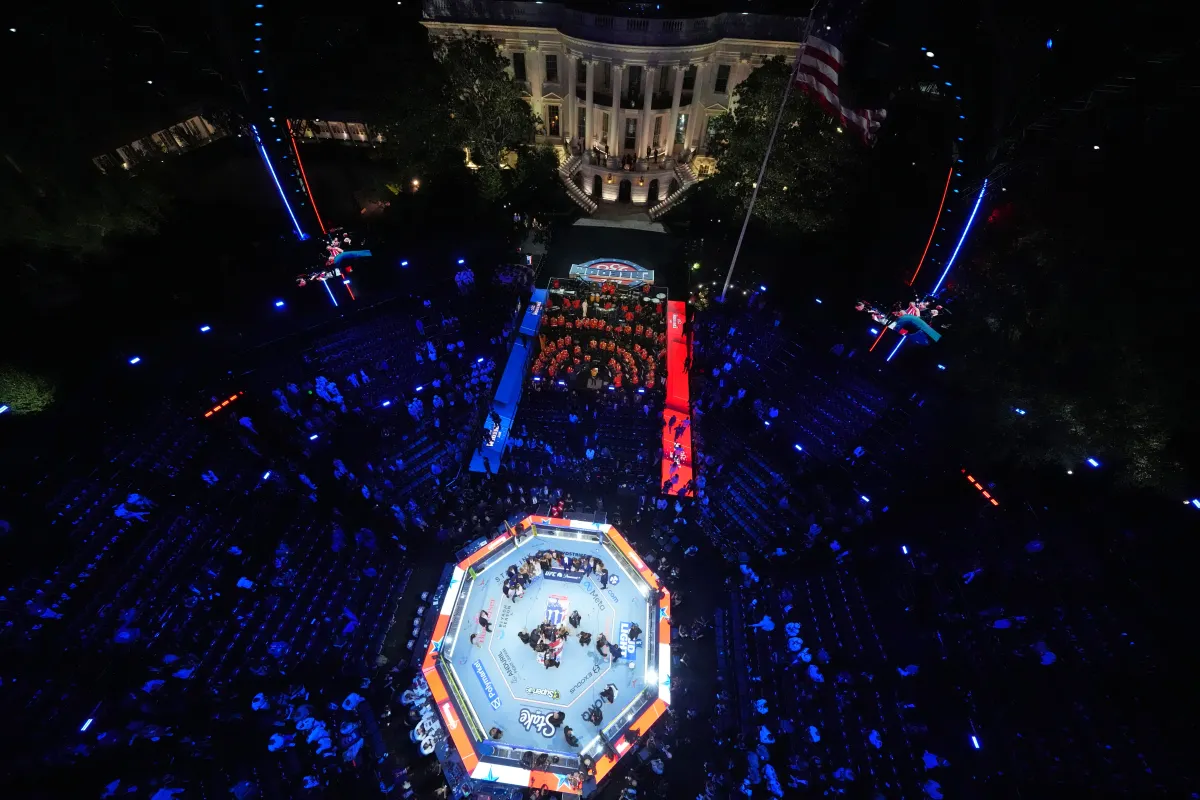
The conspiracy that federal authorities disrupted was nothing short of catastrophic in its ambition. Staged on the historic South Lawn of the White House, the June 14 UFC event was meant to be a grand spectacle, blending the raw energy of mixed martial arts with national celebrations marking the country’s 250th anniversary. With thousands in attendance, including President Donald Trump and an array of high-ranking government officials, the venue was a symbol of security and national pride. According to court documents, a highly coordinated group spanning multiple states plotted to transform this celebration into concrete tragedy. The conspirators allegedly planned to utilize sophisticated weaponry, including armed drones and firearms, to launch a mass-casualty assault on the attendees. The FBI, moving with urgent coordination alongside state and local law enforcement agencies, managed to intercept the plot just days before the fighters took to the canvas, averting a bloodbath that could have fundamentally shaken the nation’s political landscape.
Though Mercado is not accused of orchestrating the physical logistics of the attacks or pulling a trigger, his alleged involvement centers on a modern, digital form of complicity. Federal prosecutors allege that Mercado acted as a vital communication link within the conspiracy and, crucially, took swift action to cover the group’s tracks when law enforcement closed in. According to the Department of Justice, the pivotal moment occurred just one day before the scheduled UFC event, when an FBI agent contacted Mercado. Panicked or calculated, Mercado allegedly deleted the encrypted messaging application Signal from his mobile device immediately after the interaction. In doing so, investigators say he systematically erased vital communications exchanged with the cell of conspirators, effectively blinding investigators at a critical moment in their search for answers. This single act of digital deletion forms the basis of his severe federal charge: obstruction of justice, a crime that carries a maximum penalty of twenty years in federal prison.
This case shines a harsh spotlight on the decentralized nature of modern domestic extremism, where threats are no longer cultivated in physical bunkers but in the quiet anonymity of encrypted digital spaces. Mercado is the eighth individual to be charged in a web that stretches far beyond Chicago, reaching into Ohio, Missouri, Nebraska, and California. This geographic distribution illustrates how easily isolated young people across the country can be knit together into a dangerous, unified force through the internet. For prosecutors, Mercado’s sudden deletion of his communications represents a profound threat to public safety, as it potentially permanently obscured the identities of other co-conspirators and the origins of their shared radicalization. As the federal prosecutor bluntly remarked, obstructing an investigation into a violent domestic terror plot is not a minor bureaucratic infraction; it is a direct threat to the lives of thousands of citizens, transforming a young man’s panic into a major federal offense.
To truly understand how a 20-year-old photo booth attendant became entangled in a high-stakes federal terror probe, one must look at the fragile human foundation of Mercado’s life. In a poignant podcast appearance from 2024, Mercado opened up about the deep fractures in his upbringing, outlining a young life defined by profound hardship. He spoke candidly about his struggles with youth homelessness, the devastating grief of losing a sibling, and the daily, exhausting challenges of growing up in an under-resourced, unforgiving environment. These details paint a picture of a vulnerable young man who, despite his efforts to find stability in the creative community of Chicago, may have been uniquely susceptible to the false promises of community, purpose, or escape offered in the dark corners of the internet. It is a tragic paradox that someone who knew the pain of profound personal loss could be accused of shielding a group that sought to inflict unimaginable grief on hundreds of other families.
As Mercado prepares for his initial appearance in a Chicago federal court, the long-term trajectory of his life hangs in the balance. The investigation remains highly active as federal agents work to trace every remaining digital thread and identify any outstanding conspirators who posed a threat to the nation’s capital. Meanwhile, those who knew Mercado are left to reconcile the quiet, struggling young man they worked alongside with the grave accusations of federal obstruction. His story is a poignant, cautionary tale of the digital age, illustrating how easily personal trauma, vulnerability, and isolation can collide with the machinery of domestic terrorism. With twenty years of his youth potentially lost to a federal penitentiary, Mercado’s situation underscores a broader societal tragedy: the quiet loss of another young life to the fringes of digital radicalization, long before the first drone could ever take flight.