





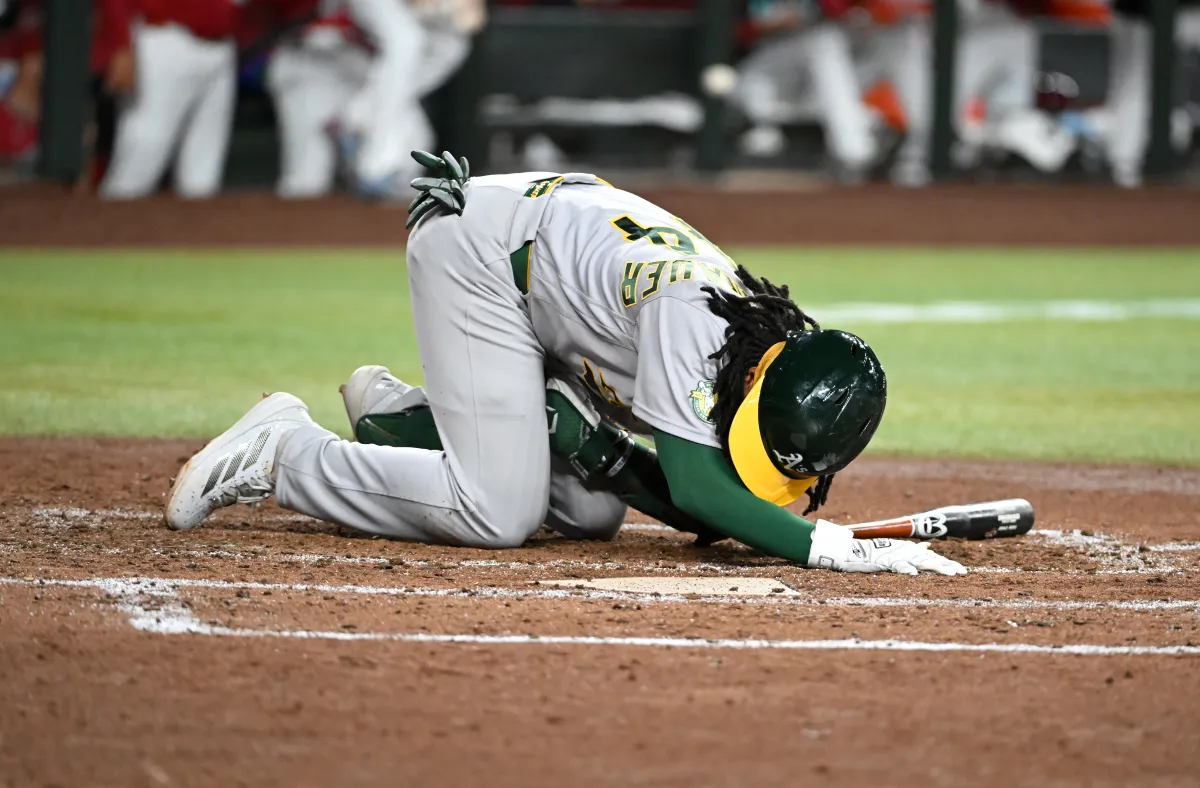
The journey of a young athlete into the upper echelons of Major League Baseball is often portrayed as a seamless, glittering ascent—a narrative written in flashing stadium lights, roaring crowds, and triumphant post-game statistics. For Joshua Kuroda-Grauer, the promising utility infielder for the Athletics affectionately known as “JKG,” this dream had recently transformed into a vibrant, breathless reality. Having made his highly anticipated big league debut on June 29, the young rookie quickly set the baseball world on fire, capturing the hearts of fans and analysts alike with his astonishing performance on the field. Over his first sixteen games, the young infielder was not merely surviving the intense pressures of the majors; he was completely dominating them, boasting a spectacular .417 batting average and racking up multiple hits in half of his appearances. On a warm Monday night in Phoenix, Arizona, Kuroda-Grauer reached what should have been the spectacular zenith of his burgeoning career, launching a majestic home run against the Diamondbacks—his very first in the major leagues. It was a moment of pure, unadulterated human triumph, the culmination of thousands of hours of unseen sweat, sacrifice, and dedication. Yet, the beautiful game of baseball possesses a cruel, unpredictable nature, where the line between absolute triumph and agonizing misfortune is razor-thin. In a split second, during a subsequent plate appearance, a routine pitch led to a sharp foul ball that bypassed his defensive instincts and violently struck him in his defensive armor’s most vulnerable gap—his sensitive inner leg area. In a shocking, heart-stopping instant, the triumphant echoes of JKG’s historic home run were replaced by the sickening reality of physical trauma, bringing the young star crashing to the dirt of Chase Field in a state of sheer, breathless agony. This moment served as a stark, visceral reminder of the fragile human beings who wear the uniforms we cheer for, stripping away the myth of athlete invincibility in a single, devastating instant.
What happened next on that Arizona infield transcends the typical boundaries of athletic persistence, transforming a painful sports mishap into an enduring saga of sheer human willpower and grit. As JKG lay writhed in pain on the ground, surrounded by concerned trainers and team staff, the television broadcasters struggled to find appropriate vocabulary, settling on the polite euphemism of an “inner leg” injury to describe a sensation of pain that most men can only envision with absolute horror. After several agonizing minutes of heavy breathing, whispered assessments, and the kind of deep, internal calculation that only an athlete under intense pressure can manage, Kuroda-Grauer did something truly extraordinary: he stood back up. Refusing to let his night end in the hands of the medical cart, he slowly walked back to the batter’s box, gripped his bat with white-knuckled intensity, and cleared his mind of the blinding pain of what was later diagnosed as a ruptured testicle. Showing an almost superhuman level of focus, he timed the next pitch perfectly, driving a clean single into the field to secure yet another multi-hit game. As if the sheer display of offensive resolve were not enough, JKG then strapped on his glove and took the field for a full half-inning of defense, running, shifting, and throwing with a severe, internal anatomical rupture. Watching him navigate those plays, completely unaware of the medical gravity of his situation, serves as a profound testament to the quiet, sometimes irrational heroism of the modern baseball player. It is a testament to the powerful psychological conditioning that demands an athlete prioritize the team, the game, and the immediate task at hand far above their own physical safety and comfort.
Once the final out of the inning was secured and the high-octane rush of adrenaline began to inevitably recede, the harsh biological reality of JKG’s injury took absolute precedence over his legendary competitive spirit. The agonizing throbbing could no longer be masked by grit, leading the training staff to immediately transport the young rookie to St. Joseph’s Hospital in Phoenix for urgent medical evaluation. There, under the sterile fluorescent lights of an emergency room far away from the cheering crowds of Oakland, doctors confirmed the worst-case scenario: a ruptured testicle, a condition requiring immediate emergency surgery to repair the delicate, highly vascular tissue and prevent any long-term structural or systemic damage. Entering emergency surgery in the dead of night is a terrifying experience for anyone, let alone a young man in his early twenties who, just hours earlier, had been celebrating the grandest athletic milestone of his life. To be abruptly shifted from the high-energy excitement of a Major League dugout to the quiet, vulnerable position of a surgical patient is a jarring emotional shift that tests the mental fortitude of even the most grounded individuals. Meanwhile, back at the stadium, the Athletics had no choice but to place their rising star on the 10-day injured list, a bureaucratic move that whispered of a painful, albeit necessary, pause in his historic momentum. As manager Mark Kotsay solemnly addressed the media, noting the “unfortunate event” and expressing hope that his player would avoid further, permanent complications, the collective hearts of the baseball community ached for a young rookie whose dream run had been so rudely interrupted by a freak, agonizing accident.
In the wake of such a deeply personal and physically distressing ordeal, the true value of team brotherhood and managerial support came to the forefront, illuminating the warm, supportive culture that exists behind closed clubhouse doors. The following morning, manager Mark Kotsay made a personal visit to St. Joseph’s Hospital, stepping into the quiet recovery room to check on the young man whose toughness had already become the talk of the baseball world. What Kotsay found was not a defeated, self-pitying victim of bad luck, but a young man burning with an unbroken spirit, radiant with a wonderful personality, and actively cracking jokes about his bizarre, painful predicament. This ability to find humor in the darkest, most vulnerable moments of life is a classic hallmark of emotional resilience, illustrating JKG’s remarkable maturity and grounded perspective. Kotsay, speaking afterward to reporters with a mixture of awe, relief, and genuine affection, marveled at the rookie’s high spirits and jokingly proclaimed that Joshua Kuroda-Grauer might very well be the only player in the entire history of Major League Baseball to rupture a testicle, remain in the box, hit a single, and then go out to play another half-inning of defense. This humorous, lighthearted locker-room banter served a vital therapeutic purpose, transforming a potentially traumatic and embarrassing medical crisis into a badge of legendary honor. It highlighted a universal human truth: when faced with sudden physical vulnerability and unexpected setbacks, the support of our peers, coupled with the saving grace of laughter, is often the most powerful medicine we can receive.
Beyond the immediate medical and human drama, Kuroda-Grauer’s sudden absence represents a significant emotional and strategic loss for the Athletics, a team that had found an unexpected spark plug in the young infielder. JKG’s performance since his June call-up was nothing short of historic; a .417 batting average over sixteen games is a stat line reserved for the absolute elite of the game, signaling the emergence of a potentially generational talent. For a rookie, maintaining such high levels of consistency—exemplified by his multi-hit performances in exactly half of his major league games—requires not just physical talent, but an incredibly disciplined approach, an analytical mind, and a steady psychological disposition. To have that spectacular, skyward trajectory abruptly halted by a freak accident is a bitter pill to swallow, forcing both the player and the franchise to pivot from active triumph to patient rehabilitation. Yet, if his response to the injury on the field is any indication of his internal makeup, JKG possesses the precise brand of mental and physical fortitude required to navigate the grueling journey of rehabilitation. The determination that allowed him to stand firm in the batter’s box with a ruptured, agonizing injury will undoubtedly serve as the primary fuel for his physical recovery over the coming weeks. His absence from the lineup will be deeply felt, but the narrative of his meteoric rise has not been erased; rather, it has simply been paused, adding a dramatic, battle-tested chapter to the origin story of a player who has already proven he is built of much stronger stuff than most.
Ultimately, Joshua Kuroda-Grauer’s agonizing experience on a Phoenix baseball diamond transcends the boundaries of sports reporting, offering a profound, humanizing glimpse into the lives of the modern gladiators we watch on television. In an era where professional athletes are often viewed as highly paid, indestructible entertainers or mere statistics on a fantasy sports roster, JKG’s injury forcefully pulls back the curtain to reveal the fragile flesh, bone, and emotion that lie beneath the uniform. It reminds us that behind every stunning batting average, every home run, and every spectacular defensive play is a vulnerable human being who risks real pain, real injury, and real long-term consequences every single time they step between the white lines. The outpouring of empathy, concern, and humor from baseball fans across the globe highlights a collective recognition of this shared humanity, bridging the gap between the fans in the stands and the player on the field. As Kuroda-Grauer rests, recovers, and begins the slow, steady process of healing, he does so with the knowledge that his unbelievable display of toughness has already secured him a permanent place in baseball lore. When he eventually makes his triumphant return to the diamond, he will not step back onto the field merely as a highly promising rookie infielder with a high batting average; he will return as a certified folk hero, a symbol of unimaginable grit, and a breathing testament to the enduring power of the human spirit to find laughter, strength, and victory in the face of agonizing adversity.