





Last year, walking around Epic’s User Group Meeting felt like stepping onto a film set for a movie about the future of medicine. This year, the same gathering in Verona, Wisconsin, felt more like a conversation in someone’s living room—still ambitious, but grounded, with a distinctly Midwestern, roll-up-your-sleeves energy. The company’s sprawling campus was as impressive as ever, but the tone had shifted from big-picture AI transformation to something more practical: how to make the future work in the messy, daily reality of a hospital. A skit during the main session captured this perfectly. In a playful nod to Inside Out, Epic employees dressed up as the different parts of an AI agent, each popping up to declare, “This is my favorite part!” before performing a task and eventually pressing a giant button to send a query. It was whimsical, elaborate and a little strange—classic Epic. But underneath the humor, it made a serious point. The conversation at this year’s UGM was no longer about what AI might someday do. It was about what AI is doing right now, in real clinics, with real patients. At the same time, a second theme kept surfacing in hallways and sessions: proving a technology works is not the same as being ready to use it. Epic spent a lot of time encouraging customers to switch on more features and get more value out of tools they already have. But many health system leaders are still asking whether they have the people, infrastructure and governance to safely manage all of it. That tension—between what’s possible and what’s sustainable—was the quiet thread running through the week.
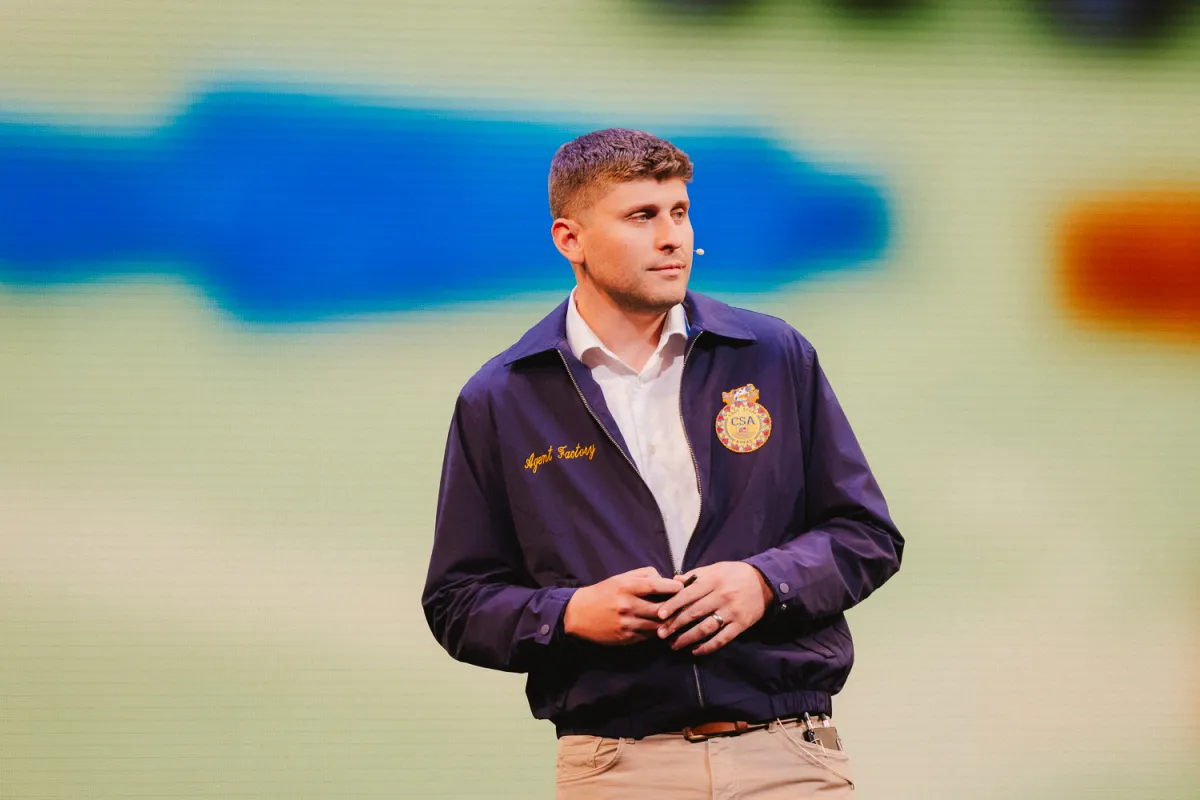
The most concrete example of that tension was Agent Factory, Epic’s platform for building and adapting agentic AI workflows. It’s a tool that lets health systems stop waiting for Epic or another vendor to build a capability, and instead construct their own. Some organizations are already seeing striking results. Inova Health, for instance, has 70 AI features in production, about 20 percent of them agentic. Its Agent Factory work on infection prevention has cut chart-review time fifteen-fold. Jon McManus, Inova’s chief data and AI officer, described a measles exposure scenario where a process that might have consumed most of a 72-hour intervention window can now be completed in about six hours. ECU Health is seeing operational wins too. Jacob Parrish, vice president of clinical operations, said an Agent Factory workflow helped drive an 86 percent increase in transfers landing at regional hospitals by prompting transfer nurses to consider alternatives to automatically sending patients to the main medical center. “When you get into the actual operational value, it’s there,” Parrish said. But the technology’s promise also raises a harder question: who is going to keep it working? Dr. Hasan Ahmad, associate CMIO at Parkview Health, left UGM with that question front and center. Agentic systems aren’t “build it and forget it,” he said. Models change, inputs change, prompts change, and outputs can drift. Someone has to watch for that degradation. “These agents are going to be built with Epic, but eventually, organizations are going to own the maintenance and monitoring,” Ahmad said. “That’s going to require additional resources, time, data scientists, informaticists, and governance infrastructure—and some organizations are not going to be able to do that.” Parkview has identified potential use cases, but Ahmad wants more clarity from Epic about what the operational model will look like. Epic, for its part, says it’s working on an Evaluation Suite to help health systems test agents before go-live, monitor them afterward, and measure whether they’re producing intended outcomes. Still, the lack of detail in the general session left several executives—including Ahmad—with more questions than answers.
Epic’s expanding ambitions are also forcing partners and competitors to rethink their positions. Last year, much of the buzz was about what Epic’s move into ambient documentation and other AI capabilities meant for the companies already selling those tools. That question hasn’t gone away. As one health tech CEO put it at the time, “it’s really tough to go against Epic with something they do first-party.” This year, Abridge CEO Dr. Shiv Rao said his company remains confident it’s “headed in a very different direction.” Abridge continues to partner with Epic, but it also works across electronic health records, with payers and life sciences companies. Even where products seem to overlap, Rao expects health systems will see that “they’re actually coming at these problems in a very different way.” It’s a relationship worth watching, especially because Epic spent so much time this year talking about community. There was a new emphasis on sharing features between health systems, more smaller platforms in the mold of Orchard, and the introduction of Epic Rangers, a program designed to help organizations fine-tune the platform one-on-one. Increasingly, Epic seems to want to be the infrastructure on which customers and partners build, customize and share their own tools. But behind that warm, collaborative messaging—and the whimsical, cotton-candy facade—there’s a quieter, more legalistic conversation happening. Days before UGM, Reuters reported that the Federal Trade Commission is investigating Epic, including how the company grants or withholds access to data. Epic denied engaging in anticompetitive behavior and said its health system customers, not Epic, control access to patient records. I heard versions of that same question throughout the week, though usually in less formal language. As Epic gives health systems more tools to build, share and deploy their own technology, customers and partners are also trying to figure out where Epic’s responsibility ends and theirs begins. Who owns the data? Who owns the innovation built on top of it? And who is responsible for keeping an agent safe once it leaves the Factory floor? Those questions don’t have easy answers, but they’re becoming impossible to ignore.
Beyond Epic, the week brought a steady stream of health care news. Optum Health CEO Krista Nelson made the case that value-based care can deliver on the “quadruple aim”—but she acknowledged that pressure from Washington would test the industry’s ability to scale it. In a virtual fireside chat, Nelson explained how Optum is reading CMS’s signals and refining its strategy. Meanwhile, Abridge made a timely move on Monday, expanding its clinical intelligence agent to every clinician at its partner health systems, including those who don’t use Abridge for documentation. The agent is designed to support clinicians before, during and after patient care, using both EHR context and medical evidence. It can generate pre-visit summaries, populate medical calculators with EHR data, answer chart queries, provide evidence-based decision support, and even draft referral letters and clinician handoffs. Abridge says clinicians at more than 300 enterprise health systems have adopted the decision-support capabilities since their April launch, and more than half of eligible Abridge clinicians are now monthly active users. CEO Shiv Rao said change management is “the biggest challenge with enterprise AI deployments because AI is moving so quickly.” He stressed the need to be deliberate about which capabilities to deploy, in what order, and how to package them so IT teams can absorb the technology over time. In another notable development, Costco is planning to enter the Medicare market through a partnership with nonprofit insurer SCAN Group. The companies will initially offer jointly branded Medicare Advantage plans in two states and a Medicare supplement plan in a third, targeting markets with roughly five million Medicare enrollees. The plans will integrate with Costco offerings like prescription drugs, vision, hearing, over-the-counter medications and food, and will be sold both inside Costco stores and through traditional channels. Federal rules prohibit including a Costco membership with the plans, but Costco sees this as a pilot to increase the value of membership. Finally, Dr. David Morens, a former senior adviser to Dr. Anthony Fauci, pleaded guilty to conspiracy to defraud the U.S. government. Prosecutors accused him of concealing federal records related to coronavirus research by using personal email for exchanges that should have been preserved. Morens could face up to five years in prison and a $250,000 fine when he’s sentenced in November. Fauci has not been charged in connection with the case, but a Senate committee recently voted to hold him in contempt of Congress after he invoked the Fifth Amendment.
The Pulse Check section of the newsletter featured a four-way interview about Agent Factory, and it offered a deeper look at how health systems are thinking about development, governance and the build-versus-buy equation. Johnston Thayer, Epic’s chief nurse executive, explained that health care is full of nuanced problems. Some processes are deterministic and can be handled with simple if-then logic. But there’s a huge space where problems are more ambiguous, where you need to bring together different types of information, reference policies or protocols, and make a judgment. That’s where agents shine. Jon McManus from Inova said the key isn’t about roles but about finding good candidates—problems where AI is safe and responsible. Infection prevention was a natural fit because it involved large-scale exposures and required reviewing charts with information scattered across notes, scanned images and discrete fields. An agent could replicate what an infection preventionist would do, but much faster. Derek De Young, an Epic R&D leader, added that agents are different from single-shot AI because they can interact with the system, search for more data, and take action. In the measles exposure example, the agent didn’t blindly review a whole population; it used tools in Epic to find the subset of patients who needed attention, then handed off to a nurse for the final decision. On the question of scale, McManus said Inova has 70 AI features live, with about 20 percent agentic. Every agentic workflow requires a “fusion team” with data engineering, data science, AI engineering, clinical or business application expertise, and an operator who owns the problem. De Young predicted there won’t be thousands of bespoke agents, but rather core agent harnesses with thousands of skills shared across the community. Jacob Parrish from ECU Health described a governance structure called the AIM Committee, noting that Epic-related initiatives are somewhat less complex because all the data stays within the Epic environment. On patient-facing AI, McManus said Inova does have patient-facing AI and plans to expand it, but consent, disclosure and transparency are essential. “Decision support, not decision replacement” was the tagline. Finally, on build-versus-buy, McManus said Agent Factory feels like a full-service product with the right protections and guardrails, so it’s likely to become a growing part of their AI strategy. Parrish echoed the “Epic first” philosophy, saying the operational value is clear when you see results like the 86 percent increase in regional hospital transfers.
The week also brought several C-suite moves worth noting. SSM Health’s CFO, Kevin Smith, is heading to Providence, where he’ll become CFO on October 26. Don Stanziano is the new chief external affairs officer at Wellstar Health System in Marietta, Georgia; he previously served as chief marketing officer at Banner Health and held leadership roles at Geisinger and Scripps Health. In his new role, Stanziano will oversee marketing, communications, government relations and strategic community development. And Cone Health selected Ryan Christensen as its new chief value-based care officer, bringing him from Intermountain Health, where he was enterprise vice president of operations for proactive care services. These moves reflect a broader shift in health care leadership, as organizations prioritize value-based care, public affairs and operational transformation. But the biggest story of the week remained Epic’s evolution from an electronic health record company into something more like an AI platform—and the complicated feelings that come with it. The enthusiasm at UGM was real, and so were the results. But so were the questions about sustainability, governance, data ownership and the limits of what individual health systems can manage on their own. Epic’s message was clear: the future is here, and it’s more accessible than ever. Yet the week also made clear that accessibility and readiness are two different things. For every health system celebrating a fifteen-fold improvement in chart review time, there’s another trying to figure out who will monitor the models next year. For every partner like Abridge insisting there’s room for collaboration, there’s an FTC investigation raising questions about how much control Epic really has. The next chapter of health care AI won’t be written by Epic alone. It will be shaped by the hospitals, doctors, nurses, data scientists and vendors who figure out how to use these tools responsibly—and by the answers to the questions that lingered long after the giant button was pressed. This was a preview of the August 20 edition of Access Health. Tap here to get the newsletter delivered straight to your inbox on Thursday mornings.