






The road to a World Cup final is paved with tears, adrenaline, and an unimaginable level of physical and emotional sacrifice. For the Argentine national team, known affectionately across the globe as La Albiceleste, the 2026 tournament in North America had been a grueling testament to their enduring grit, fighting spirit, and tactical flexibility. Having triumphed in seven consecutive, high-stakes matches to reach the ultimate stage at MetLife Stadium, they stood on the precipice of footballing immortality. The dream was simple yet monumentally heavy: to become the first men’s national team to win back-to-back World Cup trophies since the legendary Brazilian squads of 1958 and 1962. For weeks, the passions of millions of fans back in Buenos Aires and across the worldwide diaspora had converged on this single core of hope, believing that their heroes could somehow defy the odds once more and cement a historic dynasty. Yet, as they prepared to face a young, dynamic, and technically superior Spain side, the sheer scale of the challenge lay bare. Under the tactical guidance of Lionel Scaloni, Argentina knew they would have to transcend their physical limits, relying on sheer passion, defensive organization, and the occasional stroke of genius to close the gap against a Spanish squad that moved the ball with hypnotic, devastating precision. From the opening whistle, the atmosphere in New Jersey was electric, a swirling cauldron of tension, hope, and anxiety where every pass, tackle, and tactical shift felt magnified a thousand times over. The players carried the weight of history on their shoulders, playing not just for a golden trophy, but for the collective pride and identity of an entire nation that eats, sleeps, and breathes the beautiful game. Every block, clearance, and counterattack was contested with a desperate intensity, as Argentina fought with everything they had to keep their golden era alive against a relentless tide of red shirts, knowing that one mistake could shatter four years of preparation.
For ninety minutes of regulation time, Argentina managed to hold the line, executing their defensive game plan with a heroic, desperate stubbornness that frustrated the Spanish attackers and kept the global audience on the edge of their seats. Spain, known famously as La Roja, dominated possession and controlled the tempo of the match, showcasing the fluid, tiki-taka evolution that has defined their footballing philosophy for a generation. Despite Spain’s clear superiority on paper, the reigning champions refused to yield, throwing their bodies into challenges and dragging the contest into the grueling pressure cooker of extra time. The physical toll on both teams was immense, with muscles cramping and minds fraying under the humid American summer heat, yet the hope of a historic repeat remained tantalizingly alive for the South American side. However, in the 106th minute of the match, the defensive dam that Argentina had so bravely maintained finally and devastatingly broke. A brilliant, looping cross found the rising figure of Nico Williams, who showed immense composure to head the ball back across the penalty area into a dangerous, chaotic zone. Waiting there was Ferran Torres, who met the ball with a spectacularly timed, rocketed volley that bypassed the desperate dive of the Argentine goalkeeper and found the back of the net. The stadium erupted as Spain celebrated a moment of pure sporting ecstasy, a goal that would ultimately secure their second-ever men’s World Cup title and their first since the legendary triumph of 2010. For Argentina, the goal was a dagger to the heart, a sudden and brutal realization that their heroic journey was coming to an end, leaving them exhausted, defeated, and emotionally shattered on the world’s grandest stage after fighting so hard to preserve their dream, watching helplessly as the clock ticked down to their demise.
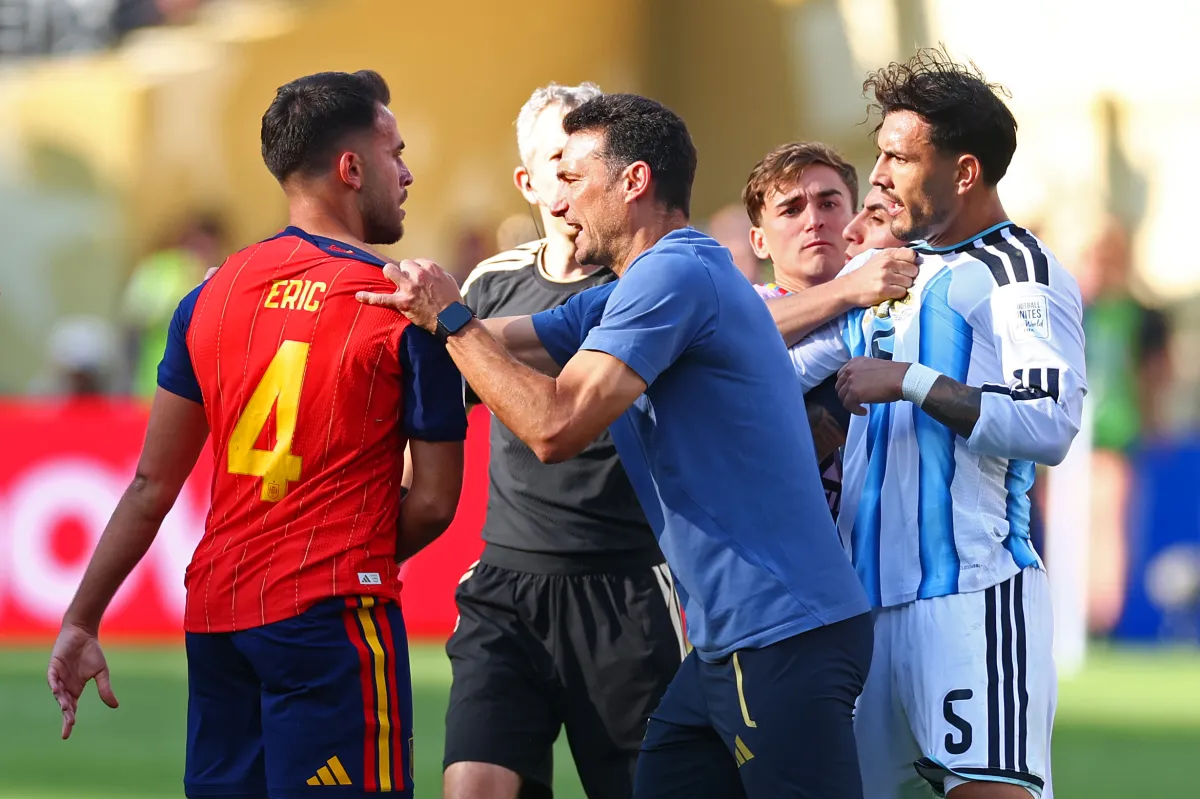
When the referee blew the final whistle, the contrast in emotions on the pitch was as stark as it was heartbreaking, but what followed quickly overshadowed the beautiful display of football that had preceded it. While the Spanish players collapsed to the turf in tears of joy, hugging one another and celebrating a historic achievement, the deep-seated frustration and exhaustion within the Argentine ranks boiled over into an ugly, uncharacteristic display of poor sportsmanship. The transition from intense athletic competition to raw, uncontrollable anger occurred in a matter of seconds, turning the pitch of MetLife Stadium into a volatile zone of confrontation. Several Argentine players, unable to process the heartbreak of their defeat and the realization that their historic crown had slipped away, began to lash out at their victorious opponents. At the absolute epicenter of this highly explosive, deeply chaotic post-match fracas was the fiery Argentine midfielder Leandro Paredes, whose emotions completely overrode his professional discipline. Instead of shaking hands or retreating to the locker room to grieve the loss in private, Paredes and several of his teammates became highly physical, initiating confrontations with the celebrating Spanish squad. This sudden, shocking outburst of physical anger shocked the spectators in the stadium and the millions watching at home, casting a dark shadow over what should have been a celebration of global sporting excellence and highlighting the volatile, unpredictable nature of elite human emotion under pressure. The sight of professional athletes, who are idolized by millions, losing their composure so spectacularly served as a stark reminder of how thin the line is between athletic passion and raw, untamed hostility. In those chaotic moments, the values of respect, teamwork, and fair play were momentarily forgotten, replaced by a primitive urge to lash out in pain after losing the game of their lives.
The situation deteriorated rapidly as Paredes, completely losing his composure, targeted Spain’s talented defenders Eric Garcia and Gavi in a flurry of physical aggression that shocked onlookers. In a moment of extreme tension, Paredes aggressively grabbed Garcia by the throat, a dangerous gesture that instantly drew players and staff from both benches onto the field to prevent a dangerous, full-blown riot. Even the veteran Argentina manager, Lionel Scaloni, recognized the severity of the situation and frantically rushed onto the pitch, attempting to intervene, restrain his player, and restore some semblance of order and dignity to the proceedings. However, Scaloni’s desperate peace-making efforts were not enough to halt the chaos, as Paredes then turned his anger toward Gavi, the youthful midfield prodigy of Spain. In a chaotic tangle of limbs and flying tempers, Paredes ended up beating up Gavi while the young, defenseless Spaniard lay crumpled on the ground, a scene of shocking physical violence that stood in stark, jarring contrast to the spirit of fair play that FIFA continuously promotes. The physical altercation lasted for several tense minutes, with security personnel, coaching staff, and cooler-headed teammates working tirelessly to separate the warring factions. This ugly incident laid bare the raw, sometimes toxic nature of athletic rivalry when the stakes are at their absolute highest, showing how the line between passionate competitive drive and dangerous, physical hostility can so easily blur when the final whistle brings a devastating end to a lifelong dream. The image of Gavi on the ground, shielded by teammates from the wrath of an opponent, became the defining, unfortunate snapshot of the tournament’s climax, leaving fans worldwide to wonder how such a magnificent tournament could have reached such a dark and disgraceful conclusion.
In the immediate aftermath of the chaotic post-match brawl, the governing bodies of international football wasted no time in addressing the controversy, ensuring that the ugly scenes would not go unpunished. Experienced journalists and football insiders, including BBC Sport’s Dale Johnson and ESPN’s Mark Ogden, quickly reported that FIFA had launched a formal investigation into the MetLife Stadium incident. According to Johnson, FIFA’s disciplinary committee acted swiftly by appointing a dedicated disciplinary and ethics prosecutor to thoroughly assess the video footage, official referee reports, and eye-witness accounts of the post-whistle fracas. The potential ramifications for Argentina are severe; any player or member of the coaching staff identified as an active participant in the violence could face devastating, lengthy multi-match international suspensions from international football, which would hamper the team’s transition into their next competitive cycle. Furthermore, the Argentine Football Association (AFA) is highly likely to face substantial financial penalties for failing to control their representatives on the world stage. This institutional response serves as a stark reminder of the massive gap between the raw, emotional reality of the players on the pitch and the cold, bureaucratic rules of the corporate entity that runs global soccer. For Argentina, a tournament that started with high hopes of repeating history has ended not only in a painful silver medal, but also in a looming cloud of disciplinary action and a damaged reputation that will take years to fully repair. The shadow of this investigation threatens to hang over the team for months, turning what should have been a proud celebration of their runner-up status into a somber, litigious period of self-reflection and damage control, proving that historical legends cannot protect a team from the strict rules of modern discipline.
Amidst the wave of public condemnation and the looming threat of official sanctions, it was the primary victim of the physical attack himself, Gavi, who offered the most surprising, mature, and deeply humanizing perspective on the entire affair. Speaking to the popular Spanish sports program El Partidazo de COPE, the young, talented midfielder displayed an extraordinary, highly admirable level of empathy and emotional intelligence, surprisingly advocating against a harsh retroactive suspension for Leandro Paredes. Gavi candidly acknowledged that while the violent scenes were certainly a terrible look for the millions of young kids watching around the world who look up to these athletes as role models, there is also a raw, occasionally violent reality to high-stakes football that outsiders sometimes struggle to comprehend. He realistically noted that in the intense heat of a final, where adrenaline, exhaustion, and national pride collide, human beings can lose control of their actions, suggesting that the most logical and fair outcome would have simply been for the referee to send Paredes off with a red card during or immediately after the match, rather than dragging the conflict into a lengthy, career-damaging bureaucratic trial. Gavi’s remarkable lack of resentment and his willingness to forgive his attacker highlighted a side of the sport that is rarely discussed: a shared, unspoken understanding among elite athletes of the intense psychological pressures they all endure on the world stage. His words serve as a powerful reminder that behind the massive spectacles, the sponsorships, and the chaotic headlines, these players are ultimately vulnerable human beings trying to navigate the extreme highs and lows of the world’s most popular and passionate game, and sometimes, a simple act of forgiveness can do more to heal the sport than any official FIFA sanction. In a world quick to penalize and castigate, Gavi’s grace offered a glimmer of hope that the beautiful game can still teach us about empathy and humanity.