





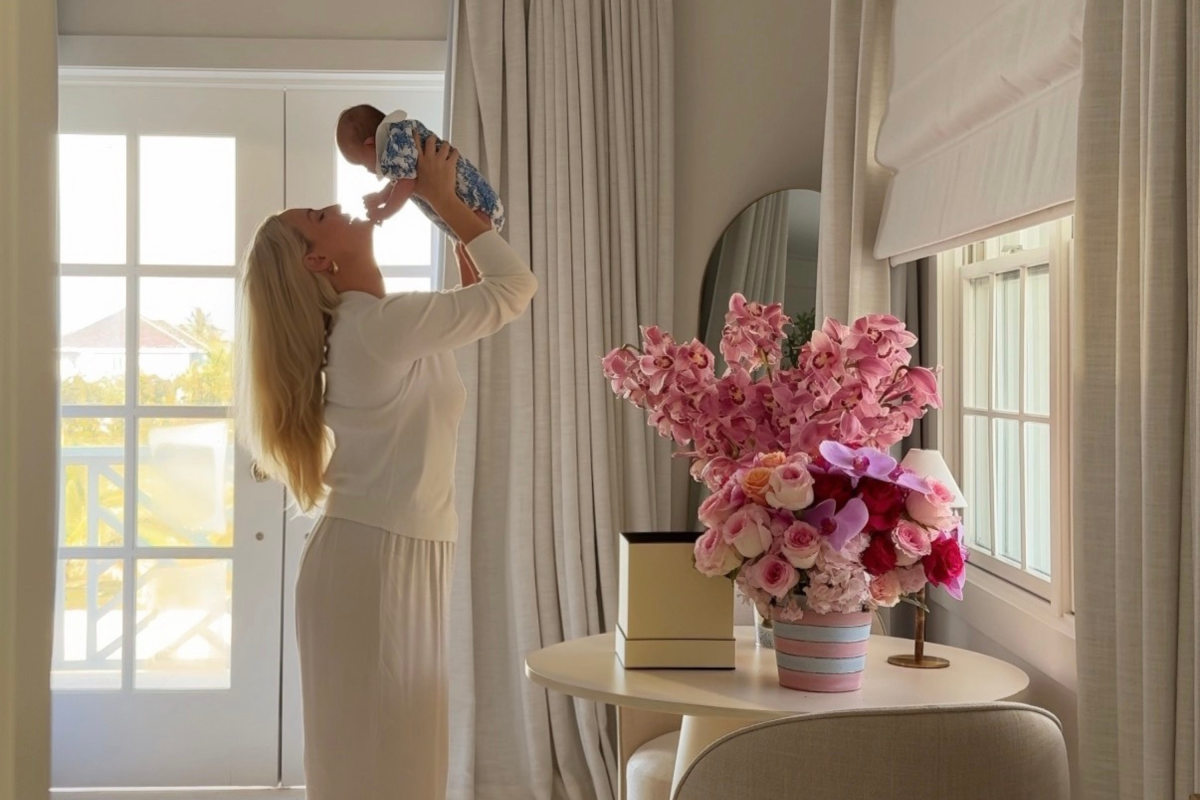
When my daughter Ever entered the world, everything unfolded with a swiftness that caught us entirely off-guard, yet with a profound, quiet peace that exceeded every hope I had held for my delivery. We were at home in our own comfortable sanctuary, and by the time the realization fully registered that my labor had progressed so rapidly, she was already making her way into our arms—so quickly, in fact, that she was safely delivered before our midwives could even walk through the front door. Those initial hours of her life were wrapped in a cocoon of post-birth bliss, an exquisite pocket of time where the world outside ceased to exist and there was only the pure warmth of our newborn baby resting against my skin. Yet, as the quiet hours of that first night ticked by, a silent, intuitive dance began between my husband Alexander and me. It started with subtle, almost imperceptible physical details that we both noticed but did not immediately give voice to: the distinct set of her eyes, the gentle curve of her hands, and a unique softness that seemed to define her physical presence. We did not speak of these observations out loud at first, choosing instead to cradle them in our own private thoughts as we adjusted to her presence in our lives. It was a mutual, unspoken processing, an internal whisper of recognition that our daughter might be walking a path slightly different from the one we had envisioned, though we lacked the clinical vocabulary to name it. This gentle mystery lingered softly in our home until about twenty-four hours after her birth, when our midwife, during a routine wellness check, gently and compassionately voiced the possibility that Ever might have Down syndrome. In that exact moment, the quiet puzzle pieces we had both been turning over in our minds slid seamlessly into place with a profound sense of clarity. When we finally shared our thoughts with each other and subsequently discussed it with our extended family, we discovered that everyone had quietly noticed the very same features, yet had held back from speaking until the right moment. This revelation was not met with devastation; instead, it felt incredibly surreal, less like receiving a piece of tragic news and much more like a gentle, collective recalibration of our family’s spiritual compass.
In the immediate aftermath of that realization, I found myself navigating a complex emotional landscape, experiencing a couple of days filled with a soft, quiet sadness that hovered in the background of our newborn bubble. However, when I allowed myself to sit deeply with that heavy feeling, to dissect it and understand its origin, I came to a profound realization: this grief was not about Ever at all. Rather, it was about the death of an illusion—the mourning of a highly specific, imagined future and the phantom version of a child that I had unconsciously constructed in my mind throughout the nine months of my pregnancy. As expectant parents, we naturally build elaborate mental blueprints of our children’s lives before they are even born, dreaming of who they will be, what they will look like, and how their existence will seamlessly fit into our pre-existing world. When a diagnosis or an unexpected reality challenges that mental portrait, even in the gentlest possible way, it triggers a legitimate sense of loss, a mourning period not for a real person, but for a cherished expectation that has suddenly dissolved. Once I recognized that my sadness was merely a farewell to a theoretical projection, a massive weight lifted from my heart, and my entire perspective shifted beautifully. I looked at Ever and realized with absolute certainty that she was exactly who she had always been from the very first moment of her conception; there was no secret, alternative version of our daughter that had been stolen from us. The clinical diagnosis did not change her essence, her soul, or the vibrant spirit she brought into our home; it merely altered the focus of the lens through which we viewed her, sharpening our vision so that we could appreciate her exact, authentic beauty without the distracting distortion of our prior expectations.
A few days after her birth, we took Ever to see our pediatrician to seek guidance on her physical characteristics, and while he noted several clinical markers associated with Down syndrome, he explained that physical signs alone were not definitive. The only way to obtain absolute, scientific certainty was to conduct a chromosomal blood test, which we promptly agreed to do, sending the sample off to the laboratory and beginning a waiting period that would span three long weeks. This interim period became an incredibly unique epoch in our lives, characterized by an exquisite blend of pure, unconditional newborn joy and a soft background of uncertainty. There were quiet afternoons when we would gaze at her tiny face and feel entirely convinced of her diagnosis, and other moments when her features looked so much like her siblings’ that we found ourselves genuinely questioning our assumptions. Within our household, this uncertainty transformed into a gentle, almost playful question—“Does she, or doesn’t she?”—voiced not with a shred of anxiety, dread, or fear, but with a lighthearted, loving curiosity that made the waiting feel peaceful. By the time those three weeks had drawn to a close, however, we realized that the clinical answer had lost all of its weight, because we had already fallen completely, irrevocably in love with the little girl lying in our arms. She was our daughter in every meaningful sense of the word, an irreplaceable part of our lives, and we knew with absolute certainty that there was not a single chromosome, trait, or characteristic we would ever want to alter. Consequently, when the laboratory results finally arrived and confirmed that Ever did indeed have Down syndrome, the news barely registered as a shock; it didn’t shift our daily reality or alter our emotions, because we already knew exactly who she was, and her identity was far grander than any medical label could define.
Looking back on my pregnancy journey, it is remarkable to consider how seamlessly and peacefully everything had unfolded prior to Ever’s arrival, especially given how common prenatal diagnoses are in modern obstetrics. Throughout my pregnancy, we had undergone all the standard, routine ultrasounds and prenatal screenings in both Canada and the Bahamas, and absolutely nothing had ever arisen to raise a red flag or suggest any developmental differences. We had intentionally chosen not to pursue more invasive genomic testing, as we felt deeply that such interventions did not align with our personal philosophy, and we had already proactively discussed how we would respond if we ever learned our child had Down syndrome. Our answer during those intimate conversations had always been simple and unwavering: we would do absolutely nothing differently, and we would welcome our baby with open, eager arms. Because of this path, I was blessed to experience my entire pregnancy in a state of absolute tranquility, harboring a deep, undisturbed confidence in my plans for a peaceful home birth, which had been a cherished dream of mine for as long as I could remember. Had we received a prenatal diagnosis of Down syndrome, my pregnancy would have almost certainly been labeled as “high-risk,” a bureaucratic medical classification that would have stripped away my autonomy and likely prevented me from experiencing the empowering, serene home birth that I so deeply desired. Reflecting on this now, I do not feel anger or regret over the lack of early detection; instead, I feel an overwhelming wave of gratitude for how the universe protected our experience. By the time we finally attached a formal name and a clinical diagnosis to Ever’s unique genetic makeup, we had already spent weeks bonding with her as an individual, free from the heavy burdens of medical labels, clinical expectations, and societal fears, which felt like an extraordinary, divinely orchestrated gift.
Today, Ever is, in the most literal and beautiful sense, an absolute dream of a baby, radiating a gentle joy that has completely transformed the atmosphere of our home. She feeds beautifully, sleeps with a peaceful regularity that is rare for newborns, and is meeting all of her early developmental milestones with a quiet, determined grace that fills our hearts with pride. We are acutely aware of how incredibly fortunate we are that her medical evaluations have shown her heart and her hearing to be completely healthy, sparing us the immediate medical crises that can sometimes accompany a Down syndrome diagnosis. Yet beyond any of the clinical parameters or developmental checklists, what truly defines Ever is her sheer, unadulterated contentment—a soft, calming presence that wraps around anyone who enters the room, demonstrating to us daily that she is not struggling, but rather blooming in her own gorgeous way. Our entire family has embraced her with an ease that is as effortless as it is profound, completely devoid of hesitation or reservation. My older children from my previous relationship—Knox, Aria, and Cruz—did not require a single moment of intellectual processing, emotional adjustment, or explanation; to them, Ever was never a diagnosis or a set of clinical symptoms, but simply their adored new baby sister who demanded their love and protection. Children possess an innate, beautiful capacity to accept reality exactly as it presents itself, completely free of the complex, fearful layers of expectation and social conditioning that adults so often project onto the world, teaching us all a valuable lesson in what it means to offer unconditional love.
Since I began sharing glimpses of Ever’s life and our family’s journey on my social media platform (@raianashanese), I have been deeply moved by the overwhelming deluge of messages from parents all over the world, many of whom are currently pregnant, navigating the raw shock of a fresh diagnosis, or struggling to find their footing in a world that feels suddenly unfamiliar. It has become painfully clear to me that society often peddles a singular, highly medicalized narrative about raising a child with Down syndrome—a story thoroughly rooted in fear, sorrow, and prospective limitation. But I want to loudly and gently remind these parents that this fearful narrative is far from the only truth, and it certainly does not define the reality of the beautiful life that awaits them. If I could offer any piece of comfort to a parent standing at the beginning of this path, it would be to give yourself the gentle permission and space to feel every single emotion that arises within you—the confusion, the fear, and even the natural grief for the life you had previously imagined. Every one of those feelings is entirely valid, but they are also temporary seasons of transition, because your baby is exactly who they have always been from the very first moment their cells began to divide: a whole, perfect, and complete soul who is missing nothing. A diagnosis does not change the essence of who your child is; it merely gently invites you to expand the boundaries of the picture you had painted in your mind, and I can promise you from experience that this new, expanded picture will turn out to be infinitely more colorful, beautiful, and deeply fulfilling than the one you originally imagined. Today, split between our vibrant lives in Niagara, Ontario, Canada, and the sunny shores of Nassau in the Bahamas, Alexander and I look at our thriving family and know with absolute certainty that we would not change a single thing about our beautiful daughter Ever, who has shown us how magnificent life can be when we simply let go of expectations and embrace the beauty of what is.