





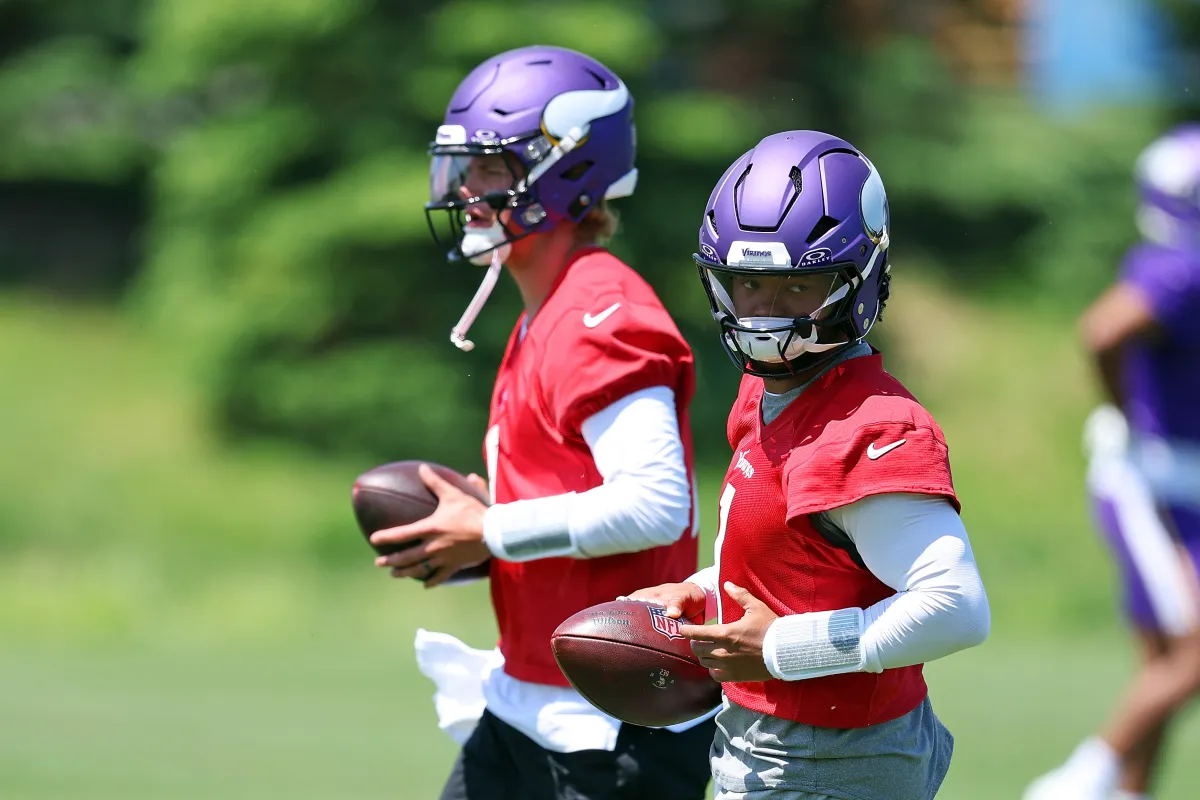
The story of professional sports is rarely a straight line; instead, it is a winding road filled with steep peaks of adulation and dark valleys of doubt, a reality that Minnesota Vikings quarterback Kyler Murray knows all too well. Once hailed as a generational dual-threat prodigy, Murray’s journey from a high school legend in Texas to a Heisman Trophy winner at the University of Oklahoma, and finally to the first overall pick in the 2019 NFL Draft, read like a script destined for Hollywood. He possessed a rare, breathtaking blend of track-star speed and a baseball infielder’s whip-like arm strength that made him an immediate nightmare for opposing defensive coordinators. Yet, the brutal nature of the National Football League has a way of testing even the most talented individuals, and Murray’s subsequent years in Arizona were characterized by occasional flashes of absolute brilliance offset by devastating, momentum-halting injuries and organizational instability that threatened to derail his promising career entirely. The human cost of this struggle is often lost in fantasy football statistics and sensationalized headlines; behind the face mask is a young man who had to undergo grueling physical therapy, face intense public skepticism regarding his passion for the game, and deal with the psychological weight of unmet expectations. Now, standing on the precipice of a brand-new chapter with the Minnesota Vikings, Murray has been gifted a rare sports commodity: a clean slate in an environment engineered to help him thrive. This transition is not merely a change of address or a swap of team colors from Cardinal red to Viking purple; it represents a profound psychological rebirth for a twenty-eight-year-old athlete who is hungry to reclaim his narrative, silence the critics who wrote him off as a fragile draft bust, and remind the entire football-watching world of the sublime talents that once made him the most exciting player in the country.
At the heart of Murray’s potential renaissance in Minnesota is the masterfully designed offensive ecosystem constructed by Vikings head coach Kevin O’Connell, a leader who has quickly established himself as one of the premier quarterback whisperers in the modern era of the sport. The transformative power of O’Connell’s coaching philosophy was put on full display during the 2024 NFL season, when he took Sam Darnold—a quarterback who had spent years being discarded by multiple franchises and labeled an drafted bust—and meticulously rebuilt his mechanics, confidence, and decision-making to guide him to a shocking, career-defining Pro Bowl season. O’Connell’s approach is deeply human and empathetic; he understands that a quarterback’s performance is intimately tied to their mental state, their trust in the system, and the belief that their coach has their back even after a costly turnover. For a highly scrutinized player like Murray, who has thrived under coaches who understand his unique psychological makeup, pairing up with a play designer of O’Connell’s caliber is akin to finding the perfect artistic collaborator. The coach’s offensive system is renowned for its rhythm, timing, and creation of space, yet it is flexible enough to accommodate the unstructured, playground-style magic that makes Murray so uniquely dangerous when play designs break down. Under O’Connell’s careful guidance, the hope is that Murray will no longer feel the exhausting burden of having to carry an entire franchise on his back, but can instead play within a structured, highly efficient system that allows him to pick his spots to unleash his devastating running ability and deep-ball accuracy. By taking the pressure off Murray’s shoulders and providing him with clear, pre-snap indicators and a physical run game, O’Connell can reduce the cognitive load that often plagued Murray in Arizona, fostering a sense of security and allowing the quarterback to play with the joyful, carefree abandonment of his college days.
This fascinating confluence of elite athletic potential and top-tier offensive coaching is precisely what caught the eye of highly respected NFL.com analyst Bucky Brooks, who recently turned heads across the sports landscape by identifying Kyler Murray as his ultimate long-shot candidate for the NFL Most Valuable Player award. Brooks’ selection is not merely a wild stab in the dark designed for cheap social media clicks; rather, it is a calculated, deeply reasoned projection rooted in the historical patterns of how the MVP award is voted upon and won. The primary engine of any MVP campaign is always a compelling comeback narrative, and Murray’s path fits this blueprint to perfection as a former Offensive Rookie of the Year who is fighting his way back from severe injury and public doubt. Brooks astutely notes that the combination of Murray’s spectacular playmaking ability and O’Connell’s creative scheming could quickly remind the football world of the player who captured the Heisman Trophy and dominated the collegiate ranks. To win the MVP, a player must not only produce eye-popping individual statistics, but they must also possess the intangible “wow factor” that captivates voters during nationally televised games, a criteria that Murray, with his electric scramble drills and highlight-reel deep throws, satisfies effortlessly. By placing Murray in the dark-horse category, Brooks is highlighting a fundamental truth about the modern NFL: when a supremely talented, dual-threat quarterback is paired with a visionary play-caller who knows how to maximize their unique skill set, the ceiling is practically limitless, and what seems like an improbable long-shot in July can quickly look like an inevitability by December. Furthermore, the MVP discussion often hinges on a player’s ability to elevate their entire team in moments of crisis, and Murray has consistently demonstrated a clutch gene that, when properly channeled, can result in miraculous, game-winning drives that capture the national spotlight.
Of course, even the most talented quarterback in the world cannot win an MVP award or lead a franchise to the promised land in a vacuum, which is why the luxurious supporting cast waiting for Murray in Minnesota is such a critical component of his potential success. Foremost among these assets is wide receiver Justin Jefferson, a transcendent, history-making talent who is widely regarded as the most complete and dominant pass-catcher in the entire sport today. For a quarterback like Murray, who possesses an incredibly beautiful, high-arching deep ball, playing alongside a receiver of Jefferson’s caliber is the ultimate cheat code; Jefferson’s uncanny ability to create separation at every level of the defense, combined with his legendary catch radius and run-after-catch ability, means that even slightly off-target throws can regularly result in explosive, game-changing touchdowns. Yet, the offensive fireworks represent only one side of the coin, as the Vikings have also built a formidable, robust foundation on the opposite side of the ball under the guidance of defensive coordinator Brian Flores. Flores’ signature “swarming” defensive style, characterized by aggressive blitz packages and disguised coverages, is designed to generate quick turnovers, disrupt opposing offenses, and keep games within striking distance. In Arizona, Murray was often forced into a highly stressful, high-risk playing style because his defense could not stop opponents, forcing him to play from behind and take unnecessary risks that led to costly mistakes and physical wear-and-tear. In Minnesota, the presence of a top-tier defense alters the psychological dynamic of the game, allowing Murray to play complementary football, take what the defense gives him, and preserve his health by avoiding the desperate, high-impact hits that have historically threatened his longevity. This holistic team environment provides Murray with the structural stability he has lacked for the majority of his professional career, transforming his role from a solo savior into a confident coordinator of a highly talented, well-orchestrated symphony.
While the internal conditions in Minnesota are ripe for a historic season, the final validation of Kyler Murray’s quest for MVP glory will ultimately be determined by how he fares in the brutal, unforgiving gauntlet of the NFC North. The division has quietly evolved into what is arguably the most competitive, physically punishing, and talent-laden division in the entire National Football League, boasting a collection of franchises that all harbor legitimate aspirations of deep postseason runs. To guide the Vikings to the divisional crown and secure his place at the head of the MVP line, Murray will have to go head-to-head with some of the bright young stars of the position, starting with the reigning kingpins in Detroit led by Jared Goff and his highly explosive Lions offense. Furthermore, he must contend with the rising power in Green Bay, where Jordan Love has emerged as a franchise-saving superstar with a breathtaking array of arm talent, as well as the Chicago Bears, who have ushered in a brave new era under the leadership of the highly touted Caleb Williams. This concentration of elite quarterback talent means that every single divisional matchup will be a high-stakes, nationally televised drama where individual performances are scrutinized under a media microscope. Brooks points out that this intense competition actually works in Murray’s favor relative to the MVP voting process; if he can successfully navigate this gauntlet, lead the Vikings to a division title over three teams that could all realistically field MVP contenders of their own, his achievement will stand out as the single most impressive quarterbacking feat of the season. To be the best, you have to beat the best, and the NFC North provides Murray with the perfect, high-visibility stage to prove that he belongs in the upper echelon of the league’s elite signal-callers, silencing any lingering doubts about his capability to lead a franchise to victory.
When the dust finally settles on this highly anticipated NFL season, the true value of Kyler Murray’s journey will not be measured solely by the advanced analytics, the win-loss column, or the glint of individual silverware, but by the profound human triumph of resilience over adversity. Football is a beautiful but brutal sport that often discards its heroes the moment they show signs of vulnerability, making the pursuit of a comeback one of the most emotionally resonant narratives in all of human endeavor. Murray has spent years enduring the quiet, painstaking agony of injury rehabilitation, the sting of public criticism, and the frustrating isolation of playing for a franchise that struggled to find its identity. His arrival in Minnesota is a testament to his enduring belief in his own abilities, and his willingness to embrace a new system, a new city, and a new fan base showcases the quiet courage that is required to start over when it would be far easier to simply fade away. If Murray can indeed capture the magic that Brooks envisions and lead the Vikings back to the pinnacle of NFL success, it will serve as an inspiring reminder that our past struggles do not have to define our future potential. It is a story that transcends the boundaries of the football field, speaking to the universal human desire for redemption, validation, and the chance to prove that we are still capable of greatness even after the world has counted us out. As the season kicks off, fans in Minnesota and beyond will not just be watching a quarterback play a game; they will be witnessing the unfolding of a deeply personal, remarkably human epic of a young man claiming his destiny, proving that his best football is still ahead of him, and writing a legacy defined not by how he fell, but by how spectacularly he chose to rise again.