




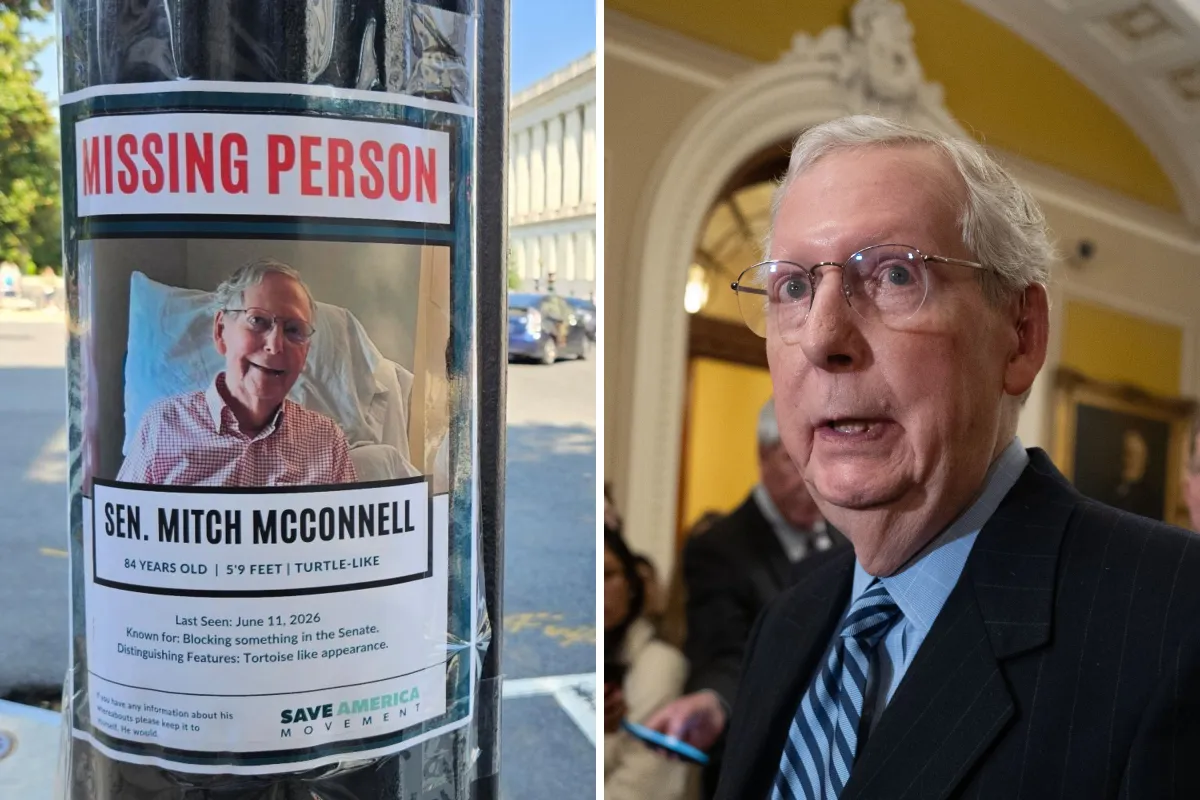
The cold, damp streets of Washington, D.C., have long served as a canvas for political warfare, but a recent wave of wheat-pasted flyers has struck a particularly raw nerve, blending sharp political satire with the fragile reality of human aging. Passersby navigating the federal corridor were greeted by mock “Missing Person” posters targeting Senate Minority Leader Mitch McConnell, whose prolonged absence from the Capitol building has left a quiet, yet heavily scrutinized void in the American legislative landscape. Printed on cheap paper with bold, alarming red lettering, the posters feature a somber photograph of the Kentucky Republican resting in a sterile hospital bed—a stark, vulnerable contrast to his usual austere and formidable presence on the Senate floor. The text beneath the photo strips away the diplomat’s armor, crudely listing his age as eighty-four, his height as five feet, nine inches, and his physical description with the mocking label of “turtle-like.” For any ordinary citizen, this depiction of a convalescing senior citizen would border on cruel cyberbullying; however, in the hyper-partisan theater of modern Washington, it represents a desperate, albeit disrespectful, cry for transparency from a public weary of closed-door governance.
The creative and logistical forces behind this provocative campaign belong to the Save America Movement, a self-described “citizen-led organization focused on defending democracy and restoring common sense.” In a digital age where political discourse is often confined to the echo chambers of social media, this group decided to bring their frustrations directly to the physical pavement of the nation’s capital. Sharing images of their handiwork on the social platform X, the group took aim not just at McConnell’s physical appearance, but at his decades-long legacy as the chief architect of Senate gridlock, noting under his “known for” section his unparalleled reputation for “Blocking something in the Senate.” By juxtaposing his famous “tortoise-like appearance” with his very real, very human medical confinement, the organizers forced a difficult conversation about the boundaries of political protest. While some view the campaign as a stomach-churning degradation of empathy—reducing an elderly man’s painful recovery to a punchline—the group maintains that their crude tactics are justified by a system that has long insulated its most powerful players from the basic accountability expected of any average American worker.
Behind the satirical ink of the flyers lies a deeply human struggle that whispers of the inescapable fragility of the physical body, regardless of one’s political stature. Mitch McConnell’s absence from the chambers of power began following a serious fall and a subsequent battle with a mild case of pneumonia—events that are hazardous for any octogenarian, let alone one carrying the immense weight of national leadership on his shoulders. From his secluded recovery, McConnell released a written statement through his office, acknowledging his grueling path forward and expressing a stubborn determination to return to his full legislative duties and to the constituents of Kentucky. Yet, the sterile, calculated nature of press releases rarely captures the exhausting, painful reality of physical therapy for an aging body, where every step toward recovery is a battle against gravity, muscle atrophy, and time. This disconnect between the human reality of a slow, painful medical rehabilitation and the relentless, fast-paced demands of the 24-hour news cycle has created a dangerous informational vacuum, allowing both genuine concern and malicious mockery to flourish in equal measure on the streets of Washington.
This prolonged silence has metastasized into a profound sense of abandonment among many of the people McConnell was elected to serve. To the four and a half million citizens of Kentucky, a senator is not merely a symbolic figurehead, but a vital conduit of state resources, federal funding, and democratic representation. A spokesperson for the Save America Movement articulated this growing sense of disenfranchisement, explaining that they resorted to the jarring flyers because the situation had reached a point of absolute absurdity. The group pointed out that for well over a month, the senior senator from Kentucky had failed to cast a single vote, had completely vanished from the legislative chamber, and had offered no verifiable, functional proof that he was actively representing the millions of citizens who placed their trust in him. For these voters, the frustration is not necessarily rooted in partisan malice, but rather in a fundamental democratic anxiety: the uncomfortable realization that while their representative recovers in private comfort, their collective voice in the halls of global power has been effectively silenced.
The discomfort surrounding McConnell’s absence has transcended public mockery and entered the formal arenas of state governance, prompting a dramatic intervention from Kentucky’s Democratic Governor, Andy Beshear. Representing the constitutional machinery of a state left partially voiceless, Beshear bypassed political pleasantries to issue a direct, uncompromising challenge to the ailing senator. The Governor called upon McConnell to step forward and “directly and verbally address the people of Kentucky and provide proof of your capacity to serve, or resign.” This demand highlights a brutal, systemic truth about high-stakes politics: there is ultimately very little room for extended human convalescence when the geopolitical balance of power is on the line. Beshear’s ultimatum forces an uncomfortable ethical question to the forefront of American life, asking whether it is humane to demand that a recovering octogenarian perform his cognitive and physical competence on camera, or if it is instead a necessary democratic safeguard to ensure that those who hold the levers of power are truly fit to wield them.
Ultimately, the spectacle of mock missing-person posters plastered across the national mall serves as a symbolic mirror reflecting a much larger, systemic anxiety regarding the aging leadership of the United States government. As the nation increasingly finds itself governed by a generation of leaders who refuse to step away from the podium even as their bodies falter, the line between private medical dignity and public accountability has become hopelessly blurred. These crude, wheat-pasted flyers show that when institutions fail to provide honest transparency about the health of their leaders, the public will fill the silence with their own bitter, human caricatures. The story of Mitch McConnell’s missing posters is more than a fleeting moment of political mischief; it is a poignant, uncomfortable reminder of the inevitable collision between human decay and lifetime political ambition, reminding us that eventually, time spares no one—not even the most formidable guardians of the state.