






Every day, millions of travelers step onto commercial flights, finding comfort in the routine of stowing luggage, buckling seatbelts, and placing their complete trust in the highly synchronized dance of modern aviation. We close our eyes or lose ourselves in books, assuming that the risks of travel are left behind once we touch the ground, or that dangerous incidents only happen high in the turbulent skies. Yet, a series of deeply unsettling events on the runways of America’s busiest transit hubs has shattered this illusion, revealing that the most intense and unpredictable part of any journey often unfolds on the crowded tarmac below. A chilling example of this delicate state of play occurred on a humid Monday in late July at Hartsfield-Jackson Atlanta International Airport, the busiest passenger airport on the planet. Two massive commercial passenger jets, both bearing the Delta Air Lines livery, found themselves in a terrifyingly close encounter during what should have been a routine sequence of arrivals and departures. An incoming flight was descending toward the runway when its pilots realized another aircraft was too slow to clear the landing strip ahead, forcing them to abort their touchdown and execute a sudden, engine-roaring go-around maneuver. As the arriving jet surged back into the sky to circle the airport, its path crossed directly into the airspace of a departing Delta flight that was simultaneously hurtling down an intersecting runway for takeoff. Cockpit warning alarms blared, sending adrenaline spiking through the veins of both flight crews as they navigated a split-second conflict. While both aircraft eventually landed safely without a single scratch on their passengers, the incident triggered an urgent federal investigation and renewed a national panic over airport runway safety, forcing us to ask how many close calls are happening just out of sight of the flying public.
While the passengers in Atlanta were fortunate enough to walk away with nothing more than rattled nerves, other recent incidents have unfortunately shown the devastating, tragic reality of what happens when these ground safety barriers completely break down. The aviation community is still deeply haunted by the horrific collision that occurred in March 2026 at New York’s notoriously congested LaGuardia Airport. In that disaster, an Air Canada Express flight was hurtling down Runway 4, preparing to take flight, when it violently collided with an airport fire truck that had mistakenly crossed onto the active runway. The force of the impact killed both pilots instantly and sent dozens of passengers to the hospital with severe injuries, creating one of the most devastating tarmac accidents in modern American history. This shocking event reignited heated debates over vehicle communication protocols, airport lighting systems, and ground radar technologies that are supposed to act as safety nets. Just over a year prior, in January 2025, another catastrophic event shocked the nation when an American Eagle regional jet collided with a U.S. Army helicopter near Ronald Reagan Washington National Airport, claiming the lives of all 67 people aboard both aircraft. The National Transportation Safety Board (NTSB) would later point to systemic issues in how the FAA managed low-altitude helicopter traffic patterns near commercial runways. These painful moments of loss are a stark reminder to passengers, regulators, and crews that on active flight strips, there is absolutely zero margin for error; a single miscommunication, a misplaced ground vehicle, or a moment of disorientation can instantly turn a routine journey into an unspeakable tragedy.
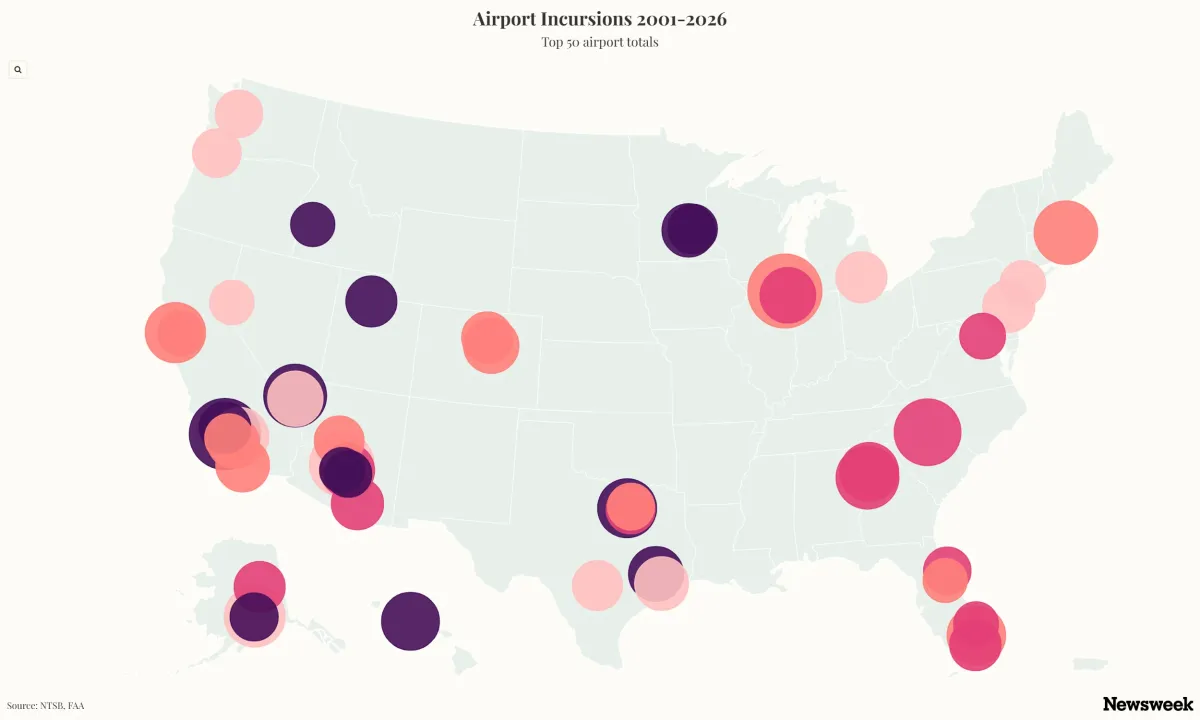
To truly understand the scale of this issue, one must look at the mountain of data tracking these runway mistakes, known in the industry as “runway incursions.” A comprehensive analysis by Newsweek of FAA safety statistics revealed that between 2001 and mid-2026, American airports logged a staggering 35,308 runway-incursion events across 530 domestic facilities. This means that thousands of times over the last quarter-century, planes, ground vehicles, or airport workers have ended up exactly where they should not be, crossing into active landing zones. The vast majority of these incidents occur at the nation’s largest aviation hubs—such as Chicago O’Hare, Los Angeles International, Boston Logan, Charlotte Douglas, and Atlanta’s Hartsfield-Jackson. For air traffic controllers and pilots, these major gateways are incredibly high-stress environments. Picture a controller sitting high up in a tower during a driving rainstorm, trying to keep track of dozens of flashing blips on a radar screen while managing pilots who are exhausted from long-haul flights and navigating complex, foreign taxiway layouts. Because these mega-airports handle hundreds of thousands of operations every single year, they naturally accumulate the highest raw number of incidents. However, aviation experts urge the public not to panic, emphasizing that the sheer volume of successful flights means the statistical risk of any individual flight experiencing a serious ground crash remains microscopic. These busy airports are not inherently dangerous, but their complexity makes them highly sensitive to the slightest human error, turning them into focal points for safety investigators trying to eliminate risk entirely.
Even with these reassuring statistics, the rapid succession of high-profile ground incidents over the past twenty-four months has left the traveling public understandably anxious. In August 2024, the wings of two massive jets literally sliced into each other on a taxiway in Atlanta when a Delta Airbus A330 clipped a Virgin Atlantic Airbus A350 that was parked and waiting for clearance. While none of the 600 combined travelers and crew members on those planes were injured, the sight of a shredded wingtip was a severe wakeup call regarding the visual challenges pilots face when maneuvering massive, wide-body jets in tight airport spaces. Up in Boston, Logan International Airport has had its own run of terrifying scares. In February 2024, two JetBlue passenger planes clipped each other on the ground, causing major structural damage, which was followed in June 2026 by an incredibly close call where a Delta pilot had to perform a last-second aborted landing because another plane had mistakenly taxied onto an intersecting runway. Meanwhile, at Chicago’s compact Midway Airport in February 2025, a Southwest Airlines pilot had to make an emergency climb to avoid colliding with an aircraft that had wandered onto the runway ahead. These events capture the nail-biting reality of tarmac operations: they are moments where absolute disaster was averted not by automated systems or computer algorithms, but by the sharp eyes, rapid reflexes, and split-second decisions of pilots who refused to let a minor mistake blossom into a major disaster.
What exactly goes wrong during these terrifying incidents, and why do they seem to be happening so frequently in our modern travel era? By definition, the FAA classifies a runway incursion as any unauthorized presence of an aircraft, vehicle, or person on a runway designated for landings and takeoffs. These range from minor “Category D” events—such as a pilot accidentally taxiing a few inches past a painted hold-short line with no other traffic around—to critical “Category A” events, which are extreme near-misses where a catastrophic collision is avoided by a hair’s breadth. The NTSB, under the leadership of Chair Jennifer Homendy, has been sounding the alarm on these high-severity incidents, holding national roundtables to demand that airports implement better ground surveillance technology, such as surface detection equipment and cockpit alert systems that warn pilots of conflicts before they happen. Over the years, many safety experts have noted that as planes have grown larger and airline schedules have become packed to maximum capacity to meet public demand, the physical footprints of America’s legacy airports have remained largely unchanged. We are essentially trying to fit more, larger, and faster aircraft onto the same networks of intersecting concrete runways laid out decades ago. When you add the human factors of chronic pilot fatigue, air traffic controller staffing shortages, and the increasing reliance on complex communication loops, the potential for a small misunderstanding to quickly escalate into a life-threatening situation becomes incredibly clear.
Despite these persistent challenges, there is a strong and comforting light at the end of the tunnel, proving that the aviation industry’s obsession with safety is actively making a difference. An FAA spokesperson confirmed that overall runway incursions actually dropped by 8% in 2025, reaching their lowest level since the pandemic-disrupted year of 2020. This positive trend is the direct result of a massive national push featuring intensive outreach programs, redesigned taxiways, improved airfield lighting, and the rapid rollout of new surface safety technologies to dozens of airports nationwide. Yet, as we look to a future where our skies will only become more crowded with flights, commercial travelers must remember that behind every dry statistic, radar blip, or news headline is a deeply human story. It is the story of the pilot who stays focused after a long, exhausting day of delays, the controller who catches a runway conflict at 2:00 AM through sheer focus, and the family sitting in row 15 who simply wants to get home safely for the holidays. Ground safety is not just a collection of rules, software, and concrete runways; it is a profound moral contract between the industry and the millions of people who step onto airplanes every day. By continuing to humanize these issues, listen to front-line workers, and invest in the human beings who run our transportation networks, we can ensure that our journeys remain safe from the moment we walk through the terminal doors until we are safely back on the ground.