


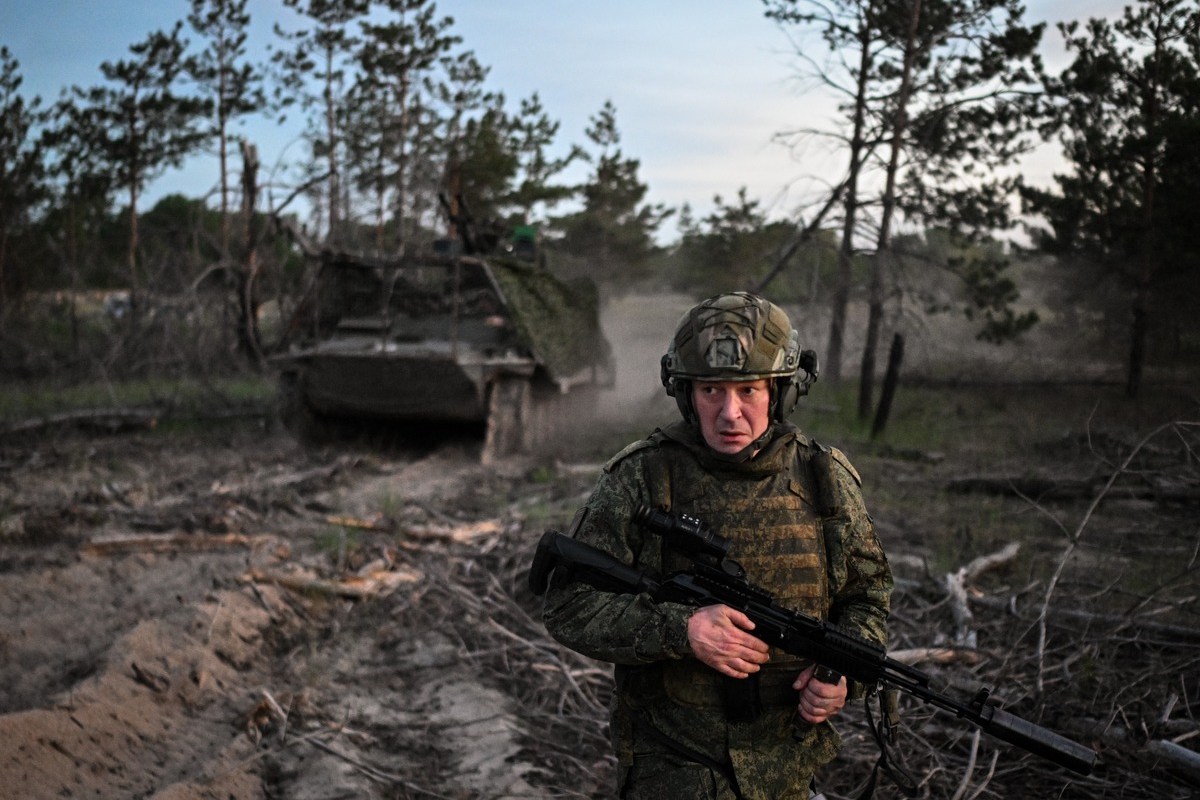
There is a kind of victory that does not always announce itself with a single dramatic breakthrough, but is instead measured in small, hard-won patches of earth. In eastern Ukraine, near the battered city of Lyman, Ukrainian forces have done exactly that over the past two weeks: they have pushed Russian troops back from more than one hundred square kilometers of territory. That is not a vast expanse by the standards of a front line that stretches for hundreds of miles, but it is a meaningful one. It means three villages have been returned to Ukrainian control. It means roads, tree lines, and farm fields that were occupied by Russian soldiers are no longer in their hands. It means the men and women of Ukraine’s Third Army Corps have something to show for weeks of exhausting, dangerous work. The announcement came from Brigadier General Andriy Biletskyi, the commander of the corps, who described a counteroffensive that began in mid-September north of Lyman, in the embattled Donetsk region. Earlier in the year, Russian forces had managed to break through in that area, and their presence threatened to unravel Ukraine’s defenses. The Ukrainian response has been methodical and fierce, the kind of operation that is easy to reduce to maps and arrows but impossible to separate from the soldiers who carry it out. For them, a square kilometer is not an abstraction; it is a position to be dug, a village to be cleared, a comrade to be carried out. The ground around Lyman has already changed hands more than once in this war, and every return comes at a price.
The operation, known as Operation Vivaldi, has become one of the more striking examples of Ukraine’s ability to seize the initiative even while under enormous pressure. Biletskyi confirmed that Ukrainian forces had mounted the counteroffensive north of Lyman after Russian troops had earlier in the year managed to break through and advance in that direction. By late September, he said, the operation had already retaken 176 square kilometers, or about 68 square miles, from Russian control. Now, according to the Third Army Corps, the total has grown to 277 square kilometers and 16 villages since the start of the operation. The name Vivaldi is itself a small act of defiance. It evokes the composer who wrote The Four Seasons, a cycle of renewal and change, but there is nothing poetic about the reality on the ground. The operation, as the Third Army Corps described it, began with the elimination of Russian infiltration and grew into a rapid and large-scale offensive. That is a clinical way of saying that Ukrainian soldiers have been clearing trenches, dodging drones, and calling in artillery strikes on positions that Russian forces once thought secure. The counteroffensive has not been without cost. Every village retaken has likely been reduced to rubble, every road has been mined, and every forest belt has been fought over. But for the soldiers involved, the progress is real. They are not just holding the line; they are moving it forward, one hard-won meter at a time.
The strategic importance of Lyman and the surrounding area cannot be overstated. Lyman is a railway hub in the Donetsk region, a place whose name has become familiar to anyone following the war. Russian forces originally captured it in the first weeks of the full-scale invasion in February 2022, but Ukraine retook it during its lightning counteroffensive in the fall of that year. Since then, Russia has not managed to recapture the city itself, but it has carried out operations in and near Lyman, probing Ukrainian defenses and trying to regain lost ground. The Russian gains north of the city earlier this year were particularly worrying for Kyiv. They put Ukrainian positions in danger and could have opened a path for Moscow to advance toward the Donetsk cities of Sloviansk and Kramatorsk. Both are known as fortress settlements, not because they have medieval walls, but because they are key to Ukraine’s defensive lines in the east. Losing them would be a severe blow, both militarily and symbolically. That is why the recent Ukrainian counteroffensive near Lyman matters so much. It is not just about reclaiming a few villages; it is about keeping the Russians far enough away from those fortress cities to prevent a broader collapse. The soldiers fighting in the fields and forests north of Lyman are carrying the weight of that responsibility. They know that if they give ground, the war could move closer to cities where civilians still live, where hospitals still function, and where life continues under the constant threat of bombardment.
Operation Vivaldi has also had a wider effect on the war, according to Ukrainian officials. Kyiv says the operation forced Moscow to quickly redeploy reinforcements to the Lyman area, which in turn weakened Russian positions elsewhere on the front line. That is a classic military trade-off: by attacking in one place, you force the enemy to react, and in doing so, you create opportunities in another. Ukrainian President Volodymyr Zelensky visited the Lyman area on September 30 and said the operation was important in many ways for Ukraine’s defense. His presence on the front line was a reminder that this war is not being fought by remote control. It is being fought by people who need to see their leaders acknowledge their sacrifice. Zelensky has made a habit of visiting frontline areas, often wearing body armor and standing in the shadow of destroyed buildings. Those visits matter. They tell soldiers that their efforts are seen, that their losses are not forgotten, and that the country is behind them. The Third Army Corps, which is leading the operation, has described it as a rapid and large-scale offensive that grew out of a more limited effort to eliminate Russian infiltration. That language suggests a battle that evolved, as Ukrainian forces found weaknesses and exploited them. It also suggests a level of adaptability that has been crucial throughout the war. The front line in Ukraine is not static; it is a living thing, shaped by weather, logistics, morale, and the decisions of commanders who are learning and adjusting every day.
Amid the Ukrainian progress, there is also a battle over the story being told about the war. Western analysts have accused Russia of exaggerating its advances in northern Ukraine, in part to distract from the recent Ukrainian gains north of Lyman. In late September, Russia’s defense minister, Andrey Belousov, and a senior Russian commander for troops deployed to Ukraine’s northeastern Sumy region claimed that Moscow had seized more than 250 square kilometers of territory in the region during the summer. But the Institute for the Study of War, a Washington-based think tank that tracks changes to the front line, said open-source evidence shows Russia has actually captured or infiltrated 151.66 square kilometers of Sumy since the start of this year, including 36.78 square kilometers between the beginning of June and the end of August. The Russian claims, the ISW said, are designed to divert attention from Ukraine’s elimination of the Russian salient north of Lyman in recent months. In other words, Moscow is fighting a narrative war as much as a military one. It wants its own public to believe that the war is going well, and it wants to obscure Ukrainian successes. But on the ground, the soil does not care about narratives. The discrepancy between the Russian claims and the evidence is not just a matter of statistics; it is a matter of lives. Every square kilometer that Russia claims to have taken but has not taken is a falsehood that hides the reality of a war that has already killed tens of thousands of people. Russia has said it has annexed the Donetsk region, along with Luhansk, Kherson, and Zaporizhzhia, but it does not fully control all four regions, and its hold on these territories is not internationally recognized. Moscow also controls Crimea, the peninsula it seized in 2014, and Kyiv has vowed to reclaim all Russian-held regions, a promise that remains as difficult as it is determined.
In the end, the story of Operation Vivaldi is not just about territory or strategy or the shifting lines on a map. It is about the human cost of war and the human will to endure. Every square kilometer that Ukraine has retaken has been paid for in blood. Soldiers have advanced through minefields, under the constant gaze of drones, with artillery shaking the earth around them. They have cleared houses that may have been booby-trapped, walked through villages where the only sounds are wind and the occasional crack of a rifle, and buried friends whose names will be added to the long list of the fallen. The operation has not ended the war, nor has it freed all of Donetsk. But it has given Ukrainians a reason to believe that the front line can move in their favor, even after months of grinding attrition. For the people of Sloviansk and Kramatorsk, the fortress cities that Russian forces once threatened to reach, the fighting near Lyman is a reminder that someone is standing in the way. For the soldiers of the Third Army Corps, the retaken villages are not just lines on a map; they are places where people once lived, where children once played, and where life might one day return. The war is far from over, and Russia still has vast resources and a willingness to sacrifice its own soldiers in staggering numbers. But as the seasons turn and the ground begins to harden, the Ukrainians near Lyman keep moving forward, one meter at a time. That is the human truth behind the numbers, the reason why a few hundred square kilometers can feel like a victory worth holding onto.