


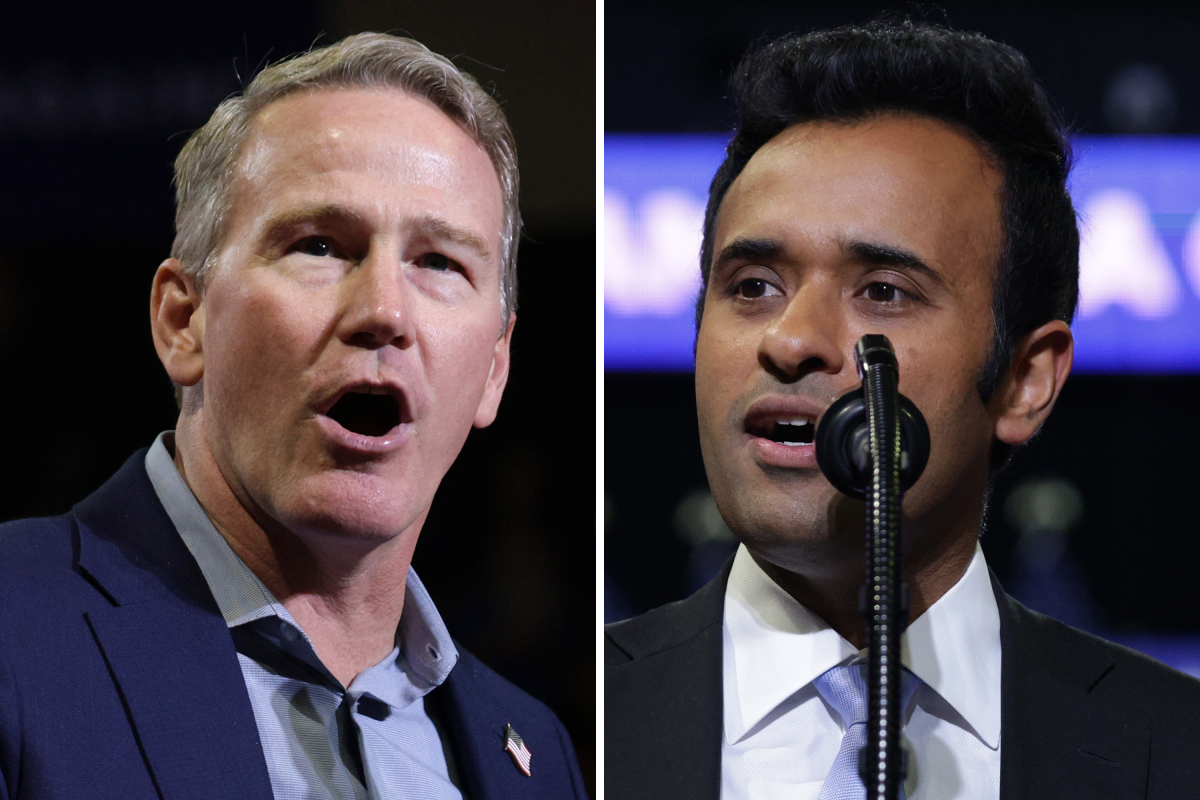
In the closing stretch of an election season that has already delivered plenty of drama, President Donald Trump made a familiar move: he seized on one favorable set of numbers and used it to declare victory before a single ballot had been cast. After holding a rally in Vandalia, Ohio, on October 3, Trump took to Truth Social to announce that Republican candidates Jon Husted and Vivek Ramaswamy were suddenly gaining ground in the Buckeye State. To prove it, he shared a chart that seemed to show Husted running two points above a generic Republican benchmark and Ramaswamy one point above the same line. “Look what happened in Ohio since my last rally,” the president wrote, adding the optimistic tagline, “It’s The Golden Age of America!” The message was clearly meant to generate momentum before another appearance at the Covelli Centre in Youngstown on October 12. But the chart he posted was not what it first appeared to be. There was no polling firm attached to it, no source cited, no methodology explained, and no direct comparison to the actual Democratic opponents Husted and Ramaswamy face. Instead of putting the Republican candidates head-to-head with Senator Sherrod Brown or Democratic gubernatorial nominee Amy Acton, the graphic measured them against a “generic ballot,” an abstract baseline that simply asks how a typical Republican would perform in a neutral race. That kind of benchmark can be useful for campaign strategists, but it is not the same thing as a real matchup. In effect, Trump was offering his supporters a heavily filtered version of reality, one crafted to look encouraging while leaving out the caveats that make the data meaningful. It was a textbook example of campaign communication in the modern era, where a single colorful chart can be used to shape a narrative regardless of what the full body of evidence suggests.
Look more closely at the actual polling landscape, and the picture becomes much more complicated. There is, to be fair, one recent survey that gives Republicans reason for hope. A co/efficient poll conducted from October 5 to October 6 among 925 likely voters found Ramaswamy leading Acton by a slim margin of 45 to 43 percent, while Husted was ahead of Brown by 44 to 43 percent. That sounds like exactly what Trump was describing. But the same poll carried a margin of sampling error of plus or minus 3.5 percentage points, which means both leads were comfortably within the range of statistical noise. In other words, those races were effectively tied, not firmly in Republican territory. The broader averages told a different and somewhat less dramatic story. At the time of writing, RealClearPolitics, which aggregates multiple polls, had Acton leading Ramaswamy by nearly four points, 48.1 percent to 44.3 percent, in the governor’s race. In the Senate contest, the same average had Brown ahead of Husted by just over three points, 47.4 percent to 44.3 percent. Even prediction markets, which use real money to weigh the likelihood of an outcome, were more cautious than Trump’s triumphant post. Polymarket gave Acton a 69 percent chance of winning the governorship, while Brown had a 62 percent chance in the Senate race. Kalshi, another prediction platform, offered similar odds, putting Acton at 68 percent and Brown at roughly 60-40. Despite all that, both RealClearPolitics and the Cook Political Report still rated both races as toss-ups, which is a reminder that averages and betting markets are not predictions, only probabilities. The difference between likely-voter polls, which try to measure who will actually show up on Election Day, and registered-voter polls, which cast a wider net, explains some of the contradictions. But the honest conclusion is that Ohio is genuinely close, and no single poll should be taken as gospel.
The governor’s race, in particular, has produced a dizzying collection of conflicting numbers. A CNN survey conducted from September 29 to October 5 among 760 likely voters showed Acton with a commanding 50 to 42 percent lead, a margin of eight points that would normally signal comfort for a Democrat. A New York Times and Siena College poll, based on interviews with 616 likely voters from September 22 to October 1, found a narrower but still notable Democratic advantage of 49 to 45 percent, with a margin of error of plus or minus 4.5 points. Marist, which reached 1,298 registered voters between September 24 and 27, put Acton ahead by six points, 50 to 44. YouGov, using an even larger sample of 3,777 likely voters, reported a 48 to 44 percent Acton lead, a four-point cushion that is consistent with several other surveys. But not every poll agreed. Big Data Poll, which questioned 680 likely voters from September 26 to 27, found Ramaswamy narrowly in front, 48 to 47 percent, once voters who initially said they were undecided were asked to lean one way or the other. That particular result had a margin of error of plus or minus four points, so it was hardly proof of a Republican surge. Still, it was enough to show that Ramaswamy is not without a path. What all of this means is that the race is less a clear trend and more a patchwork of highly variable results. Different polling firms use different methodologies, ask questions in different ways, and reach different slices of the electorate. Some surveys include independent voters heavily; others focus on party registration. Some measure only likely voters, while others include a broader universe. The result is a muddle, albeit a revealing one. Acton has a modest advantage in the averages, but Ramaswamy has repeatedly shown that he can compete in a changing environment. For voters trying to make sense of it all, the safest description is simply that the race is too close to call, and anyone who claims otherwise is probably looking at only part of the evidence.
The Senate contest is a little more consistent, though it remains competitive. Across five recent public polls, Brown led in every single one, but the margins varied widely. CNN had Brown ahead by six points, 49 to 43 percent, in the same likely-voter sample used for the governor’s test. The New York Times and Siena College poll gave Brown a 49 to 46 percent lead, a narrower three-point edge. Big Data Poll, again including leaners, found Brown on top by three points, 46 to 43 percent, among 678 likely voters. InsiderAdvantage, surveying 1,200 likely voters from September 28 to 29, produced an extremely tight 44 to 43 percent Brown lead, a result that essentially leaves the race resting on the margin of error. At the high end, Marist recorded Brown at 51 percent to Husted’s 43 percent, an eight-point spread that suggests the senator may have more breathing room than other polls indicate. None of these surveys put Husted in front, which is a meaningful difference from the governor’s race, where Ramaswamy can point to at least one poll with himself on top. But Husted is not far behind, and in a state as closely divided as Ohio, a few points can shift quickly. The stakes are national as well as local. Republicans currently hold a 53-to-47 majority in the Senate, and Democrats need a net gain of four seats to overcome Vice President JD Vance’s tie-breaking vote. If Brown wins, that goal remains difficult but not impossible. If Husted pulls off an upset, it would effectively close off one of the Democrats’ most promising pickup opportunities and complicate their path to the majority. This is why the heavy hitters are watching Ohio so closely, and why a rally in Vandalia can be followed by another in Youngstown within the space of a week. Every speech, every advertisement, every chart posted on social media is aimed at moving a small number of undecided voters in a state that may decide the direction of the entire country.
Away from the polling battles, the candidates are trying to connect with voters on issues that feel immediate and deeply personal. Amy Acton, the Democratic nominee for governor, has built her campaign around the idea that Ohioans are exhausted by economic pressure. During an interview on October 9, she said residents were “doing everything right” but had “no more breathing room,” a phrase that seems to sum up the frustration of families who work hard yet still struggle to cover their bills. She has framed her candidacy as a defense of public schools, libraries, and health care, and she has made small business owners a central part of her outreach. At Fox’s Bagel and Deli in Bexley, she bought a baker’s dozen and sat down with restaurant owners to hear about the rising costs they face. She promised to give small businesses “a voice” in state government and talked about startup loans and lowering health-insurance premiums. Ramaswamy, her Republican opponent, has also made affordability a centerpiece of his campaign, pledging to cut property taxes, reduce electricity bills, and make health care more accessible. His message was supposed to resonate with voters who feel the economy is working against them. In the Senate race, one issue has risen above the rest: the rapid expansion of massive data centers across Ohio, built to power the artificial intelligence revolution. Brown has taken a protective stance, warning that these facilities eat up farmland, consume water, and drive up energy prices for everyone else. He has seen the cranes and trucks on former agricultural land and worries that ordinary residents will end up paying the price. He promises to make data center operators cover the full cost of their enormous electricity demands rather than shifting that burden onto ratepayers. Husted, by contrast, sees data centers as an opportunity. He argues that they can bring private investment, skilled construction jobs, and new revenue for schools, provided companies pay for the infrastructure they use. “If you create the cost, you should pay the cost,” he has said, pointing to his Ratepayer Protection Act, which passed the House overwhelmingly but stalled in the Senate. The debate is about more than corporate tax breaks; it is about what kind of growth Ohio wants and who should bear its costs.
In the end, the larger story is one of uncertainty. Ohio has become a state where the old political rules no longer apply cleanly. It has drifted toward Republicans in recent presidential elections, but it has also repeatedly elected Democrats to statewide office, particularly Sherrod Brown. The current polls show a state that is genuinely divided, and the only real consensus is that the races are toss-ups. Trump’s chart may have been designed to project confidence, but the full range of evidence suggests a much more fragile picture. Even beyond the horse race, the campaigns themselves are wrestling with a new set of issues that previous generations did not have to confront. Newsweek’s AI Policy Scorecard, which rates lawmakers on a five-point scale from AI Skeptic to AI Booster based on their votes and public positions, gives Husted a “Mixed” rating of 3.2, reflecting his support for data centers and related energy policies. Brown is not rated because he is not currently in Congress, though his position on corporate accountability is clear enough. These are not just abstract debates; they are decisions about how Ohio will cope with technological change, energy demand, and economic disruption. The outcome of the election will determine whether the state embraces the new economy with open arms or puts up guardrails to protect residents from its potential downsides. And it will also determine the balance of power in Washington. Every rally, every poll, every social media post is ultimately an attempt to influence a relatively small group of undecided voters whose choice may resonate for years. The numbers will keep moving, the candidates will keep arguing, and the markets will keep adjusting, but the only numbers that truly count are the ones recorded at the ballot box. Until then, the only honest word for the state of the race is this: Ohio is up for grabs, and twelve months of confident predictions from either side will not change the fact that it will be decided by actual voters.