


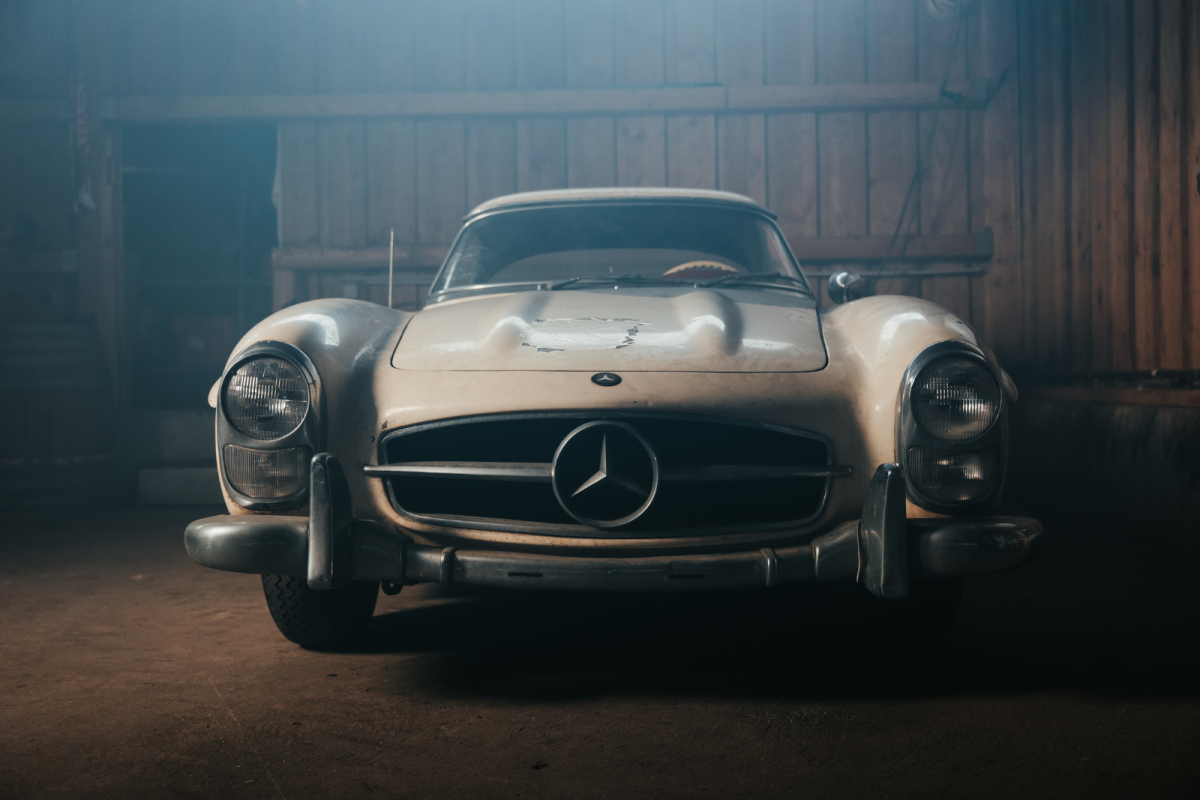
The car business has never been for the faint of heart. Every platform, every marketing campaign, every model-year change is a wager that the public will care enough to open its wallet. The used-car trade is an even sharper bet, because the inventory is finite and the customers are better informed. But the most delicate game of all is the one played by a company’s classic-car division. That is where memory meets money, and where a single rusty fender can be either a forgotten inconvenience or a fortune waiting to be unearthed. Many manufacturers treat their heritage like a museum piece: beautiful, occasionally useful, and ultimately a cost center. Mercedes-Benz decided long ago that the past was not just a story to tell—it was a business to run. In Fellbach, Germany, just outside Stuttgart, the company operates Mercedes-Benz Heritage, an entity that exists in partnership with the mothership and treats classic cars with the same discipline as any new-car division. Its CEO, Marcus Breitschwerdt, has little patience for the idea that heritage restoration cannot pay its way. People assume it is a money pit, he says, but that assumption is misleading. Strip away the romance, and the heritage business is simply the used-car business with a sharper focus. You have a workshop, you buy cars, you rebuild them, you sell them, you supply parts. The only difference is that this is the top segment of that market, the place where precision and passion must coexist. That worldview is the foundation of everything Mercedes-Benz Heritage does, and it explains why the company has spent millions on expansion rather than simply curating a collection. It sees itself not as a guardian of nostalgia, but as a profitable, sustainable operation at the pinnacle of automotive commerce. The fact that it is an old-car operation does not make it old-fashioned; it makes it savvier than most.
Of course, a business like that cannot live on passion alone. Mercedes-Benz pays Heritage an annual sum to act as the formal custodian of its factory fleet, a collection of more than 1,100 cars that stretches from the earliest motorized carriages to modern prototypes. That payment is a major piece of Heritage’s operating budget, but it is not the whole puzzle. The division also earns money from the Mercedes-Benz Museum, which draws hundreds of thousands of visitors a year, and from a busy parts operation that provides spares for decades of models. All of those streams flow into the same ledger, and while the mixture changes from year to year, the bottom line is healthy. Breitschwerdt is not shy about saying so: the calculation is mixed, but all in all, the business is profitable. That profitability matters in a way that many people outside the industry do not fully appreciate. A heritage division that depends on corporate charity is always one budget cycle away from extinction. A heritage division that earns its own keep becomes part of the company’s DNA. The parts business is especially important. When an owner of a 1970s SL walks into a Mercedes-Benz Classic workshop and asks for a hard-to-find part, the fact that the company still has that part—or can make it—is a reminder that the brand supports its products long after the warranty expires. That kind of loyalty cannot be bought with a single advertisement. It has to be earned, one order, one restoration, one relationship at a time. And because Heritage is profitable, it can reinvest in its own future. It can hire more skilled technicians, build more advanced facilities, and expand its network of verified partners around the globe. In other words, the money is not hoarded. It is put back into the very machinery that keeps history alive. That is the quiet engine behind every beautifully restored Mercedes-Benz you see at a car show, and it is why the company’s past is not fading into sepia memory but staying sharp, mechanical and tangible.
The most tangible evidence of that reinvestment is not in a glossy annual report. It is in the physical space that houses the workshop and storage area in Fellbach. Over the past several years, Mercedes-Benz Heritage has undergone a major renovation, expanding and modernizing roughly 18,000 square feet of workshop and storage space. The company says the project effectively doubled the amount of room available for its work. That extra space is not just for the Mercedes-Benz collection. It allows the team to service more customer cars, maintain the 1,100-vehicle factory fleet, and conduct restorations that are as faithful to the original as human skill can make them. The restoration process itself is a study in coexistence. Traditional techniques—hand-formed body panels, period-correct upholstery, original paint colors—sit alongside modern diagnostic tools and advanced measuring systems. There is no ideological purity about the approach. The question is simply what will do the best job while preserving the character of the car. Some tasks demand a craftsman with skill born of decades. Others need a computer and a 3D printer. The expansion was not only designed for the past; it was designed for the future. The current S-Class, with its digital displays and electrified powertrains, will eventually become a classic in its own right. Mercedes-Benz Heritage wants to be ready for that day. The facility’s infrastructure has already accounted for battery-electric vehicle service, meaning that a future classic EV can be safely handled, diagnosed and preserved using the same rigor as a 1960s Gullwing. That is a significant statement. It says that classic car restoration is not just an exercise in nostalgia. It is an ongoing commitment that will extend to the cars being built today. By the time someone declares a 2024 Mercedes an old beauty, this workshop will know exactly how to look after it. The building itself is a bridge between two eras, and both ends are firmly supported.
All this work behind the scenes has a public face, too. Mercedes-Benz Heritage has expanded its presence at the most important automotive events in the world. It is a regular fixture at the Mille Miglia, where vintage cars are driven through Italy in a living celebration of motorsport; at the Pebble Beach Concours d’Elegance, where the world’s rarest cars are displayed on manicured lawns in California; and at the Mercedes-Benz Studio in Beijing, where the company is building a new generation of enthusiasts in the world’s largest car market. The brand has also expanded its Classic Partner Network, adding Gargash Enterprises in the United Arab Emirates as an official partner, so that owners in that region have the same access to Mercedes-Benz expertise as those in Stuttgart. But the decision that truly made headlines was the decision to sell. Mercedes-Benz has gradually allowed certain crown jewels to leave its own vaults, not as a fire sale, but as a deliberate part of managing the collection and the brand. The results have been spectacular. In 2022, the 1955 Mercedes-Benz 300 SLR Uhlenhaut Coupé sold for $143 million at RM Sotheby’s, the highest price ever paid for a car at auction. A few years later, in 2025, the 1954 Mercedes-Benz W 196 R Stromlinienwagen brought $51.15 million, and the 1908 17.3-liter “Brooklands” Semmering Rennwagen added another $8.25 million to the tally. To those who follow the market, the numbers were eye-watering. But Ethan Gibson, the head of communications at RM Sotheby’s, prefers to look beyond the money. The Uhlenhaut Coupé, he points out, is one of two ever made. It is an engineering feat that had been safeguarded by Mercedes-Benz for nearly seven decades. Cars like these were never intended to be sold to private individuals. They were laboratories on wheels. Gibson uses an evocative comparison: imagine a Leonardo da Vinci painting that has stayed in a museum for generations, suddenly available for someone to own. That is the significance. These are not just expensive cars. They are pieces of a broader human story, the automotive equivalent of a masterpiece. For Mercedes-Benz, auctioning a car at that level is not a loss. It is a validation of the brand’s entire heritage—and an announcement to the world that the company is confident enough to let one of its treasures go, because it knows the story will continue.
That confidence is part of a much larger ecosystem. The classic-car division is not an isolated profit center. It feeds the whole company. A visitor who stands in the Mercedes-Benz Museum and sees the 300 SLR will inevitably look at the brand differently. A collector who watches a W196 cross the auction block will think more carefully about the engineering underneath a new model. A young enthusiast who follows the 140 Places Tour on social media may one day walk into a dealership and buy an electric Mercedes. None of those transactions shows up in Heritage’s own ledger, but they all matter. Breitschwerdt has described the heritage business as the top segment of the used-car market, and that phrase is precise. It is not a museum; it is a commercial force that happens to deal in history. The profit is, in a sense, the overlap in a Venn diagram where heritage, marketing and product development meet. The cars themselves are the public proof that Mercedes-Benz has a long and honest lineage. The company’s ability to restore, service and sell them is proof that the lineage is still alive. If a classic car is a branch of history, then Heritage is the gardener. It prunes, waters, and occasionally sells a prized specimen to keep the garden healthy. That may sound unromantic, but it is the reason the garden still exists. The reason these cars are so collectible is not just their rarity or beauty. It is the fact that they carry a story that people want to be part of. Mercedes-Benz understands that story, and it has built an entire business around making sure the story continues to be told, not in dusty archive rooms, but at car shows, on auction blocks, and on public roads. That is a much more robust way of preserving history than hiding it behind glass. It keeps the cars alive in the only way that matters: moving, breathing, and being adored.
Perhaps the clearest expression of that living history is the Mercedes-Benz 140 Places Tour, a global expedition that has covered more than 65,000 miles this year. The idea is wonderfully simple: take a fleet of vehicles to 140 cities that have meaning for Mercedes-Benz, and let people see them, hear them, and in some cases touch them. The fleet includes everything from the newest S-Class to a sympathetic replica of the 1896 Patent Motorwagen, the ancestor of all Mercedes-Benz cars. The tour is not a photo-op. The vehicles are driven, across highways and mountain passes, through deserts and city streets. It is a demonstration that a car is never truly old if it can still move, and that the values of engineering and elegance are timeless. The tour has connected the company’s past with its present in a way that no museum display could. It has also created personal memories for thousands of people who have seen the convoy roll through their hometowns. That is the human side of the classic car business, the side that is easy to overlook when reading about $100 million auction results. In the end, the reason Mercedes-Benz invests so heavily in Heritage is not because old cars are assets. It is because old cars are evidence. They are proof that a company can make something that outlives its own era. They are proof that progress does not have to mean abandoning beauty. They are proof that a car can be more than a machine—it can be a companion to a life, a marker of a moment, a piece of someone’s story. When Heritage restores a 1950s sedan, it is not just returning a vehicle to its original condition. It is preserving the possibility of that story for another generation. The tour wraps up this weekend in Stuttgart, at the Mercedes-Benz Museum, exactly where it should. It will end where the brand began, surrounded by the very cars that made the company’s reputation. But the journey will continue, as it always has. The classic car business is not about the past. It is about making sure that the past remains alive enough to shape the future.