


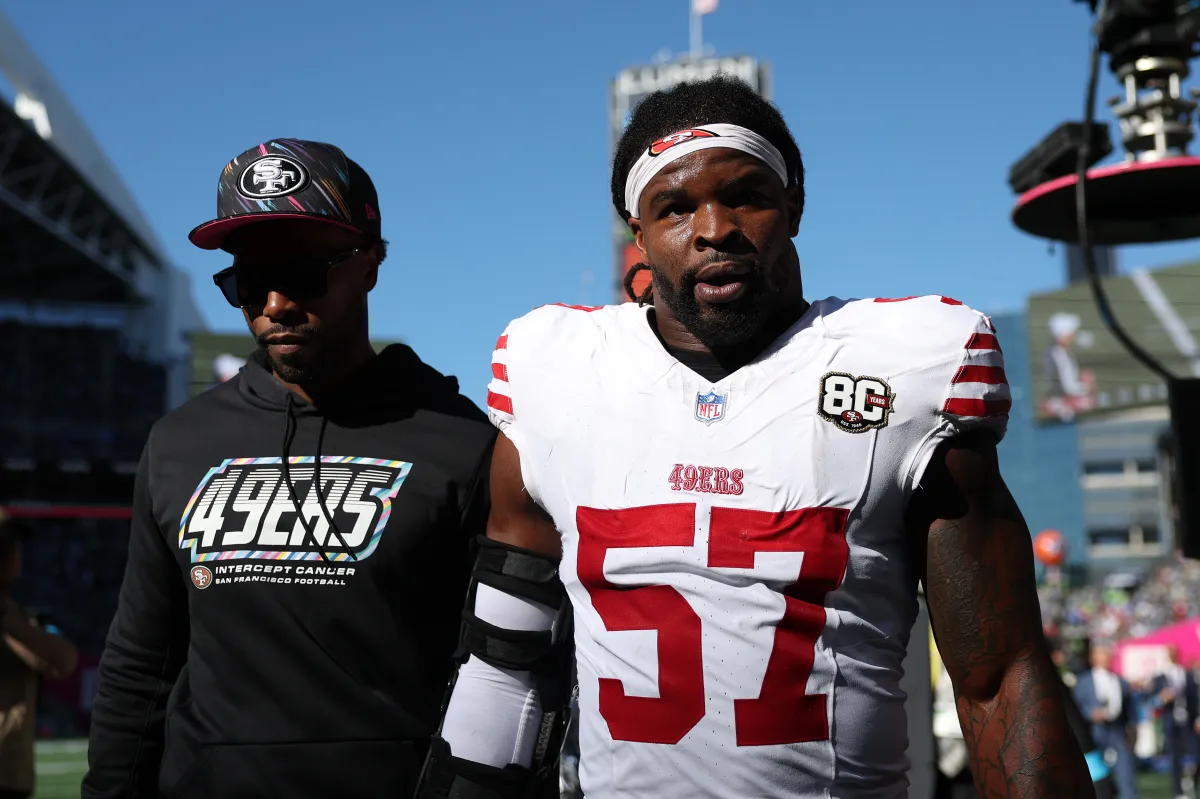
There was something about the way Dre Greenlaw came undone that felt almost inevitable, a pressure valve finally blowing in a season that has pushed the San Francisco 49ers to their absolute physical and emotional limits. For a moment on that frantic Sunday afternoon against the Seattle Seahawks, the fiery linebacker simply snapped. He had been in the middle of the chaos, tangled in the kind of violent, high-stakes football that defines this bitter NFC West rivalry, and when he headbutted Seahawks linebacker Ernest Jones — who was unprotected, his helmet already lost somewhere in the scrum — the act was less a calculated decision than a release of everything pent up inside him. The officials ejected him on the spot. The 49ers held on to win, 32–29, in a game that felt more like survival than style. But the real blow came later, when the NFL delivered its verdict: a one-game suspension that threatened to strip the team of one of its most vital emotional and physical pillars for the biggest stage imaginable, a prime-time Monday Night Football showdown against the Washington Commanders.
Greenlaw, now 29 years old, has never been the loudest voice in the locker room, but he has always been the loudest presence on the field. He is the kind of player who hits so hard the stadium feels it, who plays with a ferocity that borders on artistic expression, who makes the middle of the 49ers’ defense feel less like a zone and more like a boundary line that opposing runners simply refuse to cross without paying a price. He is also, by all accounts, a good man off the field, a teammate who will go to dinner with rookies and check on the families of practice players. Yet on that Sunday, he gave in to a moment of rage — the kind of lapse borne of exhaustion, frustration, and the mounting toll of a brutal season that has seen his team ravaged by injury, illness, and the weight of enormous expectations. When he learned of the suspension, he did what any competitor would do: he appealed. He wanted to tell his side of the story, to explain that the headbutt was incidental, borne of a tangle that left him disoriented and at a disadvantage. But the NFL was unmoved.
On Tuesday, the verdict came down with the finality of a hammer in a courtroom. Hearing officer James Thrash, jointly appointed by the NFL and the NFLPA, upheld the one-game suspension without even a faint nod to leniency. Senior VP of football and international communications Michael Signora made the announcement official on X, the words landing like a body slam on the spirits of 49ers fans everywhere. Greenlaw would not play on Monday night. He would not be in the tunnel with his teammates, leading the pack of adrenaline and fury. He would be at home somewhere, watching on television, helpless, a lion locked behind glass while his pride goes to war without him. For a player who has built his entire career on being there — on showing up, play after play, snap after snap — this forced inactivity is a kind of personal imprisonment. He will have to swallow the bitterness, apologize to his coaches, face his brothers in the locker room, and stand on the sideline in street clothes as a vindictive and undefeated Commanders team arrives in Santa Clara looking to make the 49ers’ season even more complicated.
And the sting of losing Greenlaw, who ranks second on the team with 37 tackles behind the legendary Fred Warner’s 50, is not just a statistic line that gets torn out of the ledger. It is a gut punch delivered at the worst possible moment, a cruel irony in a season that has already been defined by injuries and attrition. Frankly, it feels like the universe is testing the 49ers in ways that border on cruelty. San Francisco has eight players on injured reserve, a list that reads like a who’s-who of would-be contributors: defensive tackles Alfred Collins, Sam Okuayinonu, and CJ West; defensive ends Andrew Farmer II and Mikail Kamara; linebacker Nick Martin; cornerback Nate Hobbs; and safety Darrick Forrest. And that doesn’t even count the three other key contributors who are hobbled and out of action — edge-rusher Nick Bosa with his nagging injury, defensive tackle James Thompson Jr., and safety Marques Sigle. Each name represents a scholarship revoked, a game plan rewritten, a load shifted to someone else’s shoulders. The team doctors must feel like they’re working triage in a combat zone. And yet the show must go on.
The situation at linebacker has become so dire, so threadbare, that head coach Kyle Shanahan and defensive coordinator Nick Sorensen must be climbing out of their own skin trying to create a base alignment that doesn’t fall apart like wet paper. With fellow linebacker Garret Wallow also set to miss multiple games with a hamstring injury, the 49ers are down to just four active players at the position: Warner, the unassailable leader; Jaden Dugger, a young player still learning the professional game; Luke Gifford, a veteran grinder who will be called upon to play beyond his usual snaps; and Ogbo Okoronkwo, who is more of an edge-rusher than a true off-ball linebacker but will now have to do whatever he can to fill the void. It’s not a depth chart; it’s a skeleton crew, a patchwork unit being asked to stop a Commanders offense that features explosive playmakers at every level. The 49ers’ defense, which entered the season with such lofty ambitions of being a relentless, suffocating unit, is now a department store operating with a partial staff, one who has to play with duct tape, hope, and whatever juice Fred Warner can manufacture from sheer will.
But if you know anything about this organization, you know the response won’t be resignation. It will be defiance. The 49ers have built their entire cultural identity on resilience, next-man-up philosophy, and a stubborn refusal to feel sorry for themselves. The loss of Greenlaw, painful as it is, will not be the reason they lose if they lose; it will simply be another chapter in a season that is becoming a testament to endurance. And there is something deeply human about watching a team stripped down to its bones, forced to rely on the unheralded, the forgotten, the late-round draft picks and undrafted free agents who have been waiting for a chance to prove they belong. For Greenlaw, the suspension will be a painful lesson in emotional control, a reminder that even the most passionate competitor must find the line between fire and folly. When he returns, he will be hungry, perhaps more determined than ever. And on Monday night, when the lights come on over Levi’s Stadium and the world watches, the 49ers will play not just for the win, but for the absent brother, for the fallen teammates, for the aching faith that somewhere in the wreckage of a battered roster, a football team of extraordinary heart still stands. That’s the story worth telling, not just as a report of broken players and suspended souls, but as a reminder that the game continues, the season grinds onward, and the human heart, even bruised and suspended, always finds a way back to the field.