

1.
The black waters of the Black Sea off Bulgaria’s northern coast were supposed to be just another stretch of shipping lane. For the crew of the HS Dignity, a cargo vessel flying the flag of Guinea-Bissau, the night was routine: a long haul from Algeria, a scheduled arrival in Romania, and then home. It never came. Officials in Sofia said drones struck two cargo ships near the NATO member’s shoreline overnight, and one of them went down. The HS Dignity sank about 17 miles east of Krapets, a village close to Bulgaria’s border with Romania, in waters that have suddenly become a place where no one aboard a commercial vessel can feel safe. Six crew members were rescued, pulled from the cold and likely oil-darkened sea, but ten others are still missing. Their families are left in a terrible silence, waiting for news that may never come, imagining the worst and clinging to the smallest hope. Bulgaria has asked NATO for help in investigating what happened, because this was not a freak accident, not a storm, and not a mechanical failure. It was an attack. The sea, which has carried human trade and tragedy for centuries, has become a battleground again. The sailors on these ships are not soldiers; they carry grains, metals, and goods, not rifles or missiles. Yet they are the ones who wake to explosions, abandon ship in the dark, and sometimes do not make it to the lifeboats. The request to NATO is a recognition that no single country can police these waters alone, and that the danger is no longer someone else’s problem. It is washing up on Bulgaria’s coastline, and it has a human cost that cannot be counted in shipping losses alone.
2.
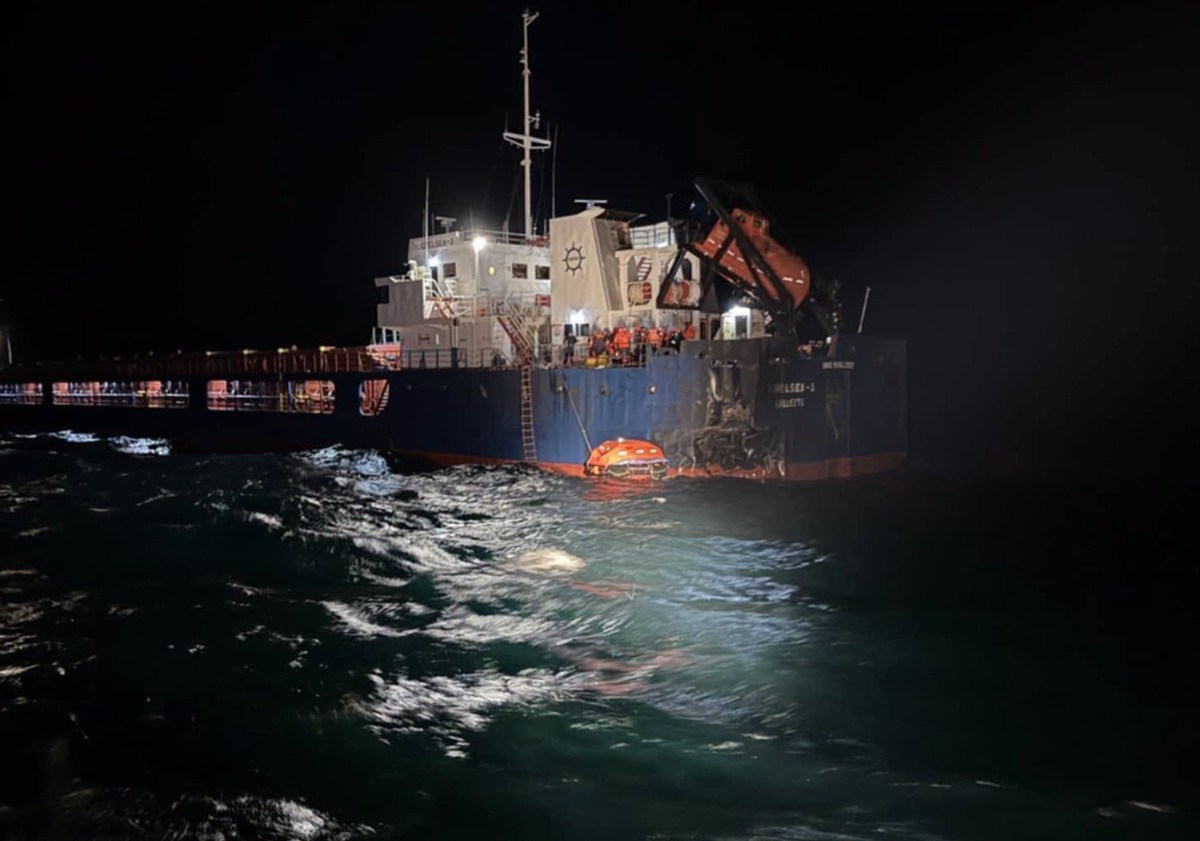
The second ship, the Maltese-flagged Chelsea-3, broadcast a distress signal at 1:30 in the morning, roughly 18 miles east of Byala, a seaside town south of Krapets. By the time authorities responded, the crew had already lived through what must have been terrifying minutes. According to Bulgarian lawmakers, the ship was owned by Ukraine and was carrying seven Ukrainian citizens and eight Azerbaijani nationals. They were not involved in any military mission; they were merchant mariners, moving from port to port, as they had done probably many times before. The Chelsea-3 had left the northeastern Turkish city of Giresun on Saturday, bound for Moldova’s Giurgiulești port, a route that took it along a coastline that has become a corridor of drone activity. Tracking data shows the HS Dignity had departed Algeria on October 5 and was supposed to arrive in Romania on Thursday. Neither voyage had anything to do with combat, yet both ships found themselves in the middle of a war that has spilled beyond any front line. All fourteen crew members of the Chelsea-3 were rescued, and five of them needed medical treatment. Bulgarian authorities in Sofia said three drones were found either on the deck or onboard the vessel. Imagine the moment of discovery: a broken machine, maybe still warm, sitting where sailors had walked and worked, a reminder of how close they came to joining their missing counterparts. The rescue crews who reached them must have felt a mixture of relief and dread, because there were others still out there. The sea does not give up its missing easily. For the Ukrainian and Azerbaijani families of the Chelsea-3, the news of rescue is a beginning, but for those connected to the HS Dignity, the waiting continues. Every hour that passes without word makes the silence harder to bear.
3.
This was not an isolated incident. It came roughly a week after two merchant ships were attacked by aerial and seaborne drones in Bulgaria’s exclusive economic zone, and one day after another drone attack sank a cargo vessel. The pattern is unmistakable: the Black Sea, once a vital artery for global food supplies, has become a hunting ground. Bulgarian Foreign Minister Velislava Petrova called the attacks wholly unacceptable, and her words carried the weight of a government that sees violence approaching its own shores. But the larger tragedy is that the people caught in these attacks are not pawns in a geopolitical game, at least not in any way they chose. They are workers, many from countries far from the war, who took jobs on ships to feed their families and build a future. They are the invisible labor force of globalization, the ones who make sure that wheat, corn, and grain reach markets where people depend on them. Now they must navigate through waters where a buzzing drone can appear out of the sky at any moment, and where a cargo hold full of grain can be mistaken for a military target. The repeated attacks near Bulgaria’s territorial waters send a clear signal to every shipmaster in the region: no vessel is safe. That message has ripple effects far beyond the immediate coastline. Insurance rates rise, shipping routes shift, and the cost of food increases in places that can least afford it. The human face of this crisis is not only the sailor on the deck, but also the mother in a distant country who cannot afford bread, and the port worker who loses his job when ships stop coming.
4.
The broader context is a war fought not only with missiles and tanks, but with grain. Russia and Ukraine have attacked one another’s agricultural sites and grain infrastructure, and both are major exporters whose harvests feed millions of people around the world. Experts say Russia increased its strikes on grain-carrying ships around Ukrainian ports throughout the summer, and most of Ukraine’s grain exports leave through ports in the southern Odesa region. That region, so vital to global food security, is now a frontline. Ukraine, meanwhile, has fought back in kind. In mid-August, it bombarded Russia’s Black Sea port city of Novorossiysk, forcing Russia to redirect its grain exports. Roughly forty percent of Russia’s grain exports pass through Novorossiysk, so even a single successful strike can send shockwaves through markets. Both countries regularly use drones, including sea drones, to carry out attacks, and the result is a maritime environment where commercial vessels are caught in a crossfire. No one needs to explain to a sailor what it means to hear an explosion below deck or to see a drone’s shadow on the water. The fear is physical, immediate, and unforgettable. For the wider world, the crisis is abstract until it appears in the price of bread or the empty shelves in a market. But for the people aboard these ships, it is a daily reality. They load grain in one port, only to be attacked on their way to another. They cannot go to war, and they cannot go home; they are locked into routes that have become deadly. The international community moves slowly, issuing statements and holding meetings, while the waters remain as dangerous as ever. Every delay in a response costs more than time; it costs lives.
5.
The official reactions to this latest attack reflect the tension of a geopolitical standoff. Ukrainian Foreign Minister Andrii Sybiha directly accused Russia of carrying out the strike, saying Moscow showed a deliberate disregard for civilian lives and maritime security. He called on partners to increase pressure on Russia, strengthen sanctions, and take decisive action to hold it accountable and protect freedom of navigation. His words were sharp, but they were also a plea from a country that has spent years urging the world to act. Bulgarian Prime Minister Rumen Radev did not explicitly blame Moscow, but he said the incident benefits the Russian Federation, a careful choice of words that signals suspicion without an accusation. He announced that he would summon the Russian ambassador to Sofia, a diplomatic move that shows Bulgaria is treating the matter seriously. The Russian envoy to Bulgaria, Eleonora Mitrofanova, said she had no information about Russian involvement. That denial, familiar to anyone who has followed the conflict, does little to reassure the families of the missing. Meanwhile, NATO chief Mark Rutte said he had spoken with Radev, indicating that the alliance is monitoring the situation closely. But monitoring and protecting are different things. While diplomats exchange statements and envoys are summoned, the sea continues to swallow evidence and no one has answered the most basic questions: who launched the drones, who gave the order, and what was the intended target? Behind the closed doors of government buildings, decisions are being made that will determine whether future attacks happen and whether the sailors now searching the horizon for help will find it. For the ten missing crew members of the HS Dignity, the diplomatic process is too slow. Their families do not need sanctions or statements; they need news, any news, about their loved ones. But in a conflict where even the truth is weaponized, they may wait a long time.
6.
In the meantime, Bulgaria is taking steps to defend its coast. Defense Minister Dimitar Stoyanov announced that the country will deploy two extra drone systems and additional missile systems to the Black Sea area, according to Bulgaria’s BTA national news agency. These are local measures, intended to protect Bulgarian waters and deter further attacks. But they are also a sign of how much the security landscape has changed. A NATO member state, once far from the front lines, is now reinforcing its coastline against drones launched from a conflict that began hundreds of miles away. NATO’s involvement, at Bulgaria’s request, may bring surveillance, intelligence, and shared resources, but it cannot bring back the missing or undo the trauma suffered by the rescued crews. The sailors who made it to shore will carry memories that no medal or compensation can erase. The five crew members who received medical treatment will heal physically, but the psychological wounds may last a lifetime. And for the families of the ten still missing, the pain has only just begun. They will wait by phones, watch news reports, and hope for a miracle. Some will wait for days, others for weeks, and a few may wait forever. The sea, as always, keeps its secrets. The attack on the HS Dignity and the Chelsea-3 is not just a geopolitical event or a news story; it is a human tragedy unfolding in real time. It is a reminder that war is not confined to battlefields, that the food we eat and the goods we buy travel through dangerous places, and that the people who deliver them are often the ones who pay the highest price. As Bulgaria asks NATO for help and as world leaders respond with careful statements, the sea remains cold, dark, and full of unanswered questions. The least that can be done for the missing and their families is to find out what happened, to hold those responsible accountable, and to make sure that no sailor has to die in the dark just to do their job.