


The New Orleans Saints are in the middle of a season that has quickly become painful to watch, and no one is trying to pretend otherwise anymore. After opening the year with a spark of hope, the team has tumbled to a 1-4 record, most recently falling to the Minnesota Vikings in Week 5 for their third straight loss. For a franchise that has long been the heartbeat of its city, this kind of start isn’t just a bad stretch of football—it’s a wound that fans feel deeply. There is something uniquely intimate about the bond between New Orleans and its Saints. Sundays are woven into the fabric of family life, of tailgates in the heat, of generations sharing the same jersey, the same rituals, the same belief that somehow, some way, this team will find a way to make them proud. And right now, that belief is being tested. The losses have piled up, the performances have looked disjointed, and the energy around the team has shifted from cautious optimism to weary frustration. People aren’t just upset that the Saints are losing; they’re upset because they know what this team has meant to this city, and they can see that the current product on the field is falling far short of that standard. There is a heaviness in the air, the kind that comes when a season that promised so much begins to slip away before October even ends. And into that atmosphere stepped Gayle Benson, not with excuses, not with spin, but with a direct acknowledgment that something has gone very wrong.
Gayle Benson has never been the type of owner to hide from her team’s struggles, but her recent public comments carried an emotional weight that felt different. Speaking at the Greater New Orleans QB Club luncheon on Tuesday, she addressed the state of the franchise with a bluntness that immediately grabbed the attention of the entire NFL world. “I want to address where we stand,” she said. “1-4, that is not acceptable to me. We have fallen short of what our fans truly deserve. I hear the frustration directed toward our team. It is not lost on me. Our fans invest their time and their hearts into the Saints. They are right to expect more than what we have delivered. As an owner, the responsibility does fall on me. I will not make excuses and I will not accept this level of performance as our standard.” These words were not a generic statement released through a public relations team. They were spoken directly, from one person to a room full of people who care about this organization, and they carried the unmistakable tone of someone who genuinely feels the pain of the fanbase. Benson has been through a lot with this city and this franchise, and she understands that the Saints are not just a business or a sports team—they are a source of pride, identity, and resilience for New Orleans. To see the team stumble so badly is not just a football problem for her; it is a personal disappointment. She made it clear that she isn’t interested in sugarcoating the situation or hiding behind the normal clichés of a struggling season. She took responsibility, and in doing so, she sent a message not only to the fans but to everyone inside the building: this level of performance will not be tolerated, and change has to come.
The biggest problem on the field, at least according to the numbers, has been the defense. The Saints are allowing 30.2 points per game, which ranks as the second-worst mark in the entire NFL. That number is staggering, especially for a franchise that has historically prided itself on defensive toughness and physicality. Watching this defense play has been a frustrating experience for fans because the issues are not subtle. Opponents are moving the ball with alarming ease, scoring in bunches, and turning what should be competitive games into lopsided affairs. There are moments when the defense looks completely out of sync, with missed tackles, blown coverages, and a general inability to get off the field on third down. The stat sheet tells a brutal story, but the eye test might be even worse. It’s one thing to be bad on paper; it’s another thing entirely to watch your team get carved up week after week, knowing that the opponent seems to score every time it gets close to the end zone. The players are clearly giving effort, but effort alone isn’t enough in this league. There are schematic issues, execution issues, and probably some fundamental issues with how this unit is being built and deployed. And when a defense is this porous, it puts enormous pressure on the offense to be perfect, which is the exact opposite of what has been happening. The Saints are not a team that can afford to be in shootouts right now, yet their defense is almost forcing them into those situations. Every missed assignment feels amplified, every big play allowed feels like a dagger, and the frustration on the sideline is becoming more and more visible. If the Saints are going to turn this season around, fixing the defense is not just a priority—it is the absolute first step. But as bad as the defense has been, it is only half of the story.
On the other side of the ball, the offense has been dealing with its own set of struggles, and together, the two have created a perfect storm of dysfunction. The Saints are averaging the fourth-fewest rushing yards per game in the league, which means they are consistently falling behind the chains and putting themselves in predictable passing situations. Without a reliable ground game, the offense becomes one-dimensional, and that makes life incredibly difficult for whoever is at quarterback and for the offensive line trying to protect him. Defenses know what’s coming, and they can tee off accordingly. But perhaps the most damning statistic of all is the turnovers. The Saints have turned the ball over more than almost any team in football, ranking second in that unfortunate category. Turnovers are killers in this league, and they are especially devastating for a team that is already struggling to find any rhythm. Every giveaway not only ends a potential scoring drive but also gives the opposition a short field and an immediate momentum boost. It’s a vicious cycle: the defense can’t get stops, the offense feels the pressure to score on every possession, they force things, they turn the ball over, the defense gets put in even worse positions, and the whole thing spirals. Watching the Saints offense has been like watching a team that is trying to do too much, too quickly, and ending up doing very little at all. Drives stall, promising moments fizzle, and the sideline looks increasingly deflated. There have been flashes of talent, certainly, but they have been too few and far between. The running game that was supposed to be a strength has been invisible, the passing attack has been inconsistent, and the turnovers have turned winnable games into frustrating losses. The offense and defense are feeding off each other’s failures, and until one side finds a way to break the cycle, this team is going to keep struggling.
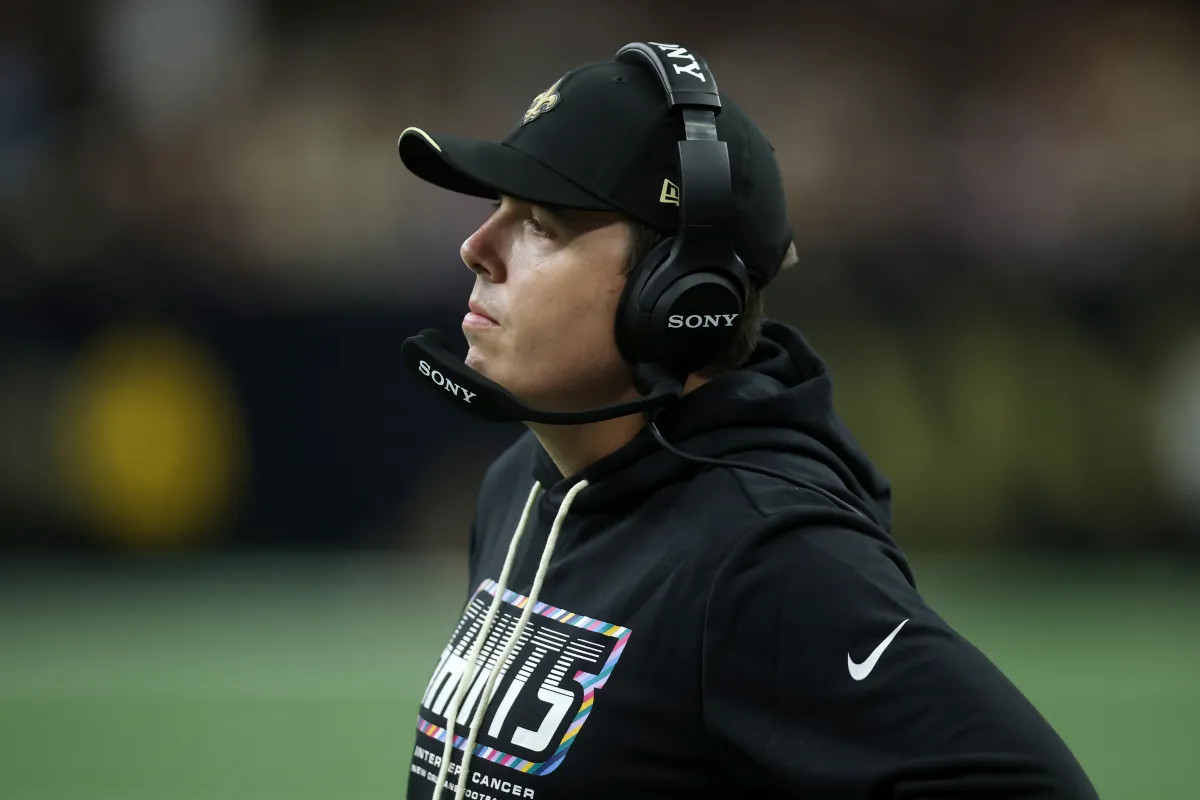
All of this puts first-year head coach Kellen Moore in an incredibly difficult position. Moore came to New Orleans with a reputation as an innovative offensive mind, but now he is being tested in ways that no one could have fully prepared him for. He has to find a way to fix the offense, support the defense, and manage the emotional toll that a 1-4 start takes on everyone in the building. There is no magic wand in the NFL, but there is also no time for patience. The fanbase is restless, the owner has spoken publicly and firmly, and the pressure is mounting with every passing week. Moore knows that the NFL is a results business, and the results so far have not been good enough. But there is still a glimmer of hope hiding in the schedule and in the standings. The Saints are in the NFC South, a division where no team has separated itself from the pack. Everyone is still within striking distance, and a few wins in a row could completely change the narrative. It sounds almost ridiculous to talk about playoff hopes for a 1-4 team, but in a division this wide open, nothing is completely off the table. The Saints have been through worse seasons, and they have always found a way to rally, partly because of the city they play for and partly because of the resilience that has been baked into the franchise’s DNA. But rallying requires action, not just talk. The words from Benson were clear, and now the team has to respond. They have an opportunity in Week 6 when they travel to New York to face the Giants, a winnable game that could stop the bleeding and give everyone a chance to breathe again. It won’t be easy, but nothing about this season has been easy so far.
In the end, Gayle Benson’s statement was more than just a frustrated owner venting about a bad start. It was a promise. A promise to the fans that their feelings are seen, their frustration is heard, and their loyalty is not being taken for granted. It was a reminder that the standard for the Saints is not just to compete, but to contend, and that being 1-4 is simply not acceptable. The season is not over, and there is still time to turn things around, but the clock is ticking. The players and coaches have to look inward, have to own their mistakes, and have to start playing with the kind of urgency that matches the passion of the people in the stands. The city of New Orleans has given everything to this team, through good times and bad, through championships and heartbreaks. They deserve a team that fights, that prepares, that takes pride in wearing the fleur-de-lis. Benson has drawn a line in the sand. Now it is up to Kellen Moore and his players to cross back over it, one game at a time. The road ahead is tough, but the path is not blocked. There is still a season to save, a division to chase, and a fanbase that is waiting, desperately, to believe again.