


In the picturesque, historic coastal city of Charleston, South Carolina, where the slow-paced Southern charm often masks the high-energy reality of modern family life, Karli Paradise-Sabecky coordinates a household that is as intellectually stimulating as it is domestically chaotic. As a highly qualified school psychologist, a dedicated stepmother navigating the complex dynamics of raising four older girls, the mother of a spirited toddler, and the founder of Full Bloom Family Consulting, LLC, Karli stands at a unique and often humorous intersection of academic child-development theory and raw, unfiltered parental reality. Through her professional practice, she spends her days advising other families on emotional regulation, behavioral interventions, and childhood milestones, giving her a deep, scientific understanding of why children behave the way they do. Yet, she is the first to tell you that all the clinical training, textbook case studies, and professional credentials in the world do not grant a parent immunity from the sheer, unadulterated chaos of a toddler’s bedtime meltdown. Recognizing the wide gap between the polished, idealized parenting advice often found online and the messy, unpredictable truth of daily life, Karli created her social media platform, @fullbloom.parenting. Through this rapidly growing digital community, she shares a refreshing blend of evidence-based support alongside the realistic, funny, and occasionally unhinged moments of her own parenting journey, actively dismantling the pressure-filled myth of the perfect parent and reminding her audience that understanding the psychology of chaos does not mean you can easily stop your own children from creating it in your own home.
This inescapable chaos is perhaps most acutely felt in the trenches of early childhood sleep deprivation, a physical and emotional trial that leaves even the most resilient parents feeling completely depleted. The profound toll of sleep loss is not just an individual struggle; it is a scientifically documented crisis that reshapes the landscape of early parenthood and impacts cognitive functioning, marital stability, and overall mental health. A landmark 2019 study published in the prestigious journal Sleep, which meticulously tracked more than 4,600 German parents over several years, revealed that sleep satisfaction and duration decline sharply after the birth of a child, reaching their absolute, most agonizing nadir during the first three months of life. Most sobering of all, researchers discovered that for first-time parents, overall sleep quality and duration do not fully return to their pre-pregnancy baselines for up to six long years after the birth of their firstborn child, with mothers bearing a significantly heavier and more prolonged burden of this exhaustion than fathers. In an effort to reclaim some semblance of physical health, mental clarity, and marital harmony, countless parents turn to the polarizing process of sleep training. This structured method aims to teach infants and young children to fall asleep independently and self-soothe when they inevitably wake during the night, but the journey to sleep independence is rarely a quiet one. It frequently involves enduring periods of intense crying as the child adjusts, a developmental hurdle that tests a parent’s resolve to its very limits and makes the late-night hours feel like a psychological endurance test for the entire household.
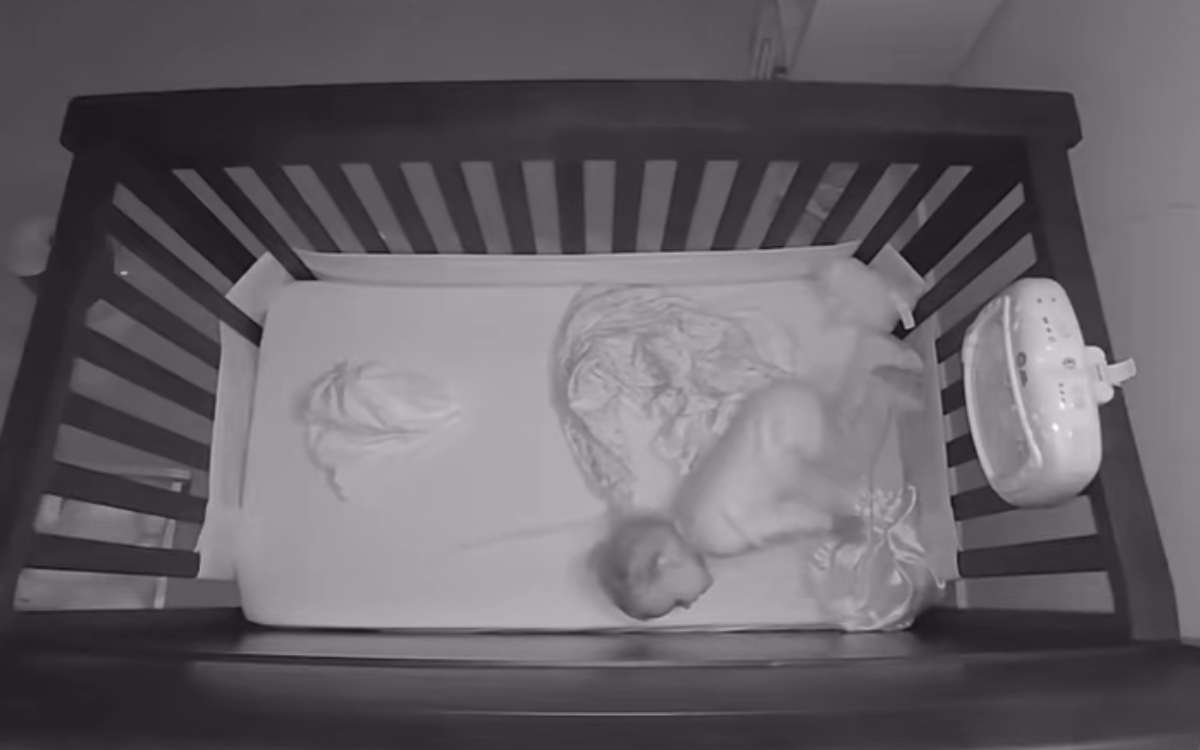
It was precisely within this crucible of exhaustion and determination that Karli found herself about a year ago, deeply embedded in the process of sleep-training her youngest daughter. On one particularly grueling night around 11:00 PM, when the rest of the neighborhood was quiet and the humid South Carolina air hung heavy outside, her highly verbal and expressive toddler began a passionate, high-volume protest from the confines of her crib. Downstairs, Karli and her husband sat in a state of near-catatonic fatigue, their brains completely drained from a long day of professional responsibilities and domestic management. At that late hour, the sophisticated principles of child psychology, behavioral science, and positive parenting were completely eclipsed by the primitive, universal longing for sleep, leaving the couple staring blankly at the glowing blue light of the baby monitor and wondering why their daughter was still screaming. Though the little girl eventually settled down and drifted off to sleep, the sheer intensity and strange cadence of her late-night outburst lingered in Karli’s mind. The following morning, driven by a mix of maternal curiosity and a professional habit of analyzing behavioral data, Karli decided to log into her baby monitor application to review the recorded video footage from the night before to see what had caused such a dramatic fuss. As she pressed play and adjusted the volume, she prepared herself for a typical toddler tantrum; instead, what crackled through the monitor’s speaker was a series of three incredibly distinct, loudly shouted words that left both Karli and her husband frozen in utter, speechless shock.
The audio quality of the baby monitor was clear enough to convey a shocking message that immediately sent the couple into a spiral of bewildered laughter and mild panic. To their utterly horrified ears, it sounded unmistakably as though their sweet, innocent toddler had looked directly toward the camera in the dark and screamed, “Hey, f*** you!” with an astonishing amount of conviction, attitude, and volume. They found themselves replaying the short clip on a continuous loop, eyes wide with disbelief, frantically trying to decipher where on earth their tiny daughter could have possibly picked up such a highly offensive, vulgar phrase. Swearing was strictly prohibited in their home, and their daughter spent her days at a gentle, wholesome Christian daycare, making the sudden appearance of a profane insult feel like a surreal, impossible glitch in reality. For several minutes, Karli and her husband analyzed the phonetic sounds of the toddler’s yells, looking at her body language on the screen as she stood in her crib. Finally, after closer listening and a bit of linguistic decoding, they realized that their daughter was actually uttering a far more innocent—yet phonetically identical—phrase: “Hey, back here!” She was not cursing out her exhausted parents; rather, she was passionately demanding their return to her room, repeating the phrase with even more urgency when she heard her father moving around downstairs.
While the discovery that their child was not actually cursing brought a massive wave of relief, the humor of the situation quickly transformed into a brand new, highly embarrassing parenting dilemma. Relieved and thoroughly amused by the misunderstanding, Karli and her husband had reacted with explosive laughter when they first cracked the code—a completely natural human reaction, but one that served as a powerful positive reinforcement for their highly observant toddler. Children are master observers of adult emotion, and seeing her parents find such joy in her words signaled to the little girl that she had just discovered a comedic goldmine. Eager to replicate that delightful reaction, she eagerly adopted “Hey, back here!” as her absolute favorite phrase, delivering it with the exact same aggressive, gravelly cadence that made it sound like an explicit, profane insult to anyone who didn’t know the backstory. The situation quickly escalated from a private family joke into a public relations nightmare, as the toddler began gleefully shouting her new favorite phrase in highly public spaces, including crowded Charleston grocery store aisles, quiet local parks, and even at her grandparents’ house. Karli found herself in the agonizingly funny position of having to frantically explain the wholesome translation to startled onlookers who genuinely believed they had just witnessed a tiny child aggressively swearing at her mother in public, proving that kids have an uncanny ability to turn private family jokes into public embarrassments.
Recognizing the brilliant, chaotic irony of the situation, Karli ultimately decided to share the baby monitor video with her online community, believing it to be the perfect antidote to the pressure-filled, highly curated world of social media parenting. By presenting her own vulnerable, unscripted, and downright hilarious struggles, she hopes to offer a sense of deep solidarity to parents everywhere who are quietly drowning in the daily challenges of raising children. Her message is a comforting reminder that even those with advanced degrees and professional consultancies do not have perfect, orderly households, and that child-development expertise does not prevent your child from screaming gibberish through a baby monitor at midnight. Parenting is an inherently messy, unpredictable, and beautiful journey that defies any attempt at perfect control, and sometimes the best coping mechanism we have is the ability to laugh at the absurdity of it all. Ultimately, Karli hopes the video brings a moment of joy and laughter to others, serving as a reminder to cherish the ordinary, ridiculous moments that make up family life. The events that feel the most stressful, embarrassing, or exhausting in the heat of the moment are almost always the very stories that, with the passage of time, soften into our absolute favorite and most treasured family memories.