






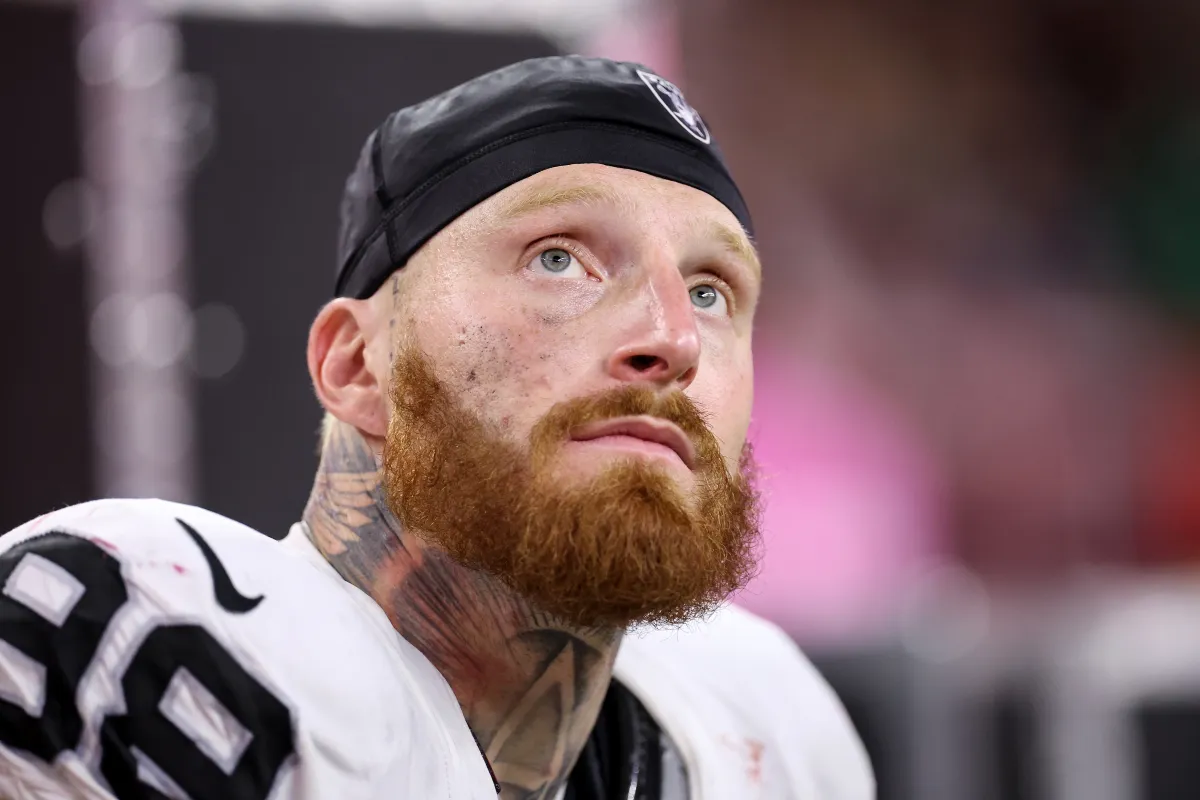
The air inside the Intermountain Health Performance Center was thick with anticipation on Wednesday afternoon as reporters gathered for the Las Vegas Raiders’ open OTA session. This was not just another routine offseason media availability; it was the moment everyone in the football world had been waiting for since early March, when one of the most shocking and chaotic trade sagas in recent NFL history quietly imploded behind closed doors. Standing before the microphone was Maxx Crosby, the All-Pro edge rusher who serves as the undisputed heartbeat, soul, and fierce identity of the Silver and Black. With his trademark intensity, extensive tapestry of tattoos, and a gaze that rarely wavers, Crosby looked every bit the franchise cornerstone the Raiders have built their entire defensive philosophy around. Yet, just a few months prior, he was mere hours away from packing his bags, leaving the desert behind, and wearing the purple and black of the Baltimore Ravens. The football public had spent weeks speculating, dissecting medical rumors, and questioning the integrity of the collapsed deal, but Crosby had remained relatively quiet, letting the noise swirl around him. On this day, however, the silence was shattered, and Crosby finally addressed the wild offseason whirlwind that almost redrew the map of his professional life, offering a masterclass in stoicism, resilience, and raw, unfiltered perspective.
To truly understand the gravity of what almost transpired, one must look back to the frantic days of early March when the NFL’s legal tampering window was preparing to open. On March 6, the Raiders and the Ravens shook the foundations of the league by agreeing on a blockbuster transaction that would have sent Crosby to Baltimore in exchange for a king’s ransom: a 2026 first-round draft pick and a 2027 first-round draft pick. For the Baltimore Ravens, an organization defined by its conservative, draft-and-develop ethos, this was an unprecedented leap into the stratosphere of aggressive player acquisition, representing the first time in their storied franchise history that they were willing to part with a future first-round selection to land an active player. The trade was agreed upon, but NFL rules dictated that it could not be officially processed or announced by the league office until the start of the new league year on March 11. During this agonizing, high-stakes limbo, the NFL apparatus operated under the assumption that the deal was a foregone conclusion, leaving fans in Las Vegas mourning the loss of their primary defensive weapon while Ravens fans salivated at the prospect of pairing Crosby with Lamar Jackson. For Crosby himself, the psychological weight of this transition must have been immense; NFL players are often discussed as mere commodities, numbers on a salary cap spreadsheet, but they are human beings with deep ties to their communities, families settled in their homes, and daily routines that bind them to their teams.
Then came the sudden, catastrophic collapse of the deal on March 10, a day that will live in NFL offseason infamy. Crosby traveled to Baltimore to undergo what was supposed to be a routine physical examination, the final administrative hurdle before the trade could be finalized. However, within the quiet confines of the Ravens’ medical facilities, team doctors flagged what they characterized as a “degenerative knee issue.” This was not a temporary setback or a standard wear-and-tear diagnosis; the phrase “degenerative” carried an ominous, career-threatening connotation that raised serious red flags, not necessarily about his availability for the upcoming 2026 season, but about his absolute long-term durability and playing future. By Tuesday night, the Raiders abruptly announced that the Ravens had officially “backed out” of the trade, leaving the sports world in a state of utter bewilderment. What followed was a deafening silence from the Ravens’ front office, which offered no public statement or explanation for why the historic deal fell apart so late in the process. Outside critics, Crosby’s camp, and key figures within the Raiders organization immediately began to question the narrative, pointing out that Baltimore already had access to Crosby’s extensive medical files, imaging, and doctors’ reports long before he boarded the plane. The suspicion lingers to this day that the medical concern may have been amplified to serve as an escape hatch for a front office experiencing sudden buyer’s remorse over relinquishing two precious first-round draft picks.
For many athletes, having their physiological integrity publicly questioned and being rejected on a national stage by a premier franchise would be a devastating emotional blow, but Maxx Crosby is not most athletes. When asked by reporters to dive into the details of the botched trade, Crosby held his head high, dismissed the drama as “water under the bridge,” and chose to look forward rather than backward. “I don’t really want to talk about that, to be honest,” Crosby said with a calm, measured demeanor that commanded the room. “It was a long time ago. A lot of things I learned about what’s going on, what this league can bring. A lot of adversity, a lot of different things, you can’t really anticipate a lot. But ultimately, I’ve been through a lot in my life. It’s nothing to me. It is what it is. I’m here. I want to be here. And I’m excited to be here.” This response is a profound reflection of Crosby’s unique life journey; he is a man who famously entered rehabilitation early in his professional career to conquer his battles with alcoholism and addiction, restructuring his entire life around accountability, mental toughness, and vulnerability. To a person who has stared down the barrel of personal ruin and emerged sober, healthy, and dominant on the other side, a failed corporate transaction in Maryland is simply a minor speed bump. Crosby’s wisdom lies in his ability to separate his worth as a human being from the cold, volatile business decisions of the National Football League, realizing that control is an illusion and that his only true power lies in how he responds to the hand he is dealt.
Yet, while Crosby has found personal peace with the situation, the competitor within him has used the entire ordeal as premium, high-octane fuel for his obsessive work ethic. Reports from close friends and associates around the league indicate that Crosby is “as fired up as ever,” possessing a massive, newly minted chip on his shoulder after the Ravens decided he was too damaged to invest in. Elite athletes possess a rare psychological ability to convert perceived disrespect, skepticism, and rejection into raw athletic motivation, and the Ravens’ decision to pass on him has given Crosby a tangible target for his fury. This motivation is particularly vital as he continues his recovery from a meniscus surgery he underwent in January, a procedure that already had him fighting to regain his peak physical form. Rather than letting the “degenerative” label depress or limit him, he has weaponized it, pouring his soul into a rigorous rehabilitation program designed to prove to the entire NFL landscape that his knee is not only sound, but capable of sustaining his relentless, high-motor style of play for another decade. The narrative that he is a declining asset has transformed his daily workouts into a mission of vengeance, ensuring that any franchise that doubted his durability will have to answer to him when the pads go on and the whistle blows.
As the Raiders transition into the heart of their offseason program, Crosby’s presence at the Intermountain Health Performance Center is a source of immense comfort and inspiration for a locker room undergoing significant changes under new defensive coordinator Rob Leonard. Crosby revealed that he is “really close” to making a full return to practice, already spending his mornings stretching alongside his teammates on the field and fully immersing himself in every film study, walkthrough, and team meeting, missing only the live, full-contact repetitions. There is a beautiful, poetic irony in the way this chaotic saga has resolved itself; the man who was nearly exiled to Baltimore remains the undisputed patriarch of the Raiders defense, standing tall in the Silver and Black where he has built his legacy. The bond between Crosby and the Raiders fan base, a community that mirrors his gritty, blue-collar, resilient attitude, has only been strengthened by this brief scare of separation. As the team looks toward the grueling season ahead, Crosby’s story serves as a powerful reminder that in the hyper-commercialized world of professional sports, where loyalty is rare and players are often treated as commodity assets, a player’s heart, character, and unyielding spirit still hold the ultimate power to define a franchise’s destiny.