



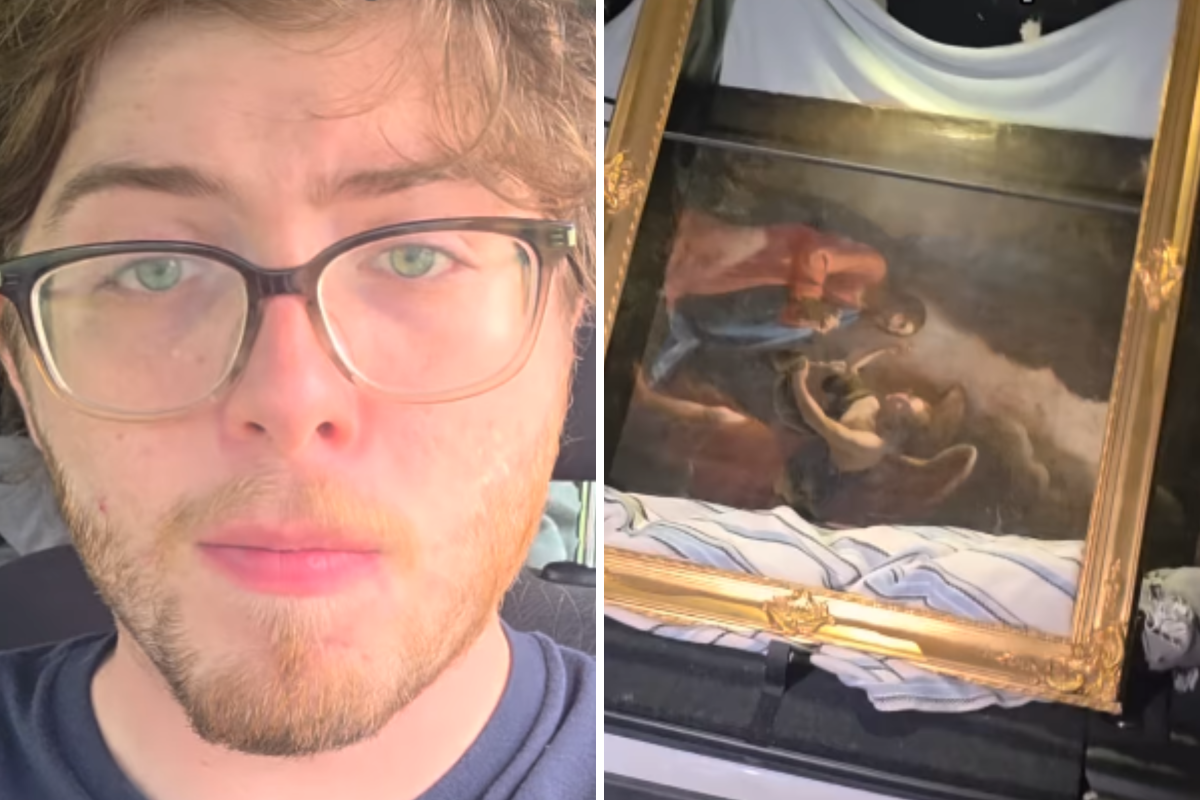
Mark Byram II didn’t set out to solve a centuries-old mystery. He was just doing what so many of us do late at night when sleep won’t come: scrolling through Facebook Marketplace, half-absorbed, thumb drifting past used furniture and vintage lamps. But then a listing stopped him cold. It was a painting, described simply as a seventeenth-century work, and something about it felt heavier than the usual online resale fare. The image was dark, moody, and undeniably old—not the kind of decorative antique one buys to fill a blank wall. It was a three-hour drive away, a fact that would have discouraged most casual buyers. But Mark, a 24-year-old with an appetite for adventure, wasn’t fazed. He reached out to the seller, a woman who turned out to be warm and gracious, and learned that she was downsizing. She didn’t just want to sell the painting; she wanted it to find a worthy home. That phrase stayed with him. It suggested the painting mattered to her, that it had presence and memory. So Mark got into his car and drove those three hours, probably not knowing that he was beginning a journey that would lead him into the quiet, strange, endlessly fascinating world of art attribution—and into the heart of a genuine cultural mystery.
When Mark finally saw the painting in person, he found himself looking at a scene both tender and sorrowful. It depicts Jesus, kneeling with his hands clasped in prayer, surrounded by soft clouds, while a winged angel hovers before him offering a chalice. This is the Agony in the Garden, a moment in Christian tradition when, after the Last Supper and before his arrest, Jesus prayed in anguish, knowing what was to come. The angel’s cup is often interpreted as a symbol of the suffering he must accept. It is a deeply emotional subject, one that has moved artists for centuries. Raphael painted it. El Greco painted it. Countless anonymous painters, too, returned to this scene again and again, each interpreting the same story through their own eyes and hands. Standing before his purchase, Mark could feel the weight of that tradition. The paint was cracked in places, the colors dimmed by age, but the emotion was still vivid. The sorrow in Jesus’ face, the gentle offering of the angel, the dreamlike clouds—it all pulled him in. He knew he had bought something that was more than just an old painting. It felt like a door left slightly ajar, inviting him to step through and discover what lay behind the surface. And the more he looked, the more he began to notice details that didn’t quite fit—details that suggested the canvas had secrets to tell.
It started with the physical structure of the piece. The canvas appeared to have been cut and then placed onto another canvas, a technique that can occur when an older work is damaged and later restored, or when a fragment of a larger composition is preserved by mounting it to a new support. Along the edges, Mark noticed handmade nails, not modern factory-made ones, but the kind of irregular, hand-forged nails that art restorers and historians associate with earlier centuries—possibly the eighteenth century. That tiny detail opened up a whole world of questions. If those nails were truly from the 1700s, it meant that someone, maybe two hundred years ago, had cared enough about this painting to repair it. Someone had touched it with their hands, made decisions about its survival, and sent it forward in time for Mark to wonder about. But the strangest clue came from the faces. A former art appraiser who examined the painting told Mark that both faces, and a larger part of the right side of the canvas, appeared to have been overpainted—and in a much lower quality than the rest. This was a crucial observation, because it meant that beneath the visible layer there might be an older, finer image, hidden by a less skilled hand at some unknown point in the painting’s long life. For Mark, this was both frustrating and exciting. The painting, as he put it, was “a total anomaly.” It didn’t neatly fit into one category. It contained too many contradictions, too many hints of a richer past than a simple old painting should have. He found himself playing detective, examining the surface, reading about old restoration techniques, and reaching out to anyone who might offer insight.
The experts Mark consulted so far have not agreed on a single answer, and that uncertainty has only deepened the intrigue. Some have suggested the painting was created in a workshop circle, possibly in seventeenth-century Italy. Others have thrown out Florence, Northern Italy, even Spain. Each new opinion added a different chapter to the story, and Mark welcomed them all, though he remained careful not to let his hopes run too far ahead of the evidence. One voice in particular helped give the mystery some definition. Reyne Hirsch, an appraiser and the owner of the Dallas Auction Gallery, told Newsweek that the painting might be more Spanish Baroque than Renaissance. She pointed to the dramatic lighting and soft brushwork, explaining that Renaissance paintings often have a daylight quality, with figures modeled by lighter shadows, while Spanish Baroque works tend to feature a single dramatic light source and figures brimming with emotion. In this painting, Christ’s face is tense with feeling, his body language quiet but charged with anguish—a far cry from the more restrained emotions typically found in earlier Renaissance art. Hirsch also reminded everyone that this particular scene is one of the most repeated compositions in Christian art, which means versions of it appear often at flea markets, estate sales, and even on Facebook Marketplace. She was sobering about the chances that Mark had discovered a long-lost masterwork, suggesting that it was more likely the work of a student or an artist working in the style of the period. But she also acknowledged that the painting could still be worth anywhere from a few hundred to possibly a low thousand dollars, and that a simple black light test could quickly reveal more about the perceived restoration. For Mark, those words were not a disappointment. They were simply part of the process, another thread in a story that was still unfolding.
Mark isn’t foolish enough to believe every painting is a lost da Vinci, but he’s also wise enough to know that not every mystery needs an old master’s name to be meaningful. In his own words, he’s keeping his expectations low, but he hasn’t stopped wanting to solve the puzzle. He’s hoping to have official technical analysis done—perhaps a proper appraisal, perhaps more advanced imaging that could illuminate what lies beneath the overpainted layers. He’s also opened the door to the public, inviting anyone with expertise to reach out to him through his Instagram page, @markbyram2, a gesture that shows his genuine desire to understand rather than simply profit. There is something deeply human about this part of the story. Mark’s adventure isn’t just about money or prestige. It’s about curiosity and connection. He talks about the painting’s educational potential, about how even if the painter was an apprentice whose name has been lost to history, the work is still fantastic and vivid, a worthy heirloom for future generations. That perspective is refreshing. In an age when so much value is measured by market price, Mark seems to understand that true worth often lies in meaning, in the stories we carry forward, and in the simple wonder of touching something that was made by human hands centuries ago. Still, he allows himself to dream a little. “If it’s a priceless masterwork,” he says with a smile, “I’ve always thought it would be fun to hit the museum circuit.” There’s a spark in that comment—not greed, but imagination, the same imagination that led him to drive three hours for a strange old painting in the first place.
In the end, Mark Byram II has stumbled into something larger than a potential art discovery. He has become a character in a timeless story about how ordinary people can find extraordinary things if they are willing to pay attention. The painting on his wall represents so much more than pigment and canvas. It is a physical link to an unknown artist who once mixed colors and moved a brush with intent. It is a memory keeper for the generations of people who owned it, who hung it in their homes, who noticed its odd details, who repaired it when it was broken. It is a conversation starter, a mystery, a piece of living history. And in a way, it doesn’t really matter whether it turns out to be a masterpiece or an apprentice’s study. What matters is the space it has created for wonder. Mark’s story reminds us that the world is still full of hidden things, that a glowing screen late at night can sometimes lead us out of our digital bubbles and into a real adventure. It reminds us that art—even anonymous art—has the power to speak across centuries, to move us, to invite us to ask questions, and to make us feel connected to the long chain of human hands that have shaped and reshaped our world. Though the painting may be old, cracked, overpainted, and uncertain in its origins, it is certainly not tired. Thanks to a young man who was willing to follow a hunch, it has found a new life, a new admirer, and a new chapter in its long and mysterious journey. And whether it ends up in a museum, a living room, or a researcher’s lab, it has already given Mark one invaluable thing: a story worth telling, and a reason to believe that history is never as far away as we think.