





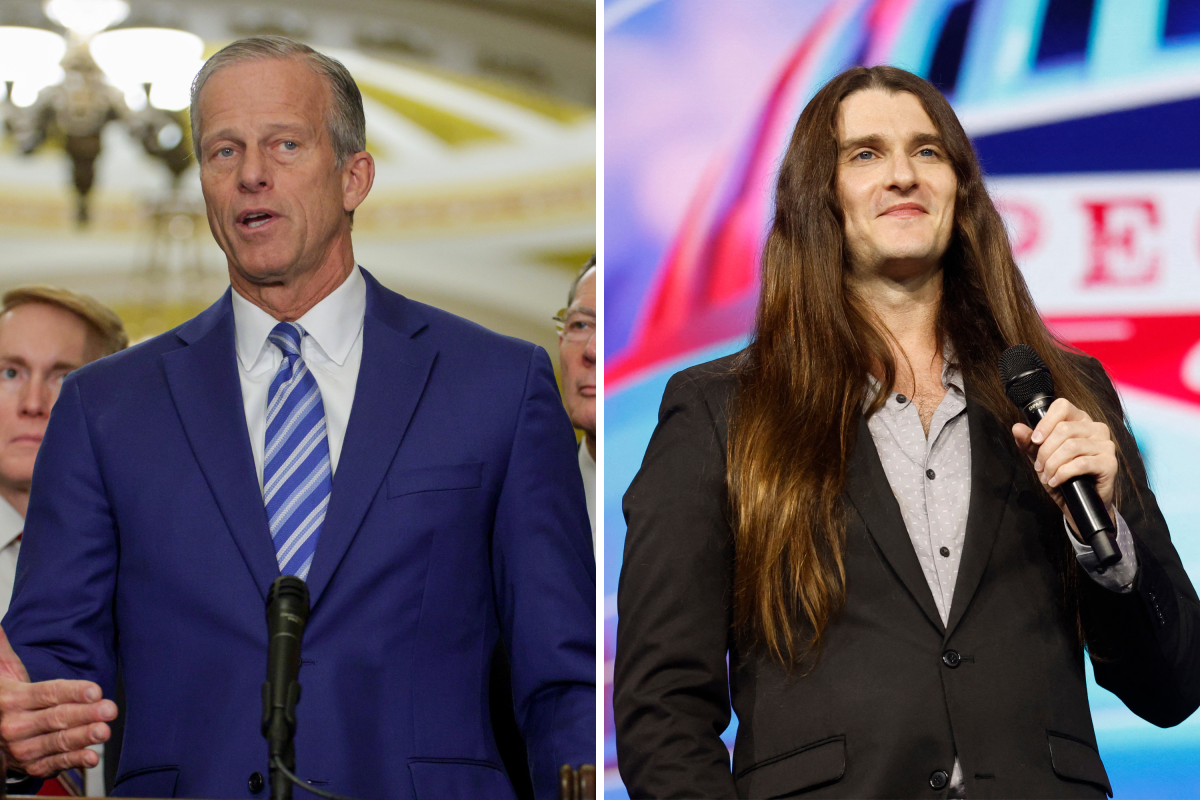
On a crisp Thursday evening in South Dakota, what was intended to be a routine, high-profile gathering of the state’s Republican elite transformed into a battleground of political betrayal, exposing the raw, simmering tensions that currently divide the modern conservative movement. Scott Presler, a ubiquitous and wildly popular grassroots conservative activist celebrated for his tireless, boots-on-the-ground voter registration drives, arrived at the South Dakota Republican Party dinner expecting to join fellow conservatives in hearing from political heavyweights, including the newly minted Senate Majority Leader John Thune and Oklahoma Senator Markwayne Mullin. Instead, Presler found himself unexpectedly barred at the threshold, turned away from the venue in a move that he quickly and publicly attributed to the direct orders of Senator Thune’s staff. Writing to his massive online following with a mixture of disbelief and wounded pride, Presler lamented the lock-out, sparking an immediate and ferocious digital firestorm that forced the highest echelons of Senate leadership to play defense. For an activist who has spent years traveling the country in service of the party’s rank-and-file, being excluded from a major Republican event felt less like a simple administrative oversight and more like a deliberate, symbolic slap in the face from the very establishment he has dedicated his life to influencing.
The fallout from the incident was instantaneous and merciless, unfolding across the digital colosseum of X, formerly known as Twitter, where the boundaries between political strategy and personal grievance are routinely blurred. Seeking to reclaim the narrative, Presler posted a pointed message directly blaming Thune’s inner circle for his exclusion, humorously noting that he thought he “looked mildly handsome” for the event while immediately pivoting to demand the passage of the SAVE America Act—a legislative high priority for the MAGA base that aims to mandate strict proof of citizenship for voting. The accusation did not sit well with Thune’s team, prompting a swift and unusually hostile public rebuttal from Ryan Wrasse, the incoming Senate Majority Leader’s communications director. Wrasse fired back with exceptional bluntness, characterizing Presler’s claims as a “categorical lie” designed to save face and deflect from what he described as an embarrassing situation of Presler’s own making. According to Wrasse, Senator Thune’s staff had absolutely nothing to do with who was allowed past the threshold, arguing that the senator’s office does not manage ticket checks or door entry for state-level party dinners. He sharply dismissed the activist’s narrative with a terse “Give me a break,” revealing the deep-seated irritation and lack of patience that establishment Republican staffers often harbor toward high-profile online influencers who possess the power to sway public opinion with a single post.
To truly understand why this doorway dispute ignited such a passionate response, one must look at the unique and symbolic role that Scott Presler plays within the contemporary Republican ecosystem. Unlike traditional political consultants who operate in air-conditioned boardrooms, Presler has built a near-mythic reputation among the MAGA faithful as a self-sacrificing, long-haired, relentlessly energetic crusader who spends his days registering voters in swing states, cleaning up trash in inner cities, and preaching the gospel of grassroots mobilization. His dedication to the Safeguard American Voter Eligibility (SAVE) Act has made him a champion for a policy that Donald Trump’s loyalists view as an existential necessity for ensuring future electoral integrity, but which has languished in the Senate due to a lack of bipartisan support. Because the bill has failed to progress under the leadership of traditional Senate Republicans, figures like Thune have increasingly become targets of intense scrutiny and frustration from the activist wing of the party. When Presler was turned away from the dinner, his followers did not see a routine ticketing mix-up; they saw a physical manifestation of a Washington elite locking out the very foot soldiers who do the hard, unglamorous work of winning elections, reinforcing a narrative of a party leadership out of touch with its most dedicated supporters.
Indeed, the confrontation highlights the tightrope that Senator John Thune must walk as he steps into the formidable shoes of his predecessor, Mitch McConnell. Taking over the Senate Republican conference is one of the most intellectually and politically demanding roles in American governance, requiring Thune to bridge the deep chasm between old-guard, chamber-oriented lawmakers and a highly reactive, populist base that demands absolute fealty to Donald Trump’s agenda. Thune, long regarded as a pragmatic and polished institutionalist, has frequently faced skepticism from hardline Trump supporters who view his past criticisms of the former president’s rhetoric and his cautious legislative approach with lingering suspicion. The South Dakota dinner was supposed to be a triumphant homecoming and a display of regional solidarity, but the public spat with Presler served as a stark reminder that the grassroots base is constantly watching, ready to interpret any perceived slide as an act of defiance against the populist revolution. By aggressively disputing Presler’s story, Thune’s team attempted to protect the senator’s domestic standing from being tarnished by accusations of elitism, yet the sheer hostility of the exchange only exposed how raw and easily agitated the relationship remains between the party’s governing class and its populist influencers.
Adding another layer of complexity to the evening’s dramatic events was the revelation that the lockout was not isolated to high-profile political activists, but extended to local journalistic institutions as well. The South Dakota Searchlight, a respected local news outlet, published an article revealing that their reporters had also been systematically blocked from entering the venue despite having completed their online registrations and receiving official confirmation emails granting them permission to attend. Upon their arrival, the journalists were abruptly turned away by state party staff who claimed they were experiencing “problems with other people who registered as media but weren’t from what the state party considers legitimate outlets.” This defensive posture by the event organizers, combined with Wrasse’s clarification that the dinner was intentionally closed to the press, paints a picture of a state Republican apparatus operating in a state of high anxiety, attempting to curate a controlled, insulated, and entirely predictable environment away from the unpredictable gaze of both independent press and rebellious grassroots influencers. In trying to build a fortress to keep out perceived disruptors, however, the organizers inadvertently created a public relations disaster that overshadowed the speeches of their honored guests and highlighted a growing hostility toward external scrutiny.
Ultimately, the petty squabble at the entrance of a South Dakota dinner serves as an instructive microcosm of the broader identity crisis gripping the modern Republican Party as it seeks to define its path forward. It illustrative of a profound, lingering disconnect: one faction of the party is focused on the institutional mechanics of power, senate decorum, and the logistical realities of governing in Washington, while the other is fueled by raw emotion, digital reach, and an unyielding demand for systemic, populist reform. When these two worlds collide—whether on the steps of a local convention hall or in the vitriolic comment sections of social media—the result is often a breakdown in communication that threatens the very unity needed to challenge political opponents. If the GOP hopes to successfully merge its legislative ambitions with its populist passion, its leaders must find a way to make activists like Presler feel valued rather than excluded, recognizing that the strength of the movement lies not just in the marble halls of the Senate, but in the muddy trenches of grassroots organizing. Until that mutual trust is established, every closed door will continue to be viewed as a conspiracy, and every administrative error will have the potential to explode into a civil war of words that leaves everyone involved looking a little less than handsome.