






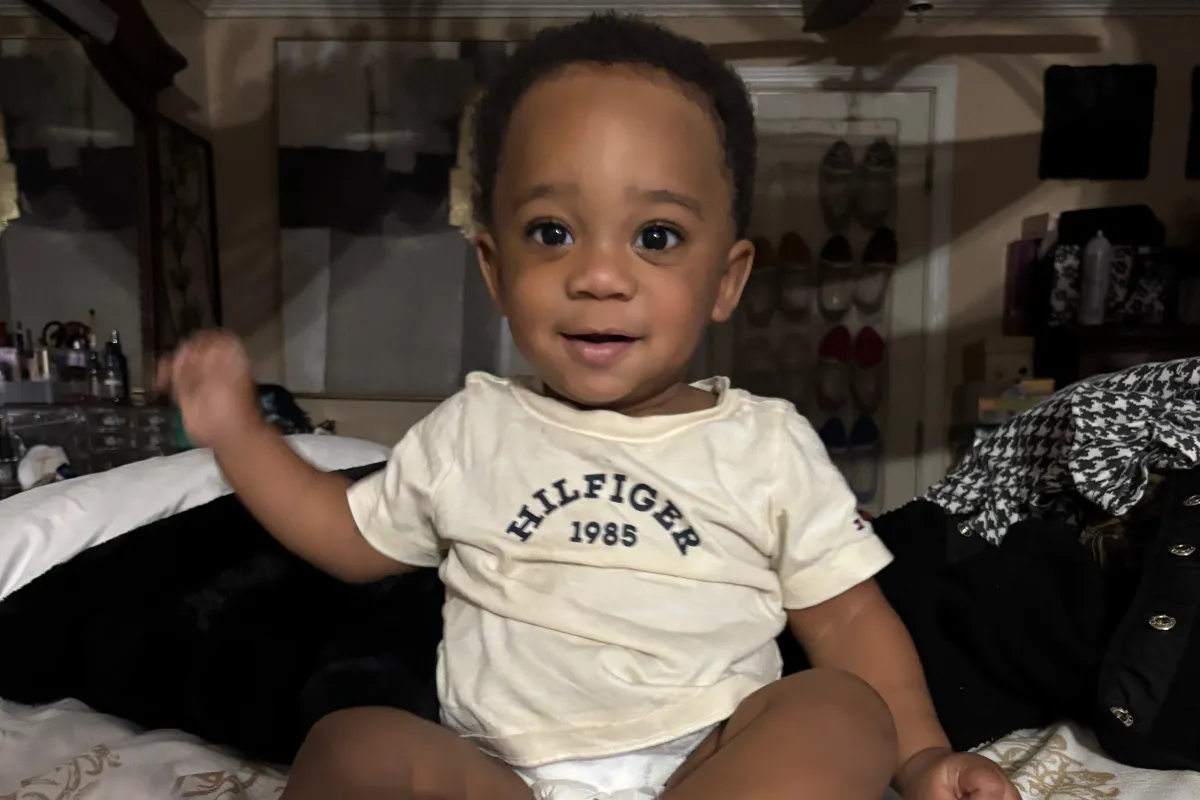
The humid Southern afternoon in Pope, Mississippi, was punctuated by a heartbreaking silence that only the loss of an innocent child could bring, as hundreds of mourners gathered to lay one-year-old Kohen Wiley to rest. On a Saturday filled with heavy hearts and damp eyes, the Hosanna Family Worship Center became a solemn sanctuary for a community shattered by an unspeakable tragedy. Outside, a pristine white horse-drawn carriage stood waiting, carrying a small, custom casket decorated with the vibrant, playful characters from the children’s television show Bluey—a painful, visceral reminder of the tender age of the boy inside, who should have been playing, laughing, and growing under the summer sun. Inside the chapel, the grief was palpable, hanging thick in the air as Kohen’s mother, Vellesiya Wiley, sat cradling a stuffed Bluey toy of her own, holding onto the physical fabric of her son’s favorite things as if it were a direct lifeline to the baby boy who had been ripped from her arms just two weeks prior. Inside the casket, nestled beside the peaceful child, was an identical plush toy, ensuring that Kohen would not be alone on his final journey. The stark contrast between the joyful, animated world of a toddler’s favorite cartoon and the solemn reality of a cemetery procession left a profound impact on everyone in attendance, visually representing a life that had barely begun before it was suddenly and violently snuffed out on a concrete parking lot. Family and friends took turns gazing at the small casket, weeping openly for an energetic toddler who had only spent a single year on this earth, yet had managed to imprint his light so deeply upon the lives of those who loved him. The physical weight of his absence was felt by everyone who watched the carriage depart.
The church, packed with nearly 300 mourners, was not just a place of mourning but also a focal point for a growing, righteous anger that demanded immediate answers and accountability for Kohen’s death. Civil rights attorney Van Turner, who is representing the devastated Wiley family during this grueling ordeal, took to the pulpit to transform the collective sorrow into a powerful mandate for justice, leading the congregation in impassioned, echoing chants of “justice for baby Kohen” that/which reverberated through the sanctuary walls. Turner’s words cut through the heavy atmosphere with razor-sharp clarity when he reminded the audience that no material item, no alleged infraction, and absolutely nothing inside a Walmart store could ever be more precious, valuable, or worthy of protection than the life of an innocent child. The funeral drew people from far beyond the local town of Pope, including dedicated members of the Black Lives Matter Birmingham Grassroots organization who had traveled across state lines to Mississippi to stand in solidarity with the grieving mother and her family. Their presence highlighted the national resonance of Kohen’s death, elevating it from a local tragedy to another painful chapter in the ongoing American dialogue regarding police violence and accountability. Even in the face of local administrative friction—such as the last-minute cancellation of a planned community candlelight vigil in nearby Sardis due to an unsubmitted city form—the resolve of the community remained unbroken, as local activists and the Building Bridges Coalition promised that no administrative oversight would quiet their voices or diminish their commitment to keeping Kohen’s memory alive in the public consciousness.
The tragedy that catalyzed this massive outpouring of grief unfolded on the warm afternoon of June 14, in a bustling Walmart parking lot in Senatobia, Mississippi, under circumstances that remain deeply contested and under intense scrutiny. According to the official narrative released by the Mississippi Department of Public Safety, the sequence of events began when local Senatobia police officers responded to a routine call regarding an alleged shoplifting incident at the retail store. Upon arriving at the scene, officers reportedly approached a vehicle parked in the lot, which was occupied by Kohen Wiley and two adults who were attempting to leave the premises. Authorities claim that as the officers closed in on the vehicle, the driver suddenly accelerated directly toward them, causing a life-threatening situation where an officer was nearly struck by the moving car. It was this rapid escalation, according to the official police statement, that prompted a responding officer to draw their weapon and fire multiple rounds into the vehicle in an attempt to neutralize the perceived threat and protect themselves from injury. One of those bullets pierced the car and struck one-year-old Kohen, inflicting catastrophic injuries that would ultimately prove fatal, transforming a minor shoplifting investigation into a horrific officer-involved shooting that ended the life of an innocent toddler. The officer who fired the lethal shot has since been placed on administrative leave while the state conducts an investigation, leaving a community to plunge into deep mourning while trying to make sense of how a routine trip to a neighborhood store could escalate into a scene of deadly police gunfire in broad daylight.
However, the official police version of that fateful afternoon stands in stark, heartbreaking contrast to the account offered by Kohen’s mother, Vellesiya Wiley, who was inside the vehicle and witnessed the horror firsthand. In her raw and emotionally devastating recount of the shooting, Vellesiya described a moment of sheer maternal instinct when she realized the danger they were in; she physically lifted her baby boy up toward the car window, desperately trying to show the approaching officers that there was an innocent, helpless child inside the vehicle. Furthermore, she vehemently disputed the police department’s claim that the vehicle was driving toward the officers, insisting instead that the car was actively reversing away from them when the officer opened fire, suggesting there was no imminent physical threat to the officers’ safety that could justify pulling a trigger. The family’s legal team, led by high-profile civil rights attorney Ben Crump, has strongly supported her version of events while flatly rejecting any allegations that anyone in the vehicle had stolen diapers or any other items from the Walmart. The attorneys have pointed out the grotesque irony of a child being killed over a suspected, minor retail dispute, demanding that law enforcement immediately release all available body-camera and surveillance footage to the public so that the truth can be laid bare. This deep divide between the sterile, defensive narrative of law enforcement and the agonizing, sensory-rich testimony of a mother who watched her baby get shot has fueled the community’s outrage, turning the quest for the truth into an urgent struggle against systemic narratives that often protect the actions of police officers.
As the Wiley family begins the painfully long process of grieving, they must also face the slow, bureaucratic gears of the justice system as they wait for answers from the Mississippi Bureau of Investigation. The state agency, which has officially taken over the investigation to ensure impartiality, has publicly prioritized Kohen’s case but has simultaneously cautioned the family and the public that thorough investigations of this nature require time and careful analysis. Spokesperson Bailey Martin stated that while the bureau typically aims to complete its investigations within a six-to-nine-month timeframe, they are treating this specific tragedy with the utmost urgency, acknowledging the immense public interest and the devastating nature of a child’s death. Once the bureau’s investigation is fully completed, their detailed findings and evidence will be turned over to the Mississippi Attorney General’s Office, which will then determine whether criminal charges will be filed against the unidentified officer currently on administrative leave. For the family and their attorneys, this prolonged timeline feels like an agonizing eternity, forcing them to live in a state of suspended grief without access to the critical body-camera footage that could confirm their account of the shooting. The refusal of authorities to immediately release the footage has only exacerbated the distrust between the community and law enforcement, as activists argue that transparency should be the first step in healing rather than a distant goal hidden behind months of procedural delays.
Ultimately, beyond the legal battles, the press conferences, and the systemic debates, the heart of this tragedy lies in the empty cradle of a one-year-old boy who will never take his first steps into preschool, never ride a bicycle, and never grow into the man he was destined to become. Kohen Wiley was a child who loved Bluey, whose laughter could fill a room, and whose brief presence brought immeasurable joy to a young mother who now faces the unimaginable task of rebuilding a life shattered by gunfire. The community of Pope, and indeed the entire state of Mississippi, has been left to contemplate the fragile value of human life and the devastating cost of split-second decisions made by those sworn to protect and serve. As the white horse-drawn carriage carried Kohen to his final resting place, the image of his small casket served as an enduring monument to innocence lost and a call to action that will not be easily silenced by time or bureaucratic delays. The promise made by the mourners, the activists, and the legal teams gathered on Saturday was simple yet profound: they will not allow Kohen’s name to be reduced to a mere statistic or a forgotten headline in a cycle of news, but will instead carry his memory forward as a catalyst for systemic change, accountability, and a future where no mother has to hold a stuffed toy in place of her child. In the quiet moments after the funeral service had ended, as the echoes of the chants faded into the Mississippi evening, the collective hope remained that truth would prevail, ensuring that baby Kohen’s short life will leave a legacy of justice that protects the most vulnerable among us for generations to come.