




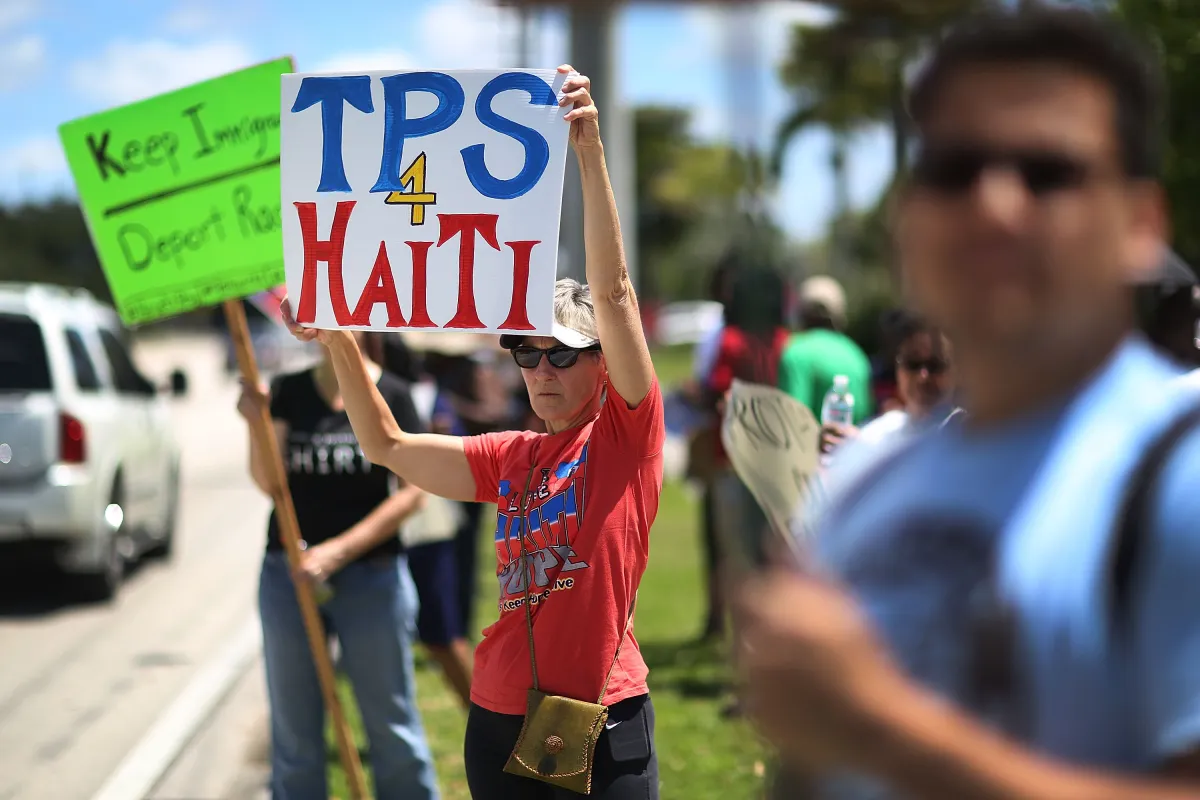
For hundreds of thousands of Haitian families living across the United States, the ultimate countdown is ticking toward a devastating Monday deadline. The scheduled expiration of Temporary Protected Status (TPS) threatens to instantly dismantle the lives of over 300,000 individuals who have spent years, and in some cases decades, building homes, raising children, and weaving themselves into the very fabric of American society. This looming policy shift is not merely a bureaucratic adjustment; it is a profound human crisis that strikes at the heart of communities from New England to the Midwest, with its heaviest weight falling squarely on Florida. Home to an estimated 158,000 Haitian TPS holders, the Sunshine State stands as the epicenter of a looming humanitarian emergency, followed closely by New York with approximately 40,000, Massachusetts with about 19,000, and significant populations in New Jersey with 16,000, Pennsylvania with 15,000, and Ohio with 14,000. For these families, the loss of TPS means the immediate forfeiture of their hard-earned work authorizations and the sudden, terrifying exposure to deportation proceedings. They are forced to confront the agonizing reality of either retreating into the exhausting shadows of undocumented life or being forcibly returned to a homeland many no longer recognize. This shift, set in motion after the Supreme Court sided with the Trump administration’s efforts to dismantle these safety nets, represents a jarring rupture in the American promise of sanctuary and stability. To understand the gravity of this moment is to look beyond the court filings and DHS declarations and see the mothers, fathers, healthcare workers, and students who must now look at their children and explain why the place they call home might soon reject them. It is a moment of collective dread, as communities brace themselves for the loss of neighbors who have become fundamental to the daily rhythm of American life, leaving them to wonder how a nation that once welcomed them could so abruptly pull the rug from beneath their feet.
The economic reality of this policy decision is as sprawling as it is devastating, revealing a truth that politicians often overlook: Haitian TPS holders are not dependents of the American system, but vital pillars supporting it. According to exhaustive data compiled by the immigrant advocacy group FWD.us, these individuals contribute an astronomical $5.9 billion annually to the United States economy, a financial influx accompanied by $805 million in federal and payroll taxes and $755 million in state and local taxes each year. In Florida alone, where approximately 93,000 TPS holders are active members of the workforce, their labor translates to a staggering $2.6 billion annual contribution to the state’s economic engine. These are the individuals staffing the frontline roles that keep society functioning: they are the compassionate aides feeding and washing our elderly in struggling long-term care facilities, the dedicated farmworkers harvesting crops under the brutal southern sun, the tireless warehouse operators managing logistics, and the security officers keeping public spaces safe. The loss of these workers will deal a crushing blow to industries already crippled by severe, systemic labor shortages. Florida’s healthcare sector, which caters to a rapidly aging population, is particularly vulnerable; losing experienced, bilingual care workers will inevitably translate to longer emergency room wait times, higher labor overheads for nursing homes, and ultimately, inflated medical bills passed down to everyday patients. In tourism-dependent regions like Miami-Dade and Broward counties—where the Miami metropolitan area alone benefits from $1.5 billion in annual economic output from Haitian TPS holders—the sudden departure of thousands of service and hospitality workers will ripple through local economies, driving up hotel rates, diminishing service quality, and decreasing local tax revenues that fund public schools and infrastructure. Beyond these massive numbers, the loss represents a profound erosion of localized wealth, as fewer paychecks mean reduced spending at neighborhood grocery stores, vacant rental apartments, and a chilling effect on the vibrant small businesses that define Haitian-American neighborhoods.
The tragedy of this forced migration is magnified exponentially by the terrifying conditions currently gripping Haiti, making the prospect of deportation seem less like a legal process and more like a human rights catastrophe. Today, Haiti is a nation under siege, dominated by heavily armed gangs that control vast swaths of the capital, Port-au-Prince, and surrounding territories, rendering daily life a desperate struggle for physical survival. The U.S. State Department itself maintains its highest travel warning for Haiti, explicitly advising American citizens to avoid travel there due to rampant kidnapping, murder, and civil unrest—an official acknowledgment of danger that stands in stark, hypocritical contrast to the administration’s eagerness to deport vulnerable people back to those very same streets. For a TPS holder who has lived peacefully in Ohio or New York for years, being sent back means entering a war zone without a safety net, where their American accent and perceived wealth make them prime targets for extortion and violence. Immigration and Customs Enforcement (ICE) is reportedly preparing aggressive enforcement operations, preparing to execute sweeps and coordinate deportations flights directly to Haiti, a move that immigrant rights advocates have condemned as a display of systemic cruelty. Moving these families from organized, high-functioning American suburbs to a state of near-anarchy is a terrifying prospect that has sent waves of panic through quiet neighborhoods, causing families to pull their children out of school, avoid public spaces, and prepare for the worst. The mental toll of this constant, vibrating anxiety is heavy, as parents lie awake wondering if a simple traffic stop on the way to work will result in their detention in a remote ICE facility, followed by a one-way flight to a country in ruins. This is the human cost of treating human beings as temporary commodities: when the political winds shift, their safety, their sanity, and their survival are treated as collateral damage in a broader ideological war.
Compounding this terror is the toxic political discourse that has increasingly sought to vilify and dehumanize the Haitian immigrant community, turning them into political scapegoats on the national stage. During the 2024 presidential campaign, President Donald Trump and his running mate, JD Vance, pushed baseless, widely debunked claims that Haitian migrants in Springfield, Ohio, were stealing and eating their neighbors’ household pets, a dangerous rhetorical gambit that local public officials repeatedly and desperately tried to clarify had absolutely no basis in reality. This weaponized misinformation did not just remain online; it translated into real-world fear, bringing bomb threats to local schools, harassment to Haitian-owned businesses, and a pervasive sense of vulnerability to a community that has historically been quiet, hardworking, and deeply religious. This demonization stands in sharp contrast to the actual legal reality of TPS recipients, who Aaron Reichlin-Melnick of the American Immigration Council points out are among the most thoroughly vetted and law-abiding immigrants in the country. To maintain their status, these individuals must undergo exhaustive federal background checks and submit biometric data every 18 months, paying significant fees each time to prove their continued eligibility for a program they entered legally in the vast majority of cases. Despite this history of compliance, the administration’s tone has remained unyieldingly punitive, as demonstrated by the blunt public statements of DHS General Counsel James Percival, who took to social media to declare “it’s closing time” and urged migrants to accept a meager $2,600 relocation stipend and a “free flight home” before the enforcement apparatus is fully unleashed. By framing a life-altering humanitarian crisis as a simple administrative eviction, officials have sought to strip the debate of its moral weight, ignoring the reality that you cannot easily dismantle the lives of families who have bought homes, established businesses, and contributed millions to their local communities over the course of more than a decade.
In the face of this administrative wall, advocates and supportive lawmakers have mounted desperate legislative battles on Capitol Hill to carve out a permanent pathway to legal status, though their efforts have repeatedly crashed against the rocks of congressional gridlock. The primary hope for a systemic cure has long been the American Dream and Promise Act, a piece of legislation designed to offer eligible TPS holders and certain Dreamers a clear, stable route to securing lawful permanent residency and, eventually, American citizenship. Recognizing the urgency of the crisis, a bipartisan coalition of lawmakers managed a rare legislative feat in the House, bypassing leadership roadblocks through a discharge petition to pass an extension of Haitian TPS by a 224-204 vote, capturing the support of ten Republicans who recognized the devastating impact the expiration would have on their home districts. Yet, despite this glimmer of bipartisan sanity, the bill ultimately languished and died in the Senate, leaving hundreds of thousands of people stranded in a legal purgatory. The frustration among advocates is palpable; they point out that the legislative branch’s failure to act has left the executive branch with unchecked authority to weaponize programs like TPS as political tools rather than the humanitarian lifelines they were designed to be. Representative Sylvia Garcia and other progressive lawmakers have tried to fuel momentum by launching discharge petitions to force floor votes on stalled immigration reform bills, but the hyper-polarized environment of modern Washington guarantees that these efforts remain uphill battles. For the families watching these legislative maneuvers from their living rooms, the political theater in Washington is not an abstract debate about policy—it is a high-stakes lottery where the prize is their right to stay with their children, and every stalled bill represents another door slamming shut on their future.
As the final hours tick away before the Monday deadline, the immediate future for the devices of the Haitian diaspora in the United States looks incredibly dark, defined by the shadow of impending ICE operations and the quiet resilience of a community refusing to break. Internal federal documents and agency whistleblowers have already revealed that ICE has quieted plans to escalate enforcement actions targeting Haitian migrants the moment protections lapse, with specific plans drafted to conduct targeted arrests in states like Ohio and immediately resume deportation flights. Although the Department of Homeland Security has attempted to frame these flights as targeting the “worst of the worst” criminal elements within the migrant population—pointing to a removal flight carrying over 100 people where individuals had convictions for serious offenses—the sheer scale of the planned enforcement indicates that thousands of law-abiding families, nursing assistants, and construction workers will inevitably be swept up in the dragnet. This looming crackdown forces us to look in the mirror as a society and answer difficult questions about who we are and what we value. It asks whether we can truly call ourselves a compassionate nation when we actively deport some of our most vetted, hardworking residents to a country ravaged by anarchy, simply because their temporary legal status has run its course. For the children of these TPS holders—many of whom are American citizens born on U.S. soil—the threat of family separation is no longer a distant nightmare but a looming reality that could arrive with a knock on the door next Tuesday morning. Yet, even in the face of this systemic cruelty, the spirit of the Haitian-American community remains unyielding, anchored by local churches, advocacy groups, and neighbors standing shoulder-to-shoulder to offer legal aid, sanctuary, and a defiant message of solidarity. The struggle for TPS is ultimately not just a legal battle over immigration statutes; it is a profound moral test of our nation’s soul, challenging us to decide whether we will choose the path of cold bureaucratic exclusion or remember the enduring human promise of safe harbor and dignity for all.