




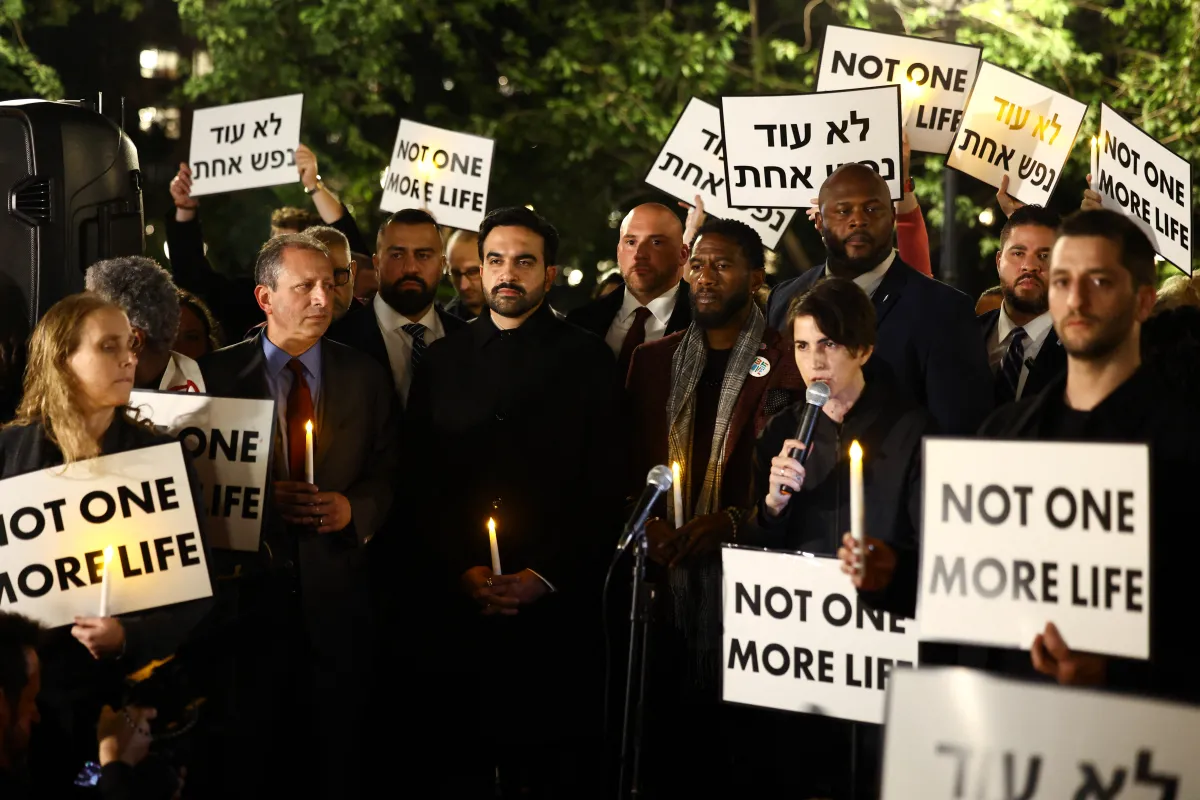
There was something almost surreal at the New York vigil marking the third anniversary of October 7. People gathered to remember the dead, the kidnapped, the brutalized, and in the middle of that sacred, sorrowful space, a crowd turned on the city’s mayor, Zohran Mamdani, and chanted: “Mamdani you can’t hide, we charge you with genocide.” The accusation hung in the air like a bad joke. It was impossible to miss the irony. This is a politician who has made a political career out of accusing Israel of genocide, who has embraced the language of the anti-Israel movement more eagerly than almost any other mainstream elected official in America. And now his own side was turning on him, spitting the same accusation in his face. You could call it poetic justice, but it was something deeper. It was a glimpse into the self-devouring logic of ideological extremism, a movement that punishes its own for not being extreme enough. Mamdani’s crime, it seemed, was not anything he had done to Palestinians. It was that he had paused, for one brief moment, to acknowledge that Jews had suffered an unspeakable atrocity on October 7, 2023. He had used the word “war crimes” to describe the Hamas massacre. He had remembered the more than 1,100 people murdered and 251 taken hostage. He had expressed sympathy for New Yorkers carrying that trauma. For some, even that was too much. A ceremony meant for grief became a theater of moral condemnation, with the mayor cast as the villain by people who had once considered him an ally. It was a chilling reminder that for a certain kind of activist, no concession is ever enough, no statement is ever pure enough, no gesture of human empathy is ever acceptable if it is aimed at Jews.
Mamdani’s statement on the anniversary was, on its surface, a carefully constructed political document. It began with the right words: “horrific war crimes” to describe Hamas’s murderous rampage, a nod to the victims, a word of compassion for those still carrying scars. But then, almost as if he could not help himself, the statement pivoted. It launched into a sweeping denunciation of Israel, accusing it of an “ongoing genocide,” invoking apartheid and occupation, condemning American complicity, and cataloguing Palestinian suffering in harrowing detail. By the time you reached the end, the initial acknowledgment had been swallowed by a much longer and more passionate indictment of the Jewish state. Even on the worst day for Jews since the Holocaust, Mamdani could not bring himself to let Jewish memory stand alone. He felt compelled to balance it, to contextualize it, to make sure that any expression of solidarity with Jewish victims was immediately paired with a rebuke of Israel. This is the trap that so many politicians have fallen into: the belief that Jewish suffering is not enough on its own, that it must always be weighed against other suffering, that mourning for murdered Israelis can be permitted only if it is accompanied by an acceptable political statement about Gaza. It is a strange moral accounting. Does anyone expect a statement mourning Palestinian children to begin with a denunciation of Hamas? Perhaps it should. But somehow, the burden of qualification always falls on Jewish victims. The mayor may have thought he was threading the needle, offering a pro-forma acknowledgment to Jews before getting to the real substance. Instead, he revealed something more troubling: an inability to recognize Jewish pain on its own terms. And because he could not do that, he satisfied no one. The activists who had cheered his rhetoric saw his brief words for Jews as a betrayal. The Jewish community saw the same words as too little, too late, wrapped in an assault on Israel. He ended up standing alone, buffeted from both sides, a politician who had tried to appease a movement that does not believe in appeasement.
And that is the deeper lesson of the bizarre scene at the vigil. The activists who turned on Mamdani are not anomalies; they are the logical endpoint of the culture he helped cultivate. For years, Mamdani and politicians like him have spoken the language of moral absolutes. They have described Israel as an apartheid state, accused it of genocide, framed the conflict as a Manichaean struggle between oppressed and oppressor. They have treated any criticism of Israel not as a policy disagreement but as a fundamental evil. In such a climate, the goalposts move. If Israel is genocidal, then anyone who recognizes Israeli victims is complicit with genocide. If the cause is sacred, then any deviation is apostasy. Revolutionary movements have always devoured their own children—the French Revolution, Stalin’s purges, the eternal spiral of accusation and counter-accusation. Mamdani has spent his entire political career trying to be pure enough, to prove that he is on the right side of history, to adopt the most strident language of the anti-Israel movement. And yet, on a night lit by memorial candles, he was branded a traitor by the very people he had tried to please. This is the logic of the purity test, and it is especially merciless on the woke left, where ideological orthodoxy is policed with quasi-religious fervor. The most devout are always looking for heresy in their ranks. What was acceptable yesterday is suspect today. What was praised last year is condemned now. This is how a mayor who has gone further than most elected officials in embracing anti-Israel rhetoric ends up being accused of genocide. The mob cannot be satisfied because satisfaction is not what it seeks. It seeks perpetual purification, endless escalation, and anyone who stops to acknowledge human suffering—especially Jewish suffering—becomes a target. We have seen this dynamic in other contexts, too. Public figures who try to give an inch to online outrage often find that the outrage simply devours the inch and demands more. Ask Ed Sheeran. Ask anyone who thought they could navigate the anger by giving it a little of what it wanted. The crowd was not negotiating. It was hunting.
This is not a New York problem. It is a global pathology, and it has infected some of the most powerful politicians in the Western world. Consider what happened in London on the anniversary of October 7. As British Jews gathered to remember the dead, the raped, the kidnapped, protesters took to the streets, marching through the city while the mourning was still under way. The Metropolitan Police explicitly asked them to hold off, just for this one day, to spare the Jewish community the sight of celebration and hatred on their darkest anniversary. The protesters refused. They marched anyway. And London’s mayor, Sadiq Khan, issued a statement on the anniversary that, like Mamdani’s, combined remembrance of Hamas’s victims with a lengthy discussion of Palestinian suffering. Khan is not a fringe figure. He is a major political leader, a man who speaks for one of the most important cities in the world. And he appears to believe that he cannot express unqualified sympathy for Israeli victims without first offering reassurances to the other side. That is not empathy; it is fear. It is the fear of activists who can ruin careers, who can fill comment sections with accusations, who can turn a statement of basic human decency into a scandal. These politicians have built their coalitions around activists and organizers who hold extreme views on Israel and Palestine. They depend on them for votes, for volunteers, for social media amplification. So when the anniversary comes, they cannot simply say, “What Hamas did was wrong, and I stand with the victims.” They must add, “But of course, Israel is also guilty, the occupation is also awful, the Palestinians are also suffering.” The result is a corrosively dishonest political culture in which the victims of terrorism are turned into props in a moral balancing act. Jewish grief is not allowed to exist on its own. It must always be met with a counter-argument, a sanitized context, a reminder that the other side has grievances too. This is not humanization. It is dehumanization dressed up as nuance. It tells Jews that their pain is not automatic, that it must be justified, that it is only valid when placed alongside the pain of their enemies. That is a terrible thing to do to any community, and it is especially damaging in a city like New York, which is home to the largest Jewish population outside Israel.
The wider consequences of this dynamic are even more alarming than the awkward position of a politician on a memorial day. When Western leaders adopt the rhetoric of the anti-Israel movement—when they talk about genocide and apartheid and resistance—they do not only shape opinion. They shape reality. They create a political climate in which terrorism is normalized as a response to oppression, in which the October 7 massacre can be excused as a symptom of something else, in which the murder of Jews becomes acceptable collateral damage in a righteous struggle. Hamas knows this. That is why it designs its attacks not primarily to defeat Israel on the battlefield, but to provoke reactions, to generate images, to win the narrative war in Western capitals. And too many politicians are playing exactly the game Hamas wants them to play. They may not support terrorism consciously. They would never say that Hamas was right. But by framing the conflict in Hamas’s terms, by treating Israeli self-defense as genocide, by making Jewish suffering contingent on Palestinian suffering, they are feeding the same monster that chanted at Mamdani. The mob that turned on the mayor is not a fringe anomaly. It is the logical product of a political culture that has lost its moral compass. It is the child of politicians who believed they could harness outrage without being consumed by it. This is especially reckless for a city like New York. The mayor has a particular responsibility to ensure that Jewish residents can mourn their dead, can light their candles, can hold their vigils without intimidation. Instead, the mayor’s own words have helped legitimize the hostility that makes Jewish life in public spaces feel precarious. He has used his platform to describe Israel in terms that are indistinguishable from the rhetoric of its enemies. He has helped create an atmosphere in which anger at Israel can slide, very easily, into anger at Jews. And now, in a cruel twist, he has felt the sting of that anger himself. The activists he courted have turned on him. The movement he amplified has expelled him. He stands there, blinking in the flashlight of cameras, hearing himself called a traitor, unable to understand how his carefully crafted positioning came to look like betrayal. He should understand. But it may take time. When you spend years trying to appease absolutists, you should not be surprised when they demand absolutism.
In the end, the lesson of this extraordinary episode is both simple and profound. Human beings cannot live by ideology alone. A movement that loses the ability to recognize the humanity of its perceived enemies will eventually lose the ability to recognize the humanity of its own members. A politician who defines himself by his enemies will eventually discover that his enemies are the only constants in his life—and that no amount of loyalty will protect him from their appetite. The protesters at the vigil were not there because Mamdani had betrayed the cause. They were there because the cause itself requires endless betrayal, endless purges, endless proof that no one is soft enough, no one is pure enough. And if the cost of that purity is trampling on the memory of the victims of the worst massacre of Jews since the Holocaust, so be it. That is what extremism does. It eats everything in its path, including its own heroes. Mamdani may now be asking himself how this happened. Perhaps he will blame the protesters, blame the media, blame the complexity of the moment. But he should really look in the mirror. He chose to play with fire. He adopted the language of genocide, apartheid, and occupation. He turned Jewish grief into a prelude to Palestinian accusation. He gave the mob the tools it needed to turn on him. And when the mob used those tools, he looked shocked. We all should take note. The answer is not to become more extreme, to find the perfect formulation that will appease the righteous, because no such formulation exists. The answer is to step back, to reclaim a basic, unadorned human decency. We can mourn Israeli victims without denying Palestinian suffering. We can criticize Israeli policies without labeling the Jewish state genocidal. We can support Palestinian rights without excusing Hamas. These are not contradictions. They are the foundations of any sane politics. Mamdani tried to straddle the abyss and fell in. We should not follow him. We should, instead, remember that the first obligation of any leader, any community, any movement is to acknowledge the simple humanity of all victims. On October 7, Jews were murdered, raped, and kidnapped. No qualification is required. No contextualization is necessary. That fact alone should be enough to merit compassion. And anyone who cannot grant it—even to an ally, even to a politician with a perfect record—has lost the thread of their own humanity. The mob that turned on Mamdani is a warning. It is not a reason to double down. It is a reason to find a way out of the madness, while there is still time.