


For fifty-three long, agonizing years, the city of New York lived in a perpetual state of basketball purgatory. Generational hopes rose and fell like the autumn tide, leaving behind a trail of heartbreak, near-misses, and the echoing ghosts of the legendary 1973 championship squad. For decades, older generations of fans passed down stories of Willis Reed and Walt Frazier like sacred folklore, while younger fans grew up knowing only the sting of disappointment, draft-lottery busts, and empty promises. Across all five boroughs, from the legendary blacktop courts of Rucker Park to the crowded sports bars in Queens, the feeling of waiting for a savior was a heavy, constant burden—a brilliant, overwhelming liberation from the weight of history that was desperately needed. But on a historic Saturday night in 2026, the collective sigh of relief and explosion of pure, unadulterated joy from millions of New York Knicks faithful was loud enough to rattle the concrete foundations of Penn Station and echo all the way down to the Battery. The Knicks did the unthinkable, defeating the San Antonio Spurs in a thrilling, highly physical five-game series to finally secure the coveted Larry O’Brien Championship Trophy. This was not merely a standard championship run; it was a masterclass in relentless momentum, grinding resolve, and historical dominance. The Knicks closed out their spectacular postseason by winning an astonishing fifteen of their final sixteen games, a blistering rampage that included a historically dominant thirteen-game winning streak that captured the imagination of the entire sporting world. Showcasing the absolute blue-collar grit and stubborn refusal to die that perfectly defines the massive city they represent, New York also became the first franchise since 1971 to win the NBA Finals after trailing by ten-plus points in every single game of the series. They simply refused to yield, proving to the basketball world that no deficit was too daunting, no obstacle too high, and no opponent too imposing to break their collective spirit. The long, seemingly endless winter of disappointment had finally given way to a glorious, golden spring in the basketball mecca.
At the absolute heart of this fairytale sports renaissance was Jalen Brunson, a man who has fully transcended the status of a mere professional athlete to become the undisputed, deeply beloved King of New York. Brunson’s journey to the absolute pinnacle of the basketball universe is the kind of heartwarming, grit-fueled cinematic legend that New Yorkers instantly fall in love with. He was a second-round draft choice once doubted at every turn—deemed by critics to be too small, too slow, and too limited to ever carry a major franchise to glory—who now stands tall as the undisputed NBA Finals MVP. Throughout this grueling, physically exhausting postseason campaign, Brunson cemented his name alongside the greatest playoff performers to ever lace up a pair of sneakers, showcasing a deadly mid-range game, a genius-level court intelligence, and a competitive heart that simply could not be measured by any scout’s radar. Yet, while Brunson was undoubtedly the head of the snake, this monumental championship was, above all else, a triumph of the ultimate team. Surrounded by a band of brothers who played with a ferocious, telepathic chemistry and an unyielding trust in one another, Brunson captained a roster that prioritized defense, absolute self-sacrifice, and an unrelenting, hard-nosed work ethic. This was a team built on the back of shared struggles, college connections, and a mutual understanding that no single individual was ever more important than the blue-and-orange jersey they wore. Together, they formed an unstoppable, highly synchronized collective force. They were a unit so tightly knit and fiercely determined that even the looming, terrifying physical presence of the Spurs’ 7-foot-4 Defensive Player of the Year, Victor Wembanyama, could do absolutely nothing to halt their date with destiny. No matter what tactical adjustments or strategic hurdles San Antonio threw their way, the Knicks met the challenge with sheer, unadulterated willpower and an iron-clad belief in each other.
The rich, dramatic narrative of the 2026 NBA Finals, however, cannot be fully appreciated without examining the fascinating, high-stakes rivalry that brewed between the world’s most passionate sports city and the towering French prodigy, Victor Wembanyama. Long before the opening tip-off of the Finals series, the seeds of genuine animosity had already been planted deep within the asphalt and concrete of Manhattan, waiting to sprout into a full-blown sports feud. The friction began in earnest back in December during the high-stakes NBA Cup chase, when the Knicks vanquished the Spurs in a high-intensity battle to claim that mid-season tournament crown. In the emotional aftermath of that early loss, Wembanyama raised eyebrows across the league with his poignant, somewhat condescending post-game comments regarding his preference for what he termed playing “ethical basketball”—a phrase that the hard-nosed, physically demanding Knicks and their intensely loyal fan base interpreted as a direct, snide slight to their gritty, uncompromising style of play. New Yorkers do not forget, and they certainly do not forgive insults thrown at their beloved franchise. To a fan base that prides itself on surviving the gritty, cold winters of the Northeast, the idea of “ethical” play sounded less like a sporting philosophy and more like a soft excuse for a team that simply couldn’t handle the heat of the kitchen. To the Madison Square Garden faithful, Wembanyama’s remarks were viewed as an arrogant, soft-spoken challenge to their very basketball identity and the proud, defensive-minded culture of their team. Over the subsequent months, the narrative of the towering, heavily hyped savior of the Spurs clashed violently with the gritty, punch-first underdog ethos of the Knicks. This tension turned every ensuing regular-season matchup into a deeply personal crusade, raising the emotional stakes for both the physical players battling on the hardwood and the raucous fans screaming from the upper decks. By the time the Finals arrived, the rivalry had matured into a beautiful, toxic storm, ensuring that a collision course in June would be nothing short of explosive.
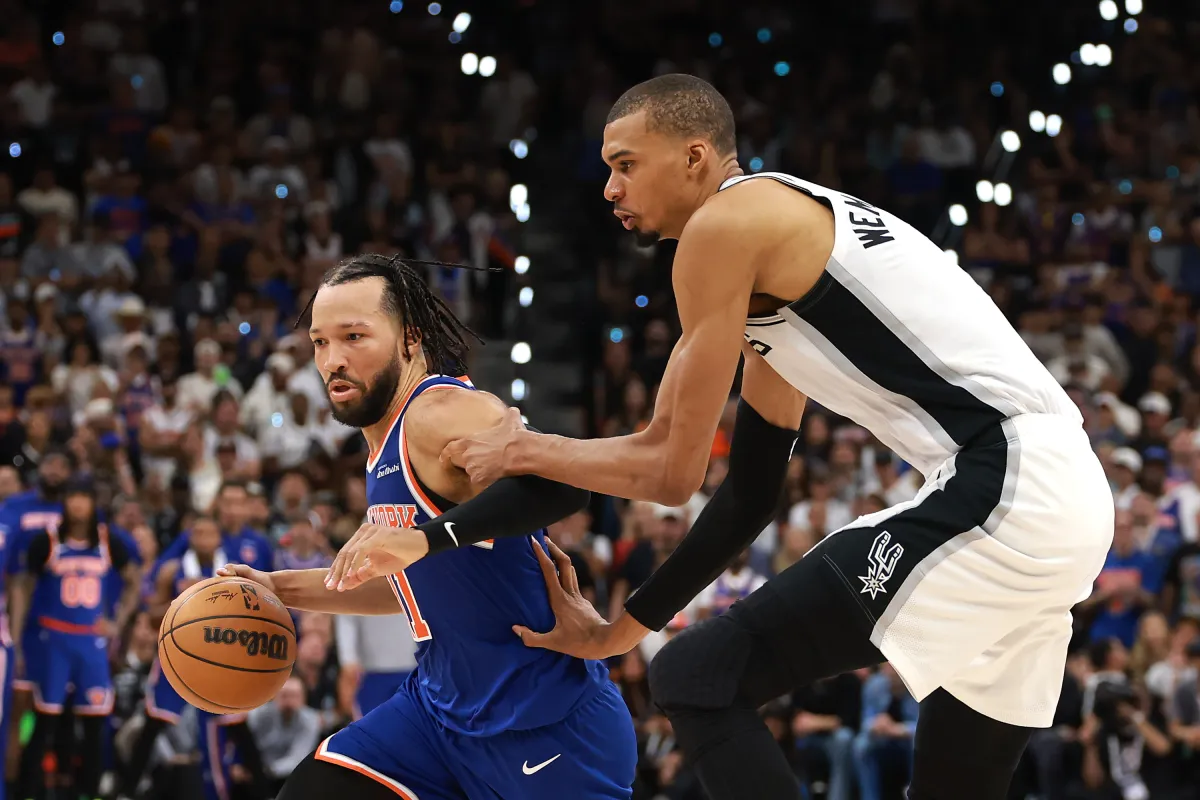
The simmering tension between the two sides reached its absolute boiling point during Game 3 in San Antonio, the lone contest that the Spurs managed to steal in the otherwise dominant five-game series. Wembanyama was spectacular that evening, putting up a staggering and historically dominant stat line of thirty-two points, eight rebounds, six assists, three blocks, and two steals, demonstrating exactly why the global basketball community regards him as a once-in-a-generation talent. Yet, it was a moment of raw physical frustration, rather than his sublime skill on the court, that permanently sealed his fate in the eyes of New York sports history. During a chaotic, high-energy sequence in the first quarter, a frustrated Wembanyama forcefully shoved Jalen Brunson in the back of the head—a dangerous, highly unsportsmanlike act that inexplicably went completely uncalled by the referees on the floor, and was later surprisingly dismissed by the league office for retroactive disciplinary action. Brunson, ever the warrior, merely shook off the blow, adjusted his headband, and kept playing, but the MSG crowd would not let the offense slide, morphing their collective anger into a thunderous weapon. When the series returned to the hallowed, hostile grounds of Madison Square Garden, the historic arena transformed into a deafening coliseum of collective retribution. A relentless, thunderous cascade of profane, heavily synchronized chants echoed from the famous blue seats all the way to the rafters, letting Wembanyama know exactly where he stood with the unforgiving Garden faithful. Asked post-game if he accepted his new mantle as New York’s newest, most hated sports villain, Wembanyama offered a smirking, diplomatic reply, comparing his status to Atlanta Hawks star Trae Young by suggesting he was nowhere near that level yet. But the young superstar was sorely mistaken; New York’s disdain for him runs far deeper, fueled by a potent mix of respect for his undeniable game and absolute fury at his physical cheap shots and perceived arrogance.
That intense, deeply personal rivalry didn’t magically dissolve when the final buzzer sounded on Saturday night; instead, it spilled over into the unvarnished, ecstatic celebrations of the newly crowned champions. In the fast-paced age of social media, the private, champagne-soaked moments of athletic triumph rarely stay secret for long, and a video quickly began circulating of the Knicks’ exclusive private team aftermarket party on Sunday night. In the shaky phone footage, a figure widely believed to be the legendary Finals MVP himself, Jalen Brunson, stands with his back to the camera, raising a glass of expensive champagne to offer a passionate, expletive-laden toast that sent a shockwave of absolute delight through the victorious fan base: “[Expletive] Wemby!” While the tricky camera angle technically leaves a tiny, microscopic portion of doubt as to the speaker’s exact identity, the surrounding crowd of ecstatic teammates and close friends instantly erupted in euphoric, loud agreement, gleefully repeating the colorful chant in a raw, unfiltered display of authentic human emotion. It was a wonderfully humanizing moment that stripped away the carefully curated public relations guards and sterile, boring corporate personas of modern professional sports, revealing the genuine, red-hot competitive fire that burns within these elite athletes. In that single, unfiltered moment, the champion Knicks showed that beneath the million-dollar contracts and the bright lights of the media, they were still just a group of passionate kids from the neighborhood, fiercely defending their own. This wasn’t just a clinical, tactical victory over a western conference rival team; it was a deeply personal, emotionally charged conquest of a literal giant who had dared to physically disrespect their captain and challenge their hard-earned supremacy. The viral toast symbolized the absolute, unbreakable unity of a team that had fought tooth and nail through the trenches of the season, refusing to let anyone, no matter how tall or highly regarded by the media, stand in the way of their collective dream.
As the dust finally settles on this historic, universe-altering championship series, the contrast between the two franchises could not possibly be more stark. On Thursday morning, the city of New York will make the easy decision to shut down its bustling streets to host a legendary ticker-tape parade of epic proportions, letting loose decades of pent-up celebration as the newly crowned champions roll triumphantly down the legendary Canyon of Heroes in Lower Manhattan. It will be a spectacular day of falling paper, roaring crowds, and generations of happy tears, permanently securing the 2026 Knicks’ place in the eternal pantheon of New York sports legends alongside the icons of yesteryear. As the ticker tape eventually rains down on Broadway, it will wash away decades of sports-related cynicism, replacing it with a golden memory that will be talked about in every neighborhood barbershop and corner diner for another fifty years to come. Meanwhile, far away in the quiet, hot deserts of Texas, Victor Wembanyama and the San Antonio Spurs must retreat into a long, agonizing summer of profound regret and painful introspection, left to wonder how their lofty championship dreams were so systematically and ruthlessly dismantled by a hungrier, tighter-knit squad. Wembanyama’s brilliant individual performance in the Finals will offer very cold comfort against the sharp sting of this loss, serving as a stark reminder that in the high-stakes game of basketball, individual height and generational hype will always succumb to the collective, unyielding power of a true, cohesive team. For the city of New York, the painful dry spell is finally over, the lingering ghosts of past failures have been laid to rest, and a new era of professional dominance has officially begun, leaving no doubt about who truly rules the hardwood. They didn’t just win a gold trophy on Saturday; they permanently won the heavy heart of a city that had been waiting half a century to fall in love with basketball all over again.