


Under the grand, historic skyline of Washington, D.C., where political legacies are forged and debated, an entirely different kind of history was written directly outside the White House during the monumental UFC Freedom 250 event. The chilly air of the outdoor arena was thick with anticipation as fans gathered to witness a clash of eras, a classic confrontation between a surging, undefeated champion and a beloved, battle-hardened veteran who many assumed was on the twilight of his career. At thirty-seven years old, Justin Gaethje walked to the Octagon carrying the tag of a heavy betting underdog, facing the seemingly insurmountable challenge of Ilia Topuria, a young king whose aura of invincibility had captured the mixed martial arts world. Yet, the moment the referee signaled the start of the bout, Gaethje threw out the script and executed a masterclass of controlled violence that defied his age and expectations. Instead of the reckless, brawling style that defined his early career, he operated with a cold, calculated precision, immediately establishing a stinging jab and finding a home for his legendary, bone-shattering low kicks. With each passing minute, the champion’s formidable defense was chipped away; Gaethje systematically bloodied Topuria’s face and sapped his explosive energy with body shots and perfectly timed counter-punches. The relentless pressure culminated in a brutal fourth round where Gaethje completely took over, unleashing a barrage that left Topuria visibly compromised and severely damaged. Realizing that their fighter was sustaining far too much trauma and possessed no clear path to victory, Topuria’s corner made the compassionate and difficult decision to throw in the towel before the fifth round could begin. The stoppage sent shockwaves through the crowd as a battered Topuria was helped out of the arena to be transported to a hospital, leaving behind a triumphant Gaethje who had once again defied gravity to claim undisputed lightweight gold.
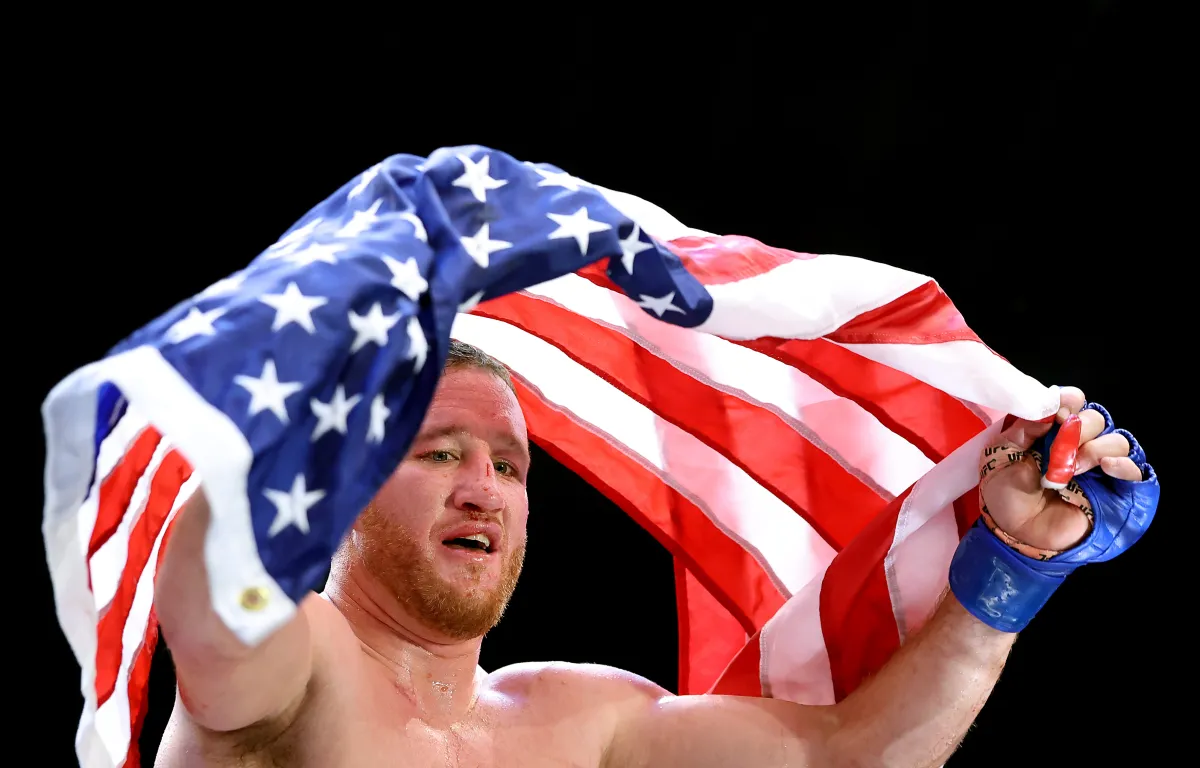
The aftermath of the fight served as a stark, visceral reminder of the immense physical toll that elite mixed martial arts exacts on the human body, casting a sober shadow over the celebratory chaos of the arena. While the deposed champion Topuria was being transported to a nearby hospital to treat his extensive facial lacerations, bruises, and concussion symptoms, Gaethje stood in the center of the cage, a stark contrast of raw, unvarnished human triumph. His own face bore the minor scrapes of battle, and his body shone with sweat, but the golden undisputed UFC Lightweight Championship belt draped over his shoulder gleamed with a brilliant, undeniable finality. For years, Gaethje had carried the reputation of being the ultimate gladiator—a man who willingly entered the fire, prioritizing historic, jaw-dropping wars over tactical self-preservation—and this victory felt like the ultimate, hard-earned validation of a lifetime spent bleeding for the sport. In his previous quests for undisputed gold, he had fallen agonizingly short, suffering heartbreaking defeats against legendary figures such as Khabib Nurmagomedov and Charles Oliveira, setbacks that made many believe he was destined to always be the bridesmaid but never the bride in the lightweight division. To systematically dismantle a seemingly invincible, undefeated champion at this late stage of his career was a narrative masterstroke that defied the natural laws of athletic decline. The triumph was rooted in a profound emotional resilience, showing the world that a fighter’s spirit, when tempered by years of experience and paired with a refined tactical approach, can overcome the physical advantages of youth. Gazing at the belt, Gaethje did not just celebrate a championship; he celebrated the redemption of a career defined by sacrifice, reminding everyone of the deeply human heart beating beneath the armor of a cage fighter.
As the roaring crowd celebrated this monumental upset, the transition from the chaotic violence of combat to the quiet, sobering reality of a fighter’s human future began inside the Octagon when Joe Rogan stepped up to interview the newly crowned champion. Rogan, his voice carrying the weight of a man who has witnessed the rise and fall of countless legends, wasted no time in steering the conversation toward the looming giant of retirement, asking if this was the perfect moment to walk away. The thirty-seven-year-old champion, still heavily breathing and absorbing the magnitude of his achievement, reacted with a vulnerable humility that stood in beautiful contrast to his ferocious, iron-willed cage persona. Rather than giving in to the adrenaline of the moment by making a rash, emotional declaration or calling out his next challenger, Gaethje revealed a deeply personal detail that humanized him far beyond his athletic identity. He explained that he had made a solemn, heartfelt promise to his mother before stepping into the cage that night: he had sworn to reserve any final, life-defining decisions about his retirement until the dust had settled and he could discuss it with his family in the safety of his home. This touching admission shed light on the quiet pacts and heavy worries that exist behind the scenes of every great fighter’s life, reminding the audience that beneath the scars and the championship gold is a son who carries the deep responsibility of his family’s peace of mind. With a professional record that now stands at twenty-eight victories and only five defeats, featuring an incredible twenty-one knockouts, Gaethje has earned the right to prioritize his family over the crowd, making his hesitation to step back into the line of fire a deeply profound, rational demonstration of love and self-preservation.
This powerful sentiment of preserving one’s physical health and hard-earned legacy was echoed strongly by former UFC Flyweight Champion Demetrious “Mighty Mouse” Johnson, who took to his popular YouTube channel to offer heartfelt, veteran advice to the newly crowned king. Johnson, universally respected as one of the most intellectually analytical and technically brilliant martial artists to ever compete, pleaded with Gaethje to recognize the rare beauty of this moment and choose the path of terminal departure. Drawing extensively from his own legendary career that spanned nearly two decades and concluded with a graceful, self-directed retirement in 2023, Johnson spoke not as a distant spectator, but as an elder statesman who successfully escaped the sport with his cognitive health, physical faculties, and financial freedom completely intact. He stressed that Gaethje has already achieved the absolute pinnacle of athletic success: he has amassed generational wealth, secured undisputed championship gold, and delivered an unforgettable defeat to an undefeated phenom who represents the vanguard of the new generation. “There is nothing left for Justin Gaethje to do; the best thing he can do is retire on this amazing victory against a legend like Ilia Topuria,” Johnson asserted, stressing that walking away now would save valuable brain cells and allow him to live a rich life beyond the cage. Johnson’s upcoming induction into the UFC Hall of Fame on July 9, sharing the summer spotlight with Conor McGregor’s highly anticipated return to the cage, highlights the contrasting paths fighters can take—one of dignified transition versus a perpetual, dangerous search for past glory. By urging Gaethje to ride off into the sunset, Johnson championed a modern, deeply empathetic philosophy that values the veteran’s humanity over the insatiable appetite of the combat sports machinery.
To truly appreciate why this philosophical crossroad is so monumentally significant for Justin Gaethje, one must examine the breathtaking, brutally honest, and fiercely courageous manner in which he has conducted his entire career. Affectionately and accurately nicknamed “The Highlight,” Gaethje has never possessed a passive gear; every single time he stepped inside the cage, he engaged in a high-wire act of mutual destruction, offering his own physical well-being as tribute to secure spectacular victories. His legendary resume reads like a masterclass in modern gladiatorial combat, marked by historic, soul-testing wars against iconoclastic figures such as Dustin Poirier, Charles Oliveira, Khabib Nurmagomedov, and a devastating, late-round knockout loss to Max Holloway in April of 2024. Rebounding from that deeply traumatic defeat against Holloway to dismantle an undefeated champion like Topuria only months later is a feat of raw willpower that borders on the miraculous. It showcases the incredible psychological evolution of a kid who began his athletic journey in a small Arizona copper-mining town, relying on a standout collegiate wrestling background before transforming himself into the most thrilling striker on the planet. Over the course of his thirty-three professional fights, Gaethje moved from a wild, reckless brawler who openly welcomed concussive damage to a mature, cerebral martial artist capable of dismantling world-class opponents with sharp tactical awareness. Yet, this supernatural ability to overcome adversity is a double-edged sword, as it often blinds fighters to their own very real human limitations, whispering the lie that they can outrun the ticking clock of athletic decline indefinitely. Gaethje’s legacy is already secure, written in the hearts of millions of fans who recognize him not only as an elite lightweight champion, but as one of the most honest and selfless competitors to ever walk the earth.
The ultimate tragedy of the combat sports world is that the exit doors are almost never adorned with golden arches; instead, the vast majority of legendary warriors are carried out on their shields, victims of their own inability to extinguish the competitive fire that burns within them. The intoxicating rush of championship victory, the thunderous adulation of tens of thousands of screaming fans, and the unparalleled high of overcoming impossible odds are phenomena that simply cannot be replicated in ordinary civilian life, explaining why so many aging fighters refuse to step away until they are forced to do so by a series of devastating, humiliating losses that tarnish their majestic records. For Justin Gaethje, the spectacular triumph in Washington, D.C. offers an exceedingly rare, golden key to a dignified escape from a merciless, unforgiving game. To walk away right now, with the undisputed lightweight championship belt wrapped tightly around his waist and his faculties fully intact, would not be an act of surrender, but rather the single greatest strategic victory of his life—a triumphant assertion of human intelligence and self-love over a dangerously insatiable ego. Such a decision demands an extraordinary amount of internal bravery, perhaps even more than the raw courage required to face down a lethal opponent in the cage, because it forces a lifelong combatant to transition into a quiet, normal domestic existence and discover who he is without the armor of “The Highlight.” Whatever future path Justin Gaethje ultimately decides to forge once he honors the promise made to his mother, his historic performance under the Washington lights will forever stand as a testament to the heights the human spirit can scale when forged in the fire of genuine passion and unfaltering resilience.