


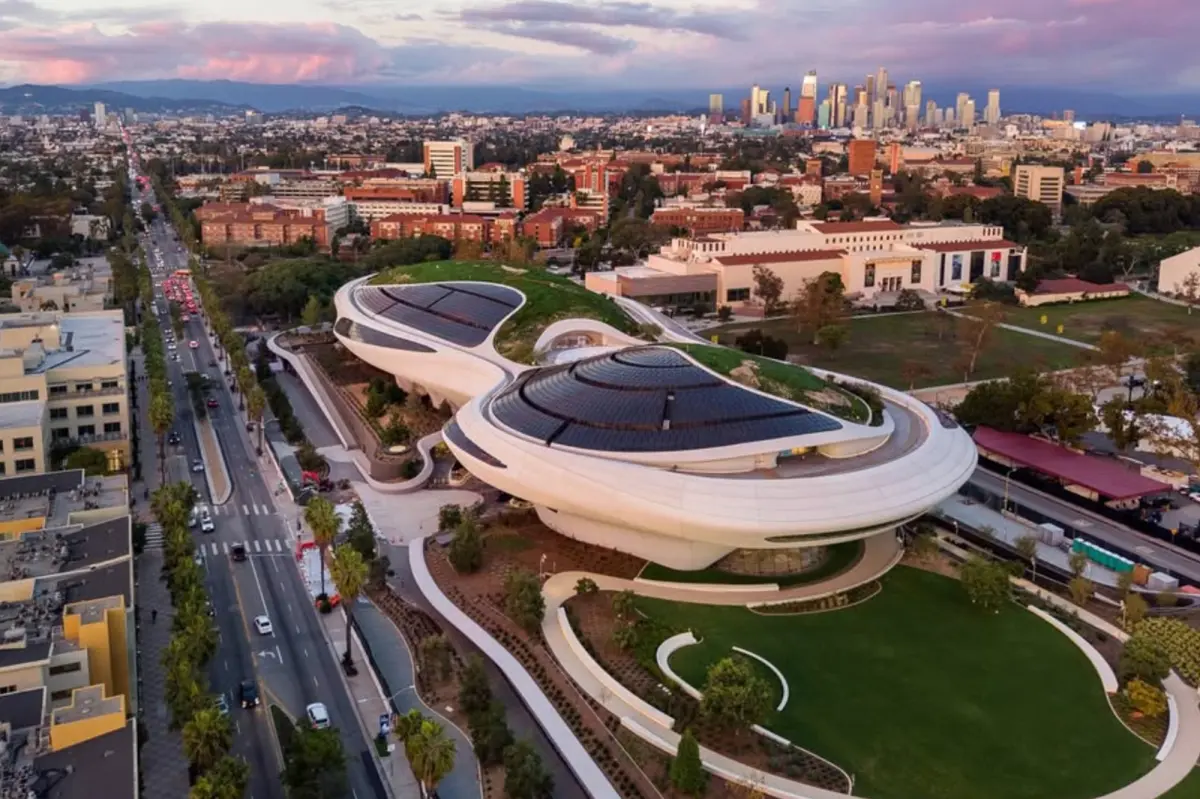
For decades, the name George Lucas has been synonymous with the boundlessness of human imagination, modern mythology, and the pioneering spirit of cinematic technology. Now, alongside his wife and co-founder Mellody Hobson, the legendary filmmaker is preparing to unveil his most ambitious, deeply personal legacy project yet: the Lucas Museum of Narrative Art. Rising from the heart of Los Angeles’s historic Exposition Park like an organic, metallic spaceship that has gently touched down beside the iconic Los Angeles Memorial Coliseum, this colossal $1-billion marvel is step-by-step transforming from a long-held dream into a physical reality. Slated to officially open its doors to the public this coming fall, the futuristic cultural beacon is poised to redefine the traditional museum experience, bridging the gap between high art and populist visual storytelling. This is not merely a static repository for relics of the past; rather, it is designed from the ground up as a kinetic, living theater of human expression, housing a massive array of narrative mediums that have shaped our global culture. By celebrating the universal human impulse to tell stories through pictures, characters, and shared myths, the museum seeks to democratize the arts, welcoming seasoned scholars and everyday dreamers alike into a space built on the premise that every great piece of art has a story to tell.
At the very core of this breathtaking architectural monument lies a profound championing of “narrative art”—a genre that has historically been marginalized by traditional elite art institutions but has always lived closest to the beating heart of the general public. Spanning an astonishing 300,000 square feet over an 11-acre campus, the museum features a staggering 100,000 square feet of dedicated exhibition space spread across 33 state-of-the-art galleries. Within these walls, visitors will encounter roughly 1,300 carefully curated artworks representing an eclectic tapestry of genres, from classic golden-age illustration and children’s book art to contemporary comic books, manga, graphic novels, theatrical set designs, and cinematic masterpieces. The sheer, awe-inspiring scale of the endeavor was recently underscored by Ryan Linkof, the museum’s senior curator and head of film programs, during an appearance at San Diego’s Comic-Con, where he noted that the astonishing scale of the project is designed to mirror the vastness of the human imagination itself. By placing a humble comic strip or a whimsical children’s book illustration on the exact same aesthetic pedestal as canonical fine art paintings, the Lucas Museum challenges centuries of artistic hierarchy. It constructs a sensory-rich environment where grandparents, children, art historians, and film buffs can find a common language, viewing the visual world not through the lens of academic exclusion, but as an endless, beautifully diverse continuum of human connection.
Perhaps the most thrilling revelation to emerge from the museum’s recent Comic-Con panel is its transition from a preservation site into an active, headline-making premiere venue, highlighted by the triumphant resurrection of a legendary piece of lost “Star Wars” history. For more than a decade, die-hard fans of the galaxy far, far away have spoken in hushed, almost mythical tones about “Star Wars: Detours,” a highly anticipated, comedic animated spin-off developed back in 2012 by the brilliant minds of Seth Green and Matthew Senreich. Conceived as an irreverent, self-deprecating parody of the beloved space opera—sharing a comedic sensibility and satirical tone with pop-culture juggernauts like “The Simpsons”—the project was abruptly shelved following Disney’s acquisition of Lucasfilm, despite the team having fully completed 39 episodes and penned dozens of additional scripts. At the Comic-Con panel, Seth Green dropped a massive bombshell that sent shockwaves through the entertainment industry: a selection of these long-buried, unseen episodes will finally see the light of day, exclusively screened as part of the museum’s inaugural public programming. Boasting an incredibly stacked, star-studded voice cast that features the talents of Green himself, alongside Seth MacFarlane, Donald Faison, Felicia Day, Zachary Levi, and iconic franchise veterans Anthony Daniels and Billy Dee Williams, the public debut of “Star Wars: Detours” cements the Lucas Museum as a vital curator of living pop-culture history, proving that even the most elusive creative treasures can eventually find a vibrant home to call their own.
Crucial to this dynamic, interactive philosophy of cultural engagement are the museum’s two state-of-the-art theaters, which are destined to become absolute sanctuaries for cinephiles and casual moviegoers alike. Far from the conventional, transactional experience of modern multiplexes—where audiences purchase a ticket, sit in the dark, and promptly leave when the credits roll—these theaters will function as continuous, curated extensions of the exhibition halls, encouraging guests to organically wander in and out as they would any traditional gallery. The first of these spaces, the Robert Flaherty Theater, will dedicate its programming to exploring cinema as a profound, primary medium for narrative translation, showcasing how filmmakers across generations have woven complex human truths into visual tapestries. Conversely, the Slavko Vorkapich Theater will dive headfirst into the visceral mechanics of filmmaking, focusing heavily on kinetic movement, avant-garde editing, and visual experimentation to show how motion itself can evoke deep, unvarnished emotional responses. This innovative approach to cinematic programming transforms the simple act of watching a film into an educational and philosophical journey, allowing visitors to instantly connect the moving images on the silver screen to the static illustrations, storyboards, and paintings displayed in the adjacent galleries, thereby demystifying the intricate alchemy of visual storytelling.
Yet, for all of its high-tech interiors and cinematic marvels, the physical presence of the Lucas Museum of Narrative Art is also a deeply compassionate love letter to the city of Los Angeles and its local communities. The building’s breathtaking, aerodynamic design mimics the organic flow of the surrounding landscape, providing a sharp but poetic contrast to the neighboring historical architecture of Exposition Park. By converting what was once vast stretches of asphalt parking lots into 11 acres of lush, vibrant, and publicly accessible parkland, Lucas and Hobson have gifted the neighborhood a sprawling green oasis complete with native gardens, pedestrian pathways, and open gathering spaces. This intentional integration of natural beauty and civic utility reflects a deep-seated desire to ensure that the museum is not an insular fortress of culture, but an open, welcoming backyard for the residents of South Los Angeles. Local families, school groups, and international tourists can gather under the shade of newly planted trees, picnic on the lawns, or look up in wonder at the sleek lines of the hovering structure, finding a space where recreation, nature, education, and world-class art seamlessly coexist without barriers or intimidation.
In the final estimation, the Lucas Museum of Narrative Art represents the ultimate, humanized synthesis of George Lucas’s lifelong devotion to the power of stories. It serves as a physical testament to the universal truth that the tales we share—whether painted on the walls of ancient caves, printed in the ink of daily comic strips, or projected in brilliant light onto massive theater screens—are what truly bind us together as a human family. By stripping away the stuffiness often associated with institutional art and replacing it with an atmosphere of unbridled wonder, intellectual curiosity, and sheer fun, this visionary complex is set to inspire generations of future storytellers to pick up a brush, a pencil, or a camera. When the doors finally swing open this fall, welcoming the public into its sun-drenched galleries, lush parklands, and revolutionary theaters, it will mark the beginning of a bold new chapter in cultural history. It is a monument constructed not just to look back at what has been created, but to boldly look forward, reminding every single visitor who steps inside that their own stories, dreams, and narratives are worthy of being told, celebrated, and preserved for the ages.