

For over half a century, the New York Knicks carried a beautiful, agonizing burden, haunted by the memories of Walter Frazier and Willis Reed’s legendary 1973 victory, while constantly chasing the elusive dream of bringing another NBA championship back to Madison Square Garden. Generation after generation of faithful fans watched hopeful eras crumble, waiting for a savior who could survive the intense glare of the metropolitan spotlight and restore pride to the city. That savior finally arrived not in the form of a hyper-athletic lottery prodigy, but in a trio of tight-knit brothers who once conquered the college basketball world under legendary coach Jay Wright at Villanova. Jalen Brunson, flanked by his trusted collegiate brothers-in-arms Josh Hart and Mikal Bridges, did what many deemed impossible: they disassembled the formidable San Antonio Spurs in a thrilling five-game NBA Finals series. This was not just a typical championship victory; it was one of the most dominant, emotionally charged, and cohesive postseason runs the sporting world has ever witnessed, demonstrating the rare power of deep, authentic chemistry. The synergy between Brunson, Hart, and Bridges felt less like a modern superteam assembled through free-agency transactions and more like a grassroots basketball revolution built on trust. Their shared history, forged in the grueling practices of Villanova and translated directly onto the hardwood of the world’s most famous arena, brought an infectious, blue-collar joy back to New York. They played with a collective telepathy, diving for loose balls, sacrificing their bodies, and trusting one another in a way that only lifelong friends could. As the final buzzer sounded and the confetti rained down, the city erupted in a cathartic release of five decades of frustration. The “Nova Knicks” had not only climbed to the mountaintop of professional basketball, but they had also done it on their own terms, proving that genuine chemistry and an unbreakable brotherhood could still triumph over the cynical landscape of modern sports.
At the absolute center of this historic triumph stood Jalen Brunson, delivering a legendary individual performance that will be discussed in barbershops, bars, and living rooms across the tri-state area for generations to come. Crowned the Bill Russell NBA Finals Most Valuable Player, Brunson was nothing short of a basketball wizard throughout the series, averaging an astonishing 32.6 points per game and slicing through San Antonio’s defense with surgical, veteran precision. When the pressure reached its absolute peak in the clinching Game 5, Brunson did not shrink; instead, he elevated his game to mythical heights, exploding for a series-high 45 points in a display of pure competitive will. Every mid-range jumper, crafty floater, and hard-nosed drive to the basket felt like a masterclass in determination, leaving spectators and defenders alike in absolute awe of his skill. The sheer human emotion of the moment was palpable as the final seconds ticked away; Brunson collapsed into the arms of his teammates, his face etched with a mixture of overwhelming physical exhaustion and pure, unadulterated joy. Yet, even in the dizzying aftermath of achieving his ultimate lifelong dream, Brunson’s down-to-earth personality and infectious humor remained fully intact. In the post-game press conference, amidst the sweet smell of expensive champagne and the flashing lights of the international media, he couldn’t help but playfully poke fun at his close friend Josh Hart over a comical late-game mistake, demonstrating the familial, lighthearted locker room dynamic that kept this team grounded through the intense pressure of a championship chase. It was this rare blend of elite, cold-blooded execution on the court and warm, human accessibility off it that endeared Brunson so deeply to the millions of fans chanting his name, showing that he was not just a champion, but one of them.
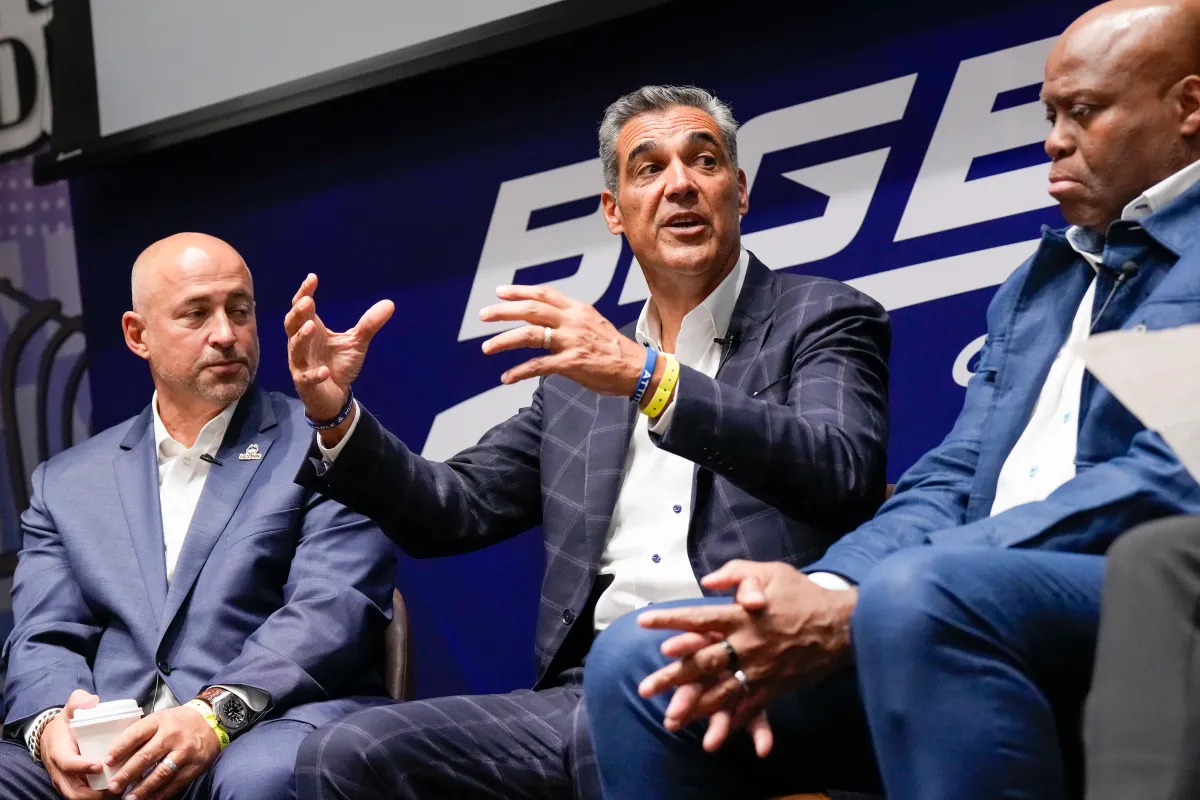
Brunson’s path to basketball immortality was paved with persistent, loud skepticism—a narrative of doubt that he quietly transformed into the ultimate fuel for his historic rise. Throughout his life, critics pointed to his physical profile, questioning whether a guard of his stature could ever serve as the undisputed number-one option on a true championship contender. Even his legendary college coach, Jay Wright, candidly admitted to harboring these doubts at one point, a revelation he shared during a deeply insightful appearance on “The Dan Patrick Show” following the Knicks’ victory. Wright spoke with immense pride about how Brunson systematically dismantled all the traditional basketball paradigms, explaining that the star guard took all of his perceived physical inadequacies—such as being labeled too small, too slow, or lacking elite vertical athleticism—and weaponized them. Instead of trying to force himself into a physical mold he didn’t fit, Brunson studied his opponents with the mind of a chess grandmaster, figuring out exactly how defenders planned to exploit his limitations and then turning those exact defensive strategies against them to his advantage. He mastered the lost arts of footwork, body control, pacing, and leverage, turning every hesitation move and pump fake into a psychological battle that he almost always won. By understanding the biomechanics of his own body and the cognitive patterns of his defenders, Brunson proved that intellectual superiority and relentless preparation can easily conquer raw physical gifts, providing an inspiring blueprint for overlooked athletes everywhere who are told they simply do not measure up to the physical ideals of their sport.
To truly appreciate the magnitude of Brunson’s current triumph, one must look back at the developmental years of his career, a period characterized by quiet patience and the willingness to learn in the shadows. He spent the first four seasons of his professional journey with the Dallas Mavericks, where he was drafted in 2018 alongside European phenom Luka Doncic. In Dallas, Brunson was often viewed through the narrow lens of a highly dependable backup or, at best, a highly competent second-fiddle to Doncic’s ball-dominant, superstar style of play. While that secondary role could have easily bred resentment or complacency, Brunson used the experience to quietly refine his leadership qualities, waiting for the perfect moment to step out into the forefront of the basketball world. That opportunity arrived ahead of the 2022-23 season when he made the bold, career-defining decision to sign with the New York Knicks in free agency, taking on the heavy mantle of the team’s undisputed floor general. Skeptics initially mocked the contract, labeling it an overpay for a glorified role player, but Brunson quickly silenced the noise by breathing new life into a stagnant, frustrated franchise. He didn’t just play for the Knicks; he embraced the heavy pressure of the city, absorbing the hopes of an entire starved fanbase and carrying them entirely on his shoulders. His transition from a quiet contributor in Texas to the fierce, beating heart of Manhattan is a testament to his self-belief and willingness to bet on himself when the stakes were highest, illustrating how a change of scenery coupled with unyielding self-confidence can unlock superstar potential that others failed to see.
The emotional shockwaves of the Knicks’ championship victory rippled far beyond the current roster, deeply touching the legends of the franchise’s past who had spent decades waiting for this moment. None felt the impact more profoundly than Patrick Ewing, the iconic Hall of Fame center who poured his heart and soul into the city during the grueling, physical battles of the 1990s but fell agonizingly short of securing a ring. Following the decisive Game 5 victory, an emotional Ewing delivered a raw, tearful response that captured the collective soul of a generation of Knicks fans. For Ewing and other franchise legends, seeing Brunson lift the Larry O’Brien Trophy was not just a victory for the current team, but a profound validation of the decades of sweat, tears, and heartbreak that preceded them. It was a bridge connecting the painful near-misses of the past with the glorious reality of the present, healing long-festering wounds and reminding the basketball world of what Madison Square Garden looks like when it is operating at the absolute peak of its powers. The images of Ewing embracing the young champions in the locker room served as a symbolic passing of the torch, a beautiful moment where the heavy burden of the past was finally lifted, replaced by a deep sense of mutual respect and shared pride. This championship did not erase the struggles of the previous fifty years; rather, it gave those struggles a beautiful, redemptive meaning, proving that the arduous journey made the eventual arrival at the mountaintop infinitely more rewarding for everyone.
With this historic championship run successfully cemented in the annals of sports history, Jalen Brunson has elevated himself into a rarefied air where few other players in New York history have ever tread. Today, he is widely and transitionally celebrated as the greatest player to ever wear the iconic blue and orange jersey, a distinction earned through his peerless clutch performances, his impeccable leadership, and his ability to unite an entire city under a single banner of basketball excellence. What makes Brunson’s legacy so incredibly powerful is the sheer humanity and humility he brings to his stardom, refusing to let the fame distort the fundamental values of hard work, loyalty, and team-first mentality that he learned from his family and his years under Jay Wright. He has transformed the identity of the New York Knicks from a recurrent league punchline into a relentless, respected powerhouse, showing that the ultimate prize in sports is won not by the loudest or most physically gifted, but by those with the biggest hearts and the sharpest minds. As New York prepares for a celebratory parade through the Canyon of Heroes, Brunson stands as a living testament to the power of perseverance, a hometown hero who took the doubts of the basketball world and turned them into a golden legacy that will shine forever in the heart of the city that never sleeps. His story is a beautiful reminder that greatness is not given based on physical measurements or pre-draft expectations; it is carved out day by day through sweat, resilience, and an unwavering belief in oneself and one’s teammates.