

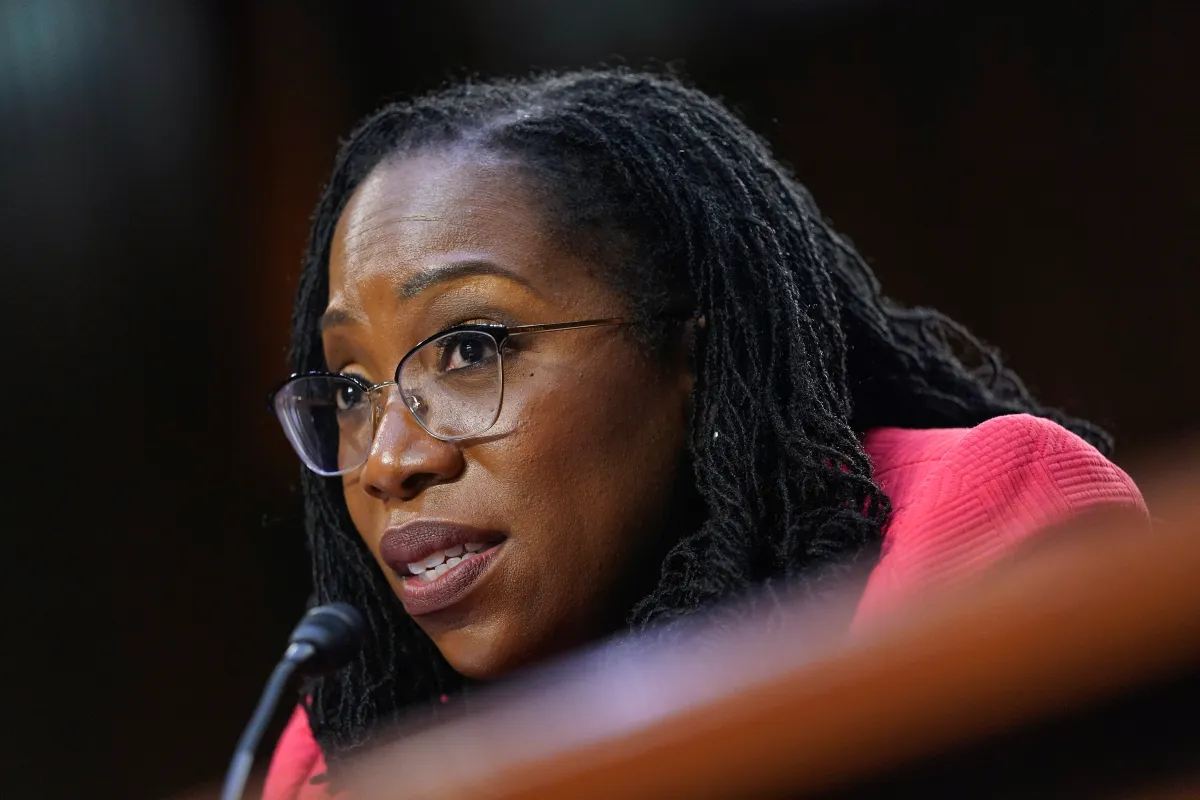
The Supreme Court often speaks in dry, procedural language, but sometimes a single order reveals the deepest tensions in American democracy. That happened this week when the Court allowed New Hampshire to prevent students from using their college IDs as a backup form of identification when voting in the November midterm elections. Justice Ketanji Brown Jackson was the only justice willing to say, in plain terms, that the decision was wrong. Her dissent was brief but powerful. “I respectfully dissent,” she wrote, “because—even, and perhaps especially, when an election is looming—I would not disturb a clearly justifiable federal-court order issued to ensure that the public receives accurate information about a State’s electoral processes.” Behind those measured words is a real human story. A student who has registered to vote in New Hampshire, who has no driver’s license and whose only photo ID is a campus card, may now be turned away at the polls. The ruling comes just twelve days before voters head to the ballot box, at a moment when election officials are already printing ballots, training poll workers, and setting up polling places. It is easy to see a Supreme Court order as an abstract legal event, but this one has immediate and concrete consequences. It affects where people can vote, whether their ballots will count, and whether they believe the system works for them. When a member of the nation’s highest court is willing to stand alone, it is worth listening to what she says. Jackson’s dissent is not just a disagreement about legal procedure; it is a warning about what happens when the rules change at the last minute and voters are left to pay the price.
The controversy did not begin with the Supreme Court. Earlier this year, New Hampshire passed a law tightening its voter identification requirements, and student IDs were no longer considered an acceptable form of identification for obtaining a ballot. Supporters of the law argued that student IDs do not always show proof of residence or meet the same standards as state-issued identification. But critics saw the law as a solution in search of a problem, and one that would disproportionately fall on young voters. For many college students, a student ID is the only photo identification they have. They may not own a car, so they never got a driver’s license. They may have left their passport at their parents’ home hundreds of miles away. They may have recently turned eighteen and registered to vote for the first time. The law meant that these students would have to find another way to prove who they were, or they would not be able to vote at all. New Hampshire’s Republican Secretary of State, David Scanlan, enforced the new restriction, barring student IDs from being used even as a backup form of identification. At first, a federal district judge allowed the law to stand. But earlier this month, the judge reversed course and issued an injunction, finding that the restriction appeared to burden young voters unfairly and allowing student IDs to be used again as a backup. Scanlan then asked the U.S. Court of Appeals for the First Circuit to block that injunction, and the appeals court refused. That set the stage for an emergency appeal to the Supreme Court, and the High Court ultimately granted it. The Court’s order did not rule on whether the law is constitutional. It simply said that, for now, New Hampshire may enforce its ban. But by doing so, it erased the protection that the lower court had put in place and sent a clear signal to election administrators: student IDs are not enough.
The legal principle at the center of the case is known as the Purcell principle, named after a Supreme Court case from 2006. The principle warns courts not to change election rules too close to an election, because doing so can confuse voters and undermine faith in the electoral process. The Supreme Court majority seemed to believe that intervening now was the right thing to do, perhaps because returning the state to the law passed by its legislature would provide clarity. But Justice Jackson saw the issue from a different angle, and her dissent is an important lesson in how the Purcell principle can cut both ways. The lower court’s injunction had been in place for almost three weeks. Voters had been informed, through news reports and public guidance, that their student IDs would once again be accepted as a backup. Election officials had adjusted their procedures. Then the Supreme Court stepped in and changed the rules again, with the election just days away. If the goal of Purcell is to avoid confusion, Jackson argued, then the Court’s order did the exact opposite. It upended an existing rule and replaced it with one that voters may not know about. The Coalition for Open Democracy, which brought the lawsuit, made the same point in a statement. The group’s legal counsel said the Court’s decision “injects confusion into the election—precisely what the Purcell principle is supposed to prevent—and authorizing an unconstitutional policy that will deprive young voters of their right to vote.” The statement went further, praising Jackson for standing up for the Constitution, the right to vote, and a rational application of Purcell. That is the crux of the disagreement. Is it more harmful to let a potentially unconstitutional law stand for a few more weeks, or to keep an injunction in place until the litigation is resolved? Jackson chose the latter, and her reasoning speaks to a broader truth about elections: clarity and trust are too important to sacrifice in the final days of a campaign.
Perhaps the most important way to understand this case is to imagine being a student caught in the chaos. Picture a young person at the University of New Hampshire in Durham, or at Dartmouth College in Hanover, or at Keene State College. They are voting for the first time. They registered at their campus address and planned to vote in their college town, because that is where they live for most of the year. They have a student ID with their name and photo on it. They do not have a driver’s license, because they have never needed one. They do not have a passport readily available. A few weeks ago, they heard that a federal court had blocked the state’s ban on student IDs. They felt relieved. They planned to bring their student ID to the polling place. Then, less than two weeks before Election Day, they heard that the Supreme Court had reversed course. Now they are not sure if they will be allowed to vote. They have limited time to figure out an alternative. The state motor vehicle office may have long lines, or they may not have enough documents to get a state ID. Their parents may need to mail a passport or birth certificate, and there may not be enough time. Some students will give up. Some will show up and be forced to cast a provisional ballot, uncertain whether it will actually be counted. Some will be turned away entirely. These are not abstract possibilities. They are the predictable consequences of a rule that singles out an entire category of identification used most often by young people. Voting-rights advocates have argued that student IDs are legitimate forms of identification, issued after the university verifies a person’s identity. But the Supreme Court’s order makes it easier for the state to treat those IDs with suspicion. It sends a message that students are not welcome at the polls, and that their right to vote is less important than administrative convenience. It is a message that young voters will remember for a long time.
The political context of New Hampshire makes the ruling even more significant. Midterm elections have always been understood as a test of the party in power, and historically, the president’s party has lost seats in Congress during midterms. In that sense, New Hampshire is one of the states where national trends and local races collide. The state has an open U.S. Senate seat, which the Cook Political Report rates as leaning Democratic. The governor’s race is rated as likely Republican. Both contests could be affected by voter turnout, and turnout among young voters is often decisive in close elections. New Hampshire is also a state with a tradition of political independence and civic engagement. In the 2024 presidential election, President Donald Trump lost New Hampshire to then-Vice President Kamala Harris, a reminder that the state is competitive and unpredictable. The Supreme Court’s order, issued just twelve days before the midterms, changes the landscape for thousands of students. Some of them will now find it harder to vote, and they may not know until they arrive at the polls that their student ID is no longer acceptable as a backup. The timing is particularly troubling because it leaves so little room for voter education. Election officials, college administrators, and voting-rights groups will have to rush to inform students about the rule change. But in a busy semester, with classes, exams, and the normal chaos of college life, many students will not get the message. The result could be fewer young voters at the ballot box in a year when their voices matter more than ever. It is impossible to know exactly how much of an impact the ruling will have. But even a small shift in turnout can change the outcome of an election, and in a state like New Hampshire, every vote counts.
Ultimately, the Supreme Court’s order is not the end of the legal battle. It is a stay, a temporary decision that allows the state to implement its law while the underlying case continues through the courts. The Coalition for Open Democracy has promised to keep fighting, saying it will continue to litigate vigorously in defense of the fundamental right to vote for young voters across New Hampshire. The case may eventually return to the Supreme Court, and the Court may then rule on the constitutionality of the law in a fuller way. But for the students who are trying to vote in the upcoming midterms, that future ruling will be too late. The harm, if their votes are lost, cannot be undone. Justice Jackson’s dissent will likely be cited again and again in the coming months, not only in this case but in elections around the country. It is a reminder that the law is not just a collection of abstract principles. It is a living system that affects real people, in real communities, at the most important moments of their civic lives. When a justice is willing to dissent alone, it can be easy to dismiss her as a lone voice. But history has shown that dissents often become the foundation for a future majority. Jackson’s words may one day be recognized as the beginning of a legal argument that protected the right to vote for students, not just in New Hampshire but everywhere. For now, the ongoing litigation and the dedicated efforts of voting-rights advocates matter. But the deeper lesson of this moment is that the right to vote is fragile. It can be weakened not just by laws that are explicitly discriminatory, but by confusing, last-minute changes to the rules. That is not the kind of government Americans should accept. It is not the kind of democracy Justice Jackson wants to see. And it is not the kind of election that the people of New Hampshire deserve.