

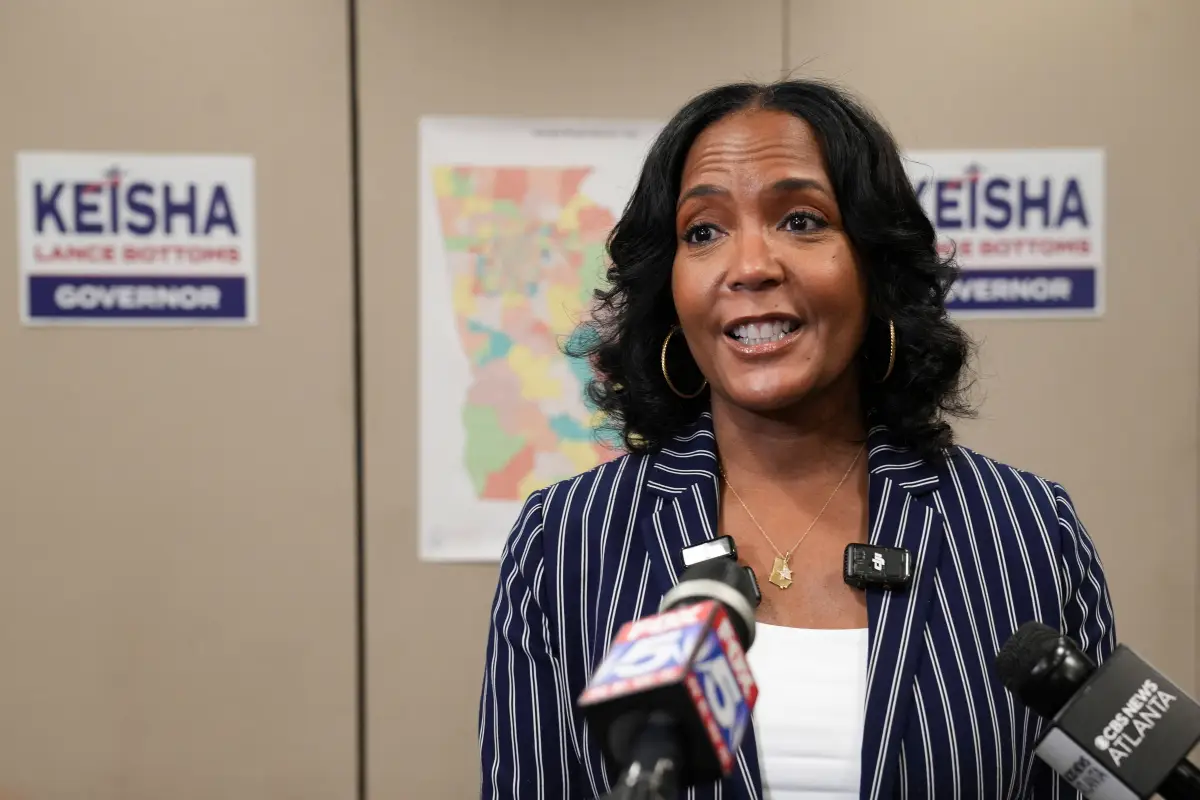
Keisha Lance Bottoms’ entry into the pivotal 2026 Georgia gubernatorial race represents a momentous turning point in modern Southern politics, carrying both the heavy weight of historical precedent and the electric prospect of a historic electoral breakthrough. For more than two decades, the Governor’s Mansion in Atlanta has remained an elusive, seemingly fortressed prize for Democrats, who have repeatedly watched a succession of conservative Republican leaders dictate the state’s policy direction even as the state’s demographics and political views rapidly shifted beneath their feet. However, the upcoming 2026 cycle presents a rare and highly coveted political alignment: the departure of the popular, two-term Republican Governor Brian Kemp due to strict constitutional term limits. This open-seat dynamic has cracked open a door that was previously slammed shut, offering the Democratic Party their most viable path to executive state power in an entire generation. Seizing this critical moment with formidable organizational focus, Bottoms—the former high-profile Mayor of Atlanta and a seasoned national public servant—successfully bypassed the grueling internal divisions that so often plague her party by securing a decisive and commanding victory in the May Democratic primary. By consolidating her base support early, she has managed to position herself as a unifying, consensus-building figure, capitalizing on a precious window of political tranquility while her Republican counterparts were locked in a fierce, expensive, and deeply personal civil war for their party’s nomination. As Bottoms hits the campaign trail, she carries a unique blend of civic leadership experience, professional executive polish, and a powerful personal narrative that resonates deeply with the state’s rapidly diversifying electorate, signaling to national donors and local organizers alike that Georgia is once again the premier battleground of American democracy. This early structural advantage has allowed her to build a robust, statewide campaign infrastructure, positioning her far ahead of where past high-profile Democratic contenders like Stacey Abrams stood at similar junctures in their campaigns. Yet, the road to victory remains paved with immense structural obstacles, as the transient nature of early polling numbers must now contend with a Republican apparatus prepared to wage an all-out war to retain its decades-long grip on the state’s executive branch.
Facing Bottoms in this high-stakes political drama is Rick Jackson, a wealthy executive from the healthcare sector who emerged victorious from a grueling, exceptionally bruising Republican runoff. By capturing 52.7 percent of the vote to defeat Lieutenant Governor Burt Jones—a contest called late into the night by the Associated Press—Jackson proved that his unconventional, self-funded outsider campaign possesses undeniable appeal among primary voters. Unlike traditional career politicians who must spend precious hours catering to party donors and building slow consensus within the party establishment, Jackson enjoys the rare luxury of writing his own campaign checks, having already poured tens of millions of dollars of his personal fortune into his campaign coffers. This immense financial independence allows him to completely bypass typical fundraising bottlenecks, keeping his campaign constantly on the airwaves with targeted media blitzes designed to craft and protect his personal narrative at a moment’s notice. Jackson’s political identity is built entirely on his corporate credentials, framing himself as a pragmatic businessman rather than a creature of the legislative chambers, a message that strikes a strong chord with suburban voters wary of partisan gridlock and careerism. However, this outsider profile is a double-edged sword; while it immunizes him from some of the legislative baggage of the state capitol, it also leaves him without the deeply entrenched statewide political networks and legislative alliances that his primary opponent would have brought to the table. This lack of institutional governance experience offers Bottoms a clear target, allowing her to contrast her years navigating the complex bureaucracy of City Hall and her high-level federal service against Jackson’s unvetted, purely corporate track record. Jackson’s strategy relies on keeping the Republican base energized with promises of aggressive tax cuts and business-friendly deregulation, but his true challenge will be defending his extensive business record under the harsh glare of a general election spotlight, where Bottoms’ campaign is already preparing to paint his corporate empire as disconnected from the daily economic struggles of working-class Georgians.
The early skirmishes of this general election matchup are reflected in a volatile sea of public opinion polling and prediction market data, revealing a race that is as tight as it is unpredictable. Early surveys, such as one conducted by Concord Public Opinion Partners and sponsored by the progressive education advocacy group Education Reform Now Advocacy, paint an incredibly optimistic picture for the Democratic nominee, showing Bottoms holding a commanding fifteen-point lead over Jackson. This survey suggests that Bottoms’ early unification of the Democratic base, combined with her widespread name recognition and the lingering hangover of the divisive Republican primary, has given her a temporary head start in defining the parameters of the race. However, seasoned political strategists on both sides of the political aisle view these early double-digit margins with healthy skepticism, knowing that as the Republican electorate consolidates behind Jackson, those numbers will inevitably contract. This cooling expectation is already playing out across real-time prediction platforms, which offer a highly reactive pulse on the race’s momentum. On the popular prediction market Kalshi, Bottoms’ probability of clinching the governorship has seen a notable decline, dropping from a robust 64.9 percent in late April down to a much more competitive 53 percent, while the collective probability of a Republican victory has climbed to 49 percent. Similarly, the decentralized betting platform Polymarket places Bottoms’ chances at 56 percent compared to the GOP’s 44 percent, highlighting that while she retains a slight edge, the market is quickly factoring in Jackson’s immense financial resources and his ability to saturate the suburban Atlanta media markets. These shifting odds highlight the fluid nature of the campaign, showing that Jackson’s immense personal wealth acts as a powerful equalizer capable of reshaping voter perceptions and eroding Bottoms’ early lead through sheer advertising volume. Consequently, the Bottoms campaign faces the urgent task of converting her current polling advantage into a durable, grassroots-driven movement before Jackson’s media barrage begins to define her negatively in the eyes of late-deciding moderate and independent voters.
To truly appreciate the towering mountain Keisha Lance Bottoms is attempting to climb, one must look closely at the daunting historical terrain of Georgia’s gubernatorial politics. The last time the citizens of Georgia elected a Democrat to lead their state was in 1998, when Roy Barnes won a term that ended in 2003; since his defeat, the governor’s office has been an exclusive Republican domain, resisting even the most powerful national Democratic waves. This twenty-three-year drought persists despite the fact that Georgia has fundamentally transformed into a premier federal battleground, as evidenced by historic Democratic victories in recent U.S. Senate contests and Joe Biden’s narrow presidential victory in 2020. This stark divergence—where Georgia voters are willing to send Democrats to Washington but consistently choose conservative Republicans to run their state government—exposes a deep-seated cultural and political firewall. State-level campaigns often hinge on entirely different priorities than national ones, with Georgia voters historically viewing local Republican governors as steady stewards of the state’s booming corporate economy, solid fiscal health, and conservative social values. Governor Brian Kemp’s comfortable seven-point reelection victory in 2022 over national progressive star Stacey Abrams serves as a sobering reminder of this reality, demonstrating that suburban moderate voters who reject national-brand Trumpism are still highly receptive to localized executive Republican leadership. For Bottoms to shatter this decades-old glass ceiling, she cannot simply rely on the nationalized coalition that delivered federal victories; she must construct a unique, home-grown coalition of her own. This will require her to make aggressive inroads into Georgia’s rapidly growing suburban counties like Gwinnett, Cobb, and North Fulton, while simultaneously preventing any drop-off in turnout among rural Black voters and working-class communities who represent the bedrock of the Democratic base. Breaking this historical pattern requires not just a popular candidate, but a fundamental realignment of how suburban split-ticket voters perceive the Democratic Party’s ability to steward the state’s robust economic engine.
While state issues will dominate the debate, the looming shadow of national politics—particularly the polarizing figure of Donald Trump—will play an undeniable role in shaping the final outcome of the race. Recent data indicates that Trump’s standing in Georgia has grown increasingly toxic, with Civiqs polling showing him saddled with a staggering net-negative approval rating of minus-twenty percent, with only forty-one percent of Georgia voters holding a favorable view of the former president. This widespread dissatisfaction is largely driven by persistent public anxiety over the national economy, coupled with a deep-seated public backlash against the volatile and highly controversial military conflict in Iran, issues that have alienated the very independent and moderate suburban voters who decide close elections in Georgia. Bottoms’ campaign has been quick to seize on this national discontent, seeking to tether Rick Jackson to Trump’s brand and frame the entire Republican ticket as an extension of an unpopular federal MAGA agenda. By casting the gubernatorial race as a referendum on the direction of the country and the protection of democratic institutions, Bottoms hopes to mobilize highly educated suburban women and young voters who are motivated by a fierce opposition to national conservative policies. However, this strategy is not without significant risk, as political historical patterns show that localizing federal anger onto a state candidate is an imperfect science. Jackson has actively attempted to insulate himself from Washington’s toxic polarization by leaning heavily into his private-sector business credentials and steering clear of divisive national cultural battles that might alienate centrist voters. Furthermore, the economic frustrations of Georgia voters are a double-edged sword; if voters blame the incumbent national administration in Washington for rising costs of living, that economic discontent could easily turn into a headwind for Bottoms, requiring her to articulate a clear, independent economic vision that addresses local kitchen-table issues like housing affordability, healthcare access, and quality educational funding.
Ultimately, the 2026 Georgia gubernatorial race is shaping up to be a classic, high-stakes battle of contrasting political philosophies, operational strategies, and human stories. Keisha Lance Bottoms enters the general election arena with a formidable array of assets: a unified and energized party base, a deep and tested record of executive municipal leadership, and a proven ability to perform on the national stage. On the other side of the ledger stands Rick Jackson, armed with a virtually bottomless campaign war chest, an appealing outsider narrative, and the backing of a state Republican infrastructure that has spent decades mastering the art of winning statewide executive offices. As the summer months give way to the intense heat of the fall campaign, the true test for both candidates will lie in their ability to navigate the razor-thin margins that define modern Georgia politics, where victory is often decided by a few thousand votes across a handful of key suburban precincts. It will be a test of whether Bottoms can break through the deep historical skepticism that has kept Georgia’s executive branch red for a generation, and whether Jackson’s self-funded message can successfully paper over his lack of public governance experience. In this quintessential swing state, where every vote must be hard-earned and no margin is safe, the outcome will not just decide who occupies the governor’s office in Atlanta; it will serve as a critical national bellwether, signaling the direction of the American South and redefining the limits of political possibility in a divided nation. The world will be watching as these two formidable candidates engage in a relentless, exhausting campaign to write the next chapter of Georgia’s political history, proving whether grassroots hope can triumph over corporate might.