


As the United States rapidly approaches its highly anticipated semiquincentennial celebrations, the historic town of Colonial Williamsburg, Virginia, widely revered as the “birthplace of America,” is buzzing with a renewed sense of purpose and massive preparations for what promises to be an unforgettable summer. The air in this beautifully preserved colonial enclave is thick with anticipation as coordinators meticulously plan for the momentous “America 250” events, with the grand centerpiece set to illuminate the sky on the evening of July 4th over the vast and historic Courthouse Green. Robert Currie, the passionate director of entertainment, special events, and evening programs for Colonial Williamsburg, enthusiastically notes that the community is gearing up for the largest, most spectacular crowds in its modern history, preparing to launch a groundbreaking show that fuses classical pageantry with modern visual technology. Walking down the tree-lined Duke of Gloucester Street today, one can almost feel the weight of history merging with the excitement of the future, as the entire town prepares to transform into a vibrant, living stage where millions can gather to reflect on the fragile beginnings of a global superpower. This celebration is not merely about looking back at dusty archives, but about breathing vibrant new life into the stories, the struggles, and the people who laid the emotional and political foundations of the nation, inviting citizens from every corner of the world to experience the raw, unfiltered energy of America’s dawn. The upcoming festivities highlight a shared national journey, utilizing the physical setting of this restored colonial capital to bridge the gap between our complex history and our modern ideals of democratic unity.
Long before it became an open-air museum, Williamsburg was a bustling, muddy, and vibrant colonial capital where the conceptual seeds of American independence were sown, debated, and nurtured. In the mid-18th century, the town served as Virginia’s political epicenter, a lively crossroads where towering intellectual and political figures like George Washington, Thomas Jefferson, Patrick Henry, and George Mason walked the very same dusty streets that visitors tread today. These men frequented local taverns, huddled in highly charged committee rooms, and engaged in fierce debates over British taxation and natural rights, dreaming of a free society while surrounded by the sights and sounds of a rapidly growing colony. Yet, as historian Peter Inker points out during immersive tours of the landmark area, the true soul of Williamsburg lay not just in its famous statesmen, but in its incredibly diverse and hardworking ordinary citizenry. Wealthy planters and influential political dynasties like the Randolphs and Carters shared the city with a bustling middle class of artisans, blacksmiths, printers, cabinetmakers, shopkeepers, and tavern keepers whose daily labor and local enterprise formed the economic and social spine of the developing community. It was this rich tapestry of human experiences—where elite philosophers rubbed shoulders with gritty laborers over pints of ale—that fostered the unique, collaborative environment necessary to spark a continent-spanning revolution, showing that the birth of a nation was a collective effort carried on the shoulders of everyday people.
Among the city’s most enduring contributions to global democracy was the drafting and adoption of the Virginia Declaration of Rights on June 12, 1776, an extraordinary document penned largely by George Mason during the Fifth Virginia Convention at the capitol building. This radical text boldly asserted that all human beings possess inherent, natural rights—including the preservation of life, the enjoyment of liberty, and the acquisition and pursuit of property—and firmly declared that all political power ultimately derives from the people rather than a distant, hereditary monarchy. This document served as the direct philosophical blueprint for both the Declaration of Independence and the later United States Bill of Rights, cementing Williamsburg’s reputation as a true cradle of constitutional liberty. However, a modern, honest humanization of this history requires acknowledging the deep, painful paradox that defined the era: while wealthy white men debated the finer points of human freedom, a vast portion of Williamsburg’s actual population consisted of enslaved African Americans who possessed no rights of their own. Today, Colonial Williamsburg has dedicated itself to telling an inclusive, unvarnished story, placing the lives, struggles, and ultimate contributions of these enslaved individuals at the very center of its historical programming, illustrating how their forced labor built the foundation of the colony and how their enduring spirit helped shape the complex moral fabric of the emerging nation, demanding that we recognize everyone who built America.
Following the end of the Revolutionary War and the subsequent relocation of Virginia’s state capital to Richmond, the once-glorious town of Williamsburg fell into a long, quiet period of economic decline, with its historic buildings slowly decaying under the weight of time and neglect. By the dawn of the twentieth century, many of its most historic structures were on the verge of collapsing into obscurity, until a visionary local Episcopal rector named Reverend W.A.R. Goodwin conceived a revolutionary idea to completely restore and preserve the entire town as an active, immersive living history museum. Believing that the physical preservation of these historic spaces could serve as an educational lighthouse for future generations of Americans, Goodwin tirelessly championed his dream, eventually capturing the imagination and financial backing of the wealthy philanthropist John D. Rockefeller Jr. Beginning in the late 1920s, Rockefeller quietly poured his vast family fortune into the monumental task of acquiring, restoring, and rebuilding hundreds of colonial-era structures with meticulous historical accuracy. This unprecedented act of cultural rescue did not merely save brick-and-mortar buildings; it preserved an entire physical landscape where future generations could walk through the past, touch the hand-carved wood, and gain a profound, tactile understanding of the daily lives, struggles, and complex ideas that birthed the American experiment, making history personal rather than academic.
Today, visitors who travel to this magical corner of Virginia—which forms the iconic “Historic Triangle” along with the foundational settlements of nearby Jamestown and Yorktown—are treated to an immersive sensory experience that feels akin to stepping through a portal in time. Guests can stroll leisurely down shady lanes, catch the scent of woodsmoke drifting from historic hearths, listen to the rhythmic cloop-cloop of horse-drawn carriages, and engage in deeply personal conversations with highly trained, costumed historical interpreters who bring the legendary “nation-builders” to life. Along the way, curious travelers can uncover fascinating, lesser-known cultural fragments of the town’s social history, such as the venerable Pulaski Club, founded in 1779 to honor Count Casimir Pulaski, the bold Polish nobleman and volunteer soldier celebrated as the “Father of the American Cavalry.” This enduring civic club serves as a beautiful reminder of the international alliances, diverse immigrant contributions, and deep-seated traditions of local community organizing that have defined American society from its very inception. By allowing visitors to sit on the same wooden benches, walk the same pathways, and reflect on the same civic virtues as their ancestors, Colonial Williamsburg creates a deeply human bridge that spans across centuries, connecting modern hopes with ancient dreams of liberty, showing that the pursuit of happiness has always been a communal journey.
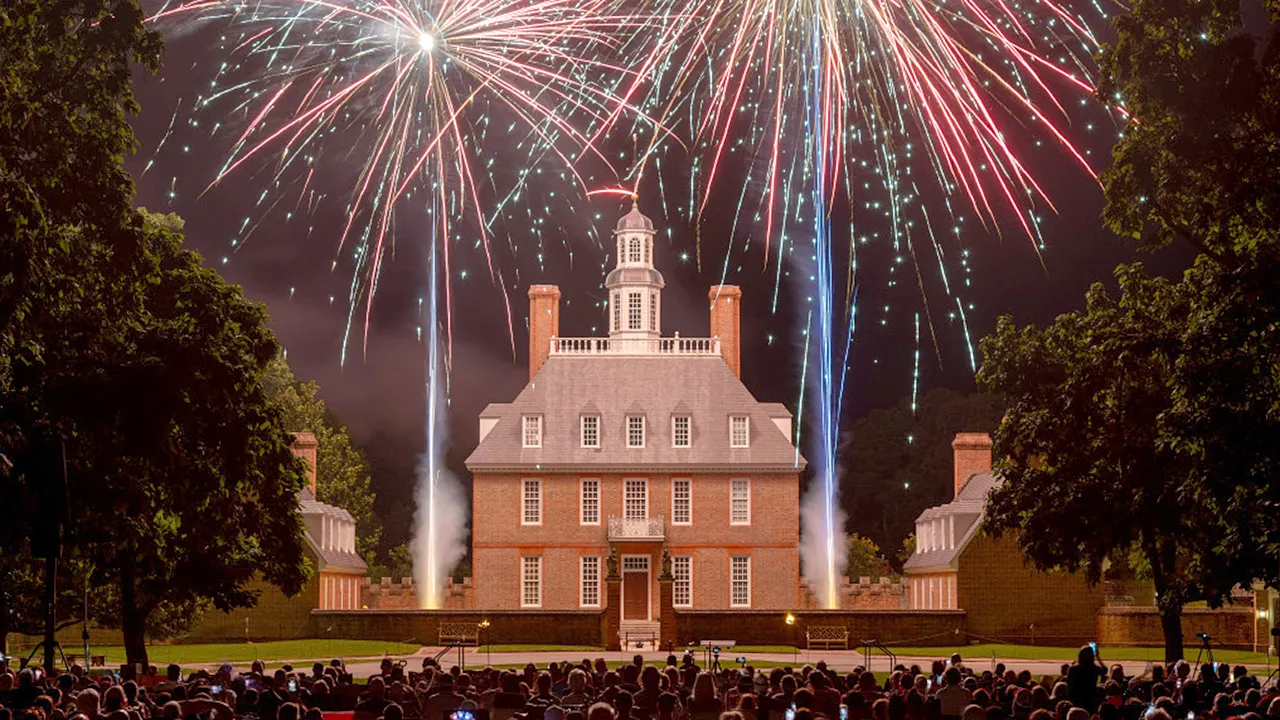
As the highly anticipated July 4th celebrations of the Semiquincentennial approach, Williamsburg is preparing to open its arms wider than ever before, offering an array of spectacular, free public programs designed to welcome and inspire guests from all walks of life. The day’s grand festivities will feature dramatic, emotional readings of the Declaration of Independence, stirring military reenactments with thundering fife and drum corps, interactive audiences with costumed historical figures, and complimentary, all-access admission to the town’s world-class art museums and historic structures. The day will culminate in a breathtaking, sensory-rich evening spectacle on the Courthouse Green, where the booms of a massive, traditional fireworks display will harmonize with a synchronized, state-of-the-art drone light show dancing across the Virginia night sky. This brilliant fusion of 18th-century heritage and 21st-century innovation serves as the perfect, poetic metaphor for the ongoing progress of the nation—a visual reminder that while America’s founding ideals were forged in the fires of the past, the work of building a more perfect union remains an active, evolving, and deeply human endeavor that belongs to us all, calling on every generation to carry the torch forward.