



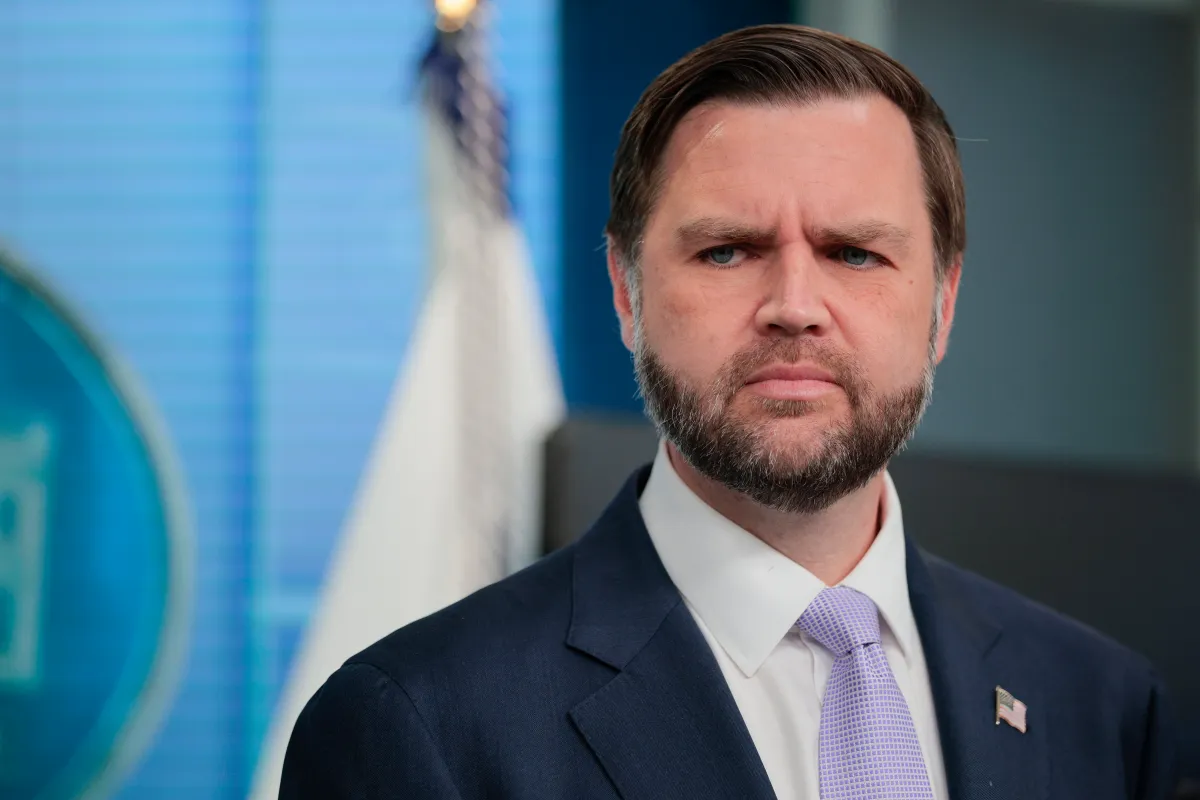
In a political landscape often defined by rigid polarization and soundbite-driven debates, Vice President JD Vance’s new book, Communion: Finding My Way Back to Faith, arrives as a deeply reflective and system-challenging manifesto. Rather than viewing faith as a convenient tool for partisan mobilization or a private hobby to be hidden from the public square, Vance presents Christianity as an indispensable moral framework capable of healing America’s deepest fractures. As a high-profile convert to Catholicism, Vance’s spiritual journey has led him to a place of profound skepticism toward the modern political status quo. He offers a blistering, even-handed critique of both major political parties, arguing that they have systematically divorced their political ideologies from the realities of human suffering and genuine moral integrity. By dissecting the spiritual failures of both the American Left and Right, Vance attempts to rescue faith from the clutches of partisan exploitation, urging a return to a holistic Christian vision that places human dignity, family cohesive wellness, and community restoration above political expediency. He challenges the American populace to reconsider how ancient teachings can shed light on modern crises, arguing that a society without a shared moral center is doomed to eat itself alive from the inside out.
Vance’s critique cuts straight to the heart of the modern cultural divide, accusing both political extremes of elevating false idols at the expense of common-sense human flourishing. He reserves particularly sharp words for his fellow Republicans, whom he accuses of blindly worshiping the dogmas of the free market, assuming that unregulated commercial transactions will naturally produce a moral and healthy society. Concurrently, he takes aim at Democrats for what he describes as an idolatry of the self, where every action or whim pursued in the name of individual self-discovery is automatically celebrated as a moral good. This dual critique reveals Vance’s belief that both political philosophies have abandoned the common good in favor of sterile, transactional dogmas. To Vance, the widespread clamor for a total separation of church and state has not liberated American politics; instead, it has sterilized it. When politicians demand that the Church remain silent on controversial issues, they effectively strip society of its moral conscience, isolating faith in a sterile box and rendering the Church irrelevant to the tangible struggles of daily life. Vance argues that a genuine Christian faith must inform every facet of a person’s existence, including how they vote, organize communities, and govern, rather than being treated as a dynamic that can be turned on and off depending on which political party’s agenda is on the line.
Perhaps nowhere is this tension more palpable than in the ongoing national debate over immigration, a topic where Vance’s defense of the Catholic Church’s moral authority has surprised both allies and adversaries. In the wake of a deeply compassionate 2025 statement by the US Conference of Catholic Bishops expressing alarm over aggressive border policies, family separations, and the dehumanizing rhetoric surrounding undocumented migrants, many conservative hardliners reacted with intense anger. Former Border Czar Tom Homan famously dismissed the bishops’ concerns, telling the Catholic Church to focus on fixing its own internal scandals rather than lecturing the government on border enforcement. Vance, however, took a remarkably different path in his book, defending the bishops’ statement as “admirably measured” and praising the late Pope Francis for forcing painful but necessary conversations about our collective moral responsibilities. While acknowledging the government’s legitimate right to secure its borders, Vance emphasizes that the Church has a divine mandate to stand in solidarity with the vulnerable, remind migrants that they are not alone, and assert that national security and basic human dignity do not have to be mutually exclusive goals. By validating the Church’s voice on such a controversial issue, Vance models a form of political leadership that refuses to discard religious teachings when they become politically inconvenient.
Applying Christian principles to the messy, real-world reality of immigration is, as Vance readily admits, one of the most agonizing challenges of modern governance. He explicitly rejects the simplistic, black-and-white hypotheticals favored by partisans on both sides of the aisle, urging instead an honest confrontation with the tragic human costs of policy decisions. For instance, Vance points out that even if one believes deportations are lawful and necessary for maintaining the rule of law, the actual execution of those deportations will inevitably bring immense personal heartache, shattered families, and profound human suffering. Conversely, he warns that overly Lax border enforcement is far from compassionate, as it actively fuels the horrific black market of human trafficking and exploitation of vulnerable people. Furthermore, he touches upon the socio-cultural challenges of rapid demographic shifts, noting that excessive levels of immigration can strain a nation’s capacity for cultural assimilation and social cohesion. Vance argues that as secularism grew and political leaders actively rejected the unifying moral grammar of Christian culture, the nation lost its shared foundation, resulting in widespread identity crises, rising loneliness, gender divides among young people, and a declining population. In his view, a renewed embrace of Christian cultural principles would surprisingly create a more robust, stable society capable of sustaining deep, respectful debate and disagreement without collapsing into tribal warfare.
This same demand for moral integration extends into Vance’s vision for the American economy, where he raises a fundamental question: what does a truly Christian economy look like in the modern world? He strongly rejects the prevailing capitalistic obsession with maximizing Gross Domestic Product (GDP) above all else, arguing that economic metrics are only valuable insofar as they promote actual human flourishing and support stable family life. To Vance, treating the economy as an end in itself, rather than a practical tool to help human beings live good and virtuous lives, is a form of self-dehumanization. He heavily criticizes former Vice President Kamala Harris’s economic proposals, such as expanding the public school day to align directly with corporate working hours, viewing it as a capitulation to a corporate-dominated lifestyle that forces parents to spend more time working and less time with their children. Vance insists that the solution is not to warp childhood to fit the grueling demands of the modern office, but to reform the economy so that parents are empowered to work less and be present in their homes. By centering the economic conversation on the preservation and nurture of the nuclear family, Vance seeks to shift the political paradigm away from raw transactional efficiency and toward relational health and parental dignity.
Vance’s most passionate economic criticism, however, is aimed directly at the hyper-capitalist and libertarian factions within the conservative movement, whom he accuses of practicing a cold, sterile worship at the altar of commerce. He explicitly calls out free-market advocates like Vanessa Brown Calder of the libertarian Cato Institute, who argued against federally mandated paid parental leave on the grounds that it would increase labor and healthcare overhead costs for private corporations. Vance describes this line of reasoning as astonishingly heartless and intellectually bankrupt, pointing out the moral absurdity of suggesting that paid leave is bad for women simply because it might temporarily trim the profit margins of their employers. For Vance, this argument represents the darkest extreme of a society that has completely surrendered its moral values to the demands of business and corporate efficiency. He argues that a truly Christian economic model must be radically restructured around the concepts of creation, family protection, and human dignity, urging Christians to stop neglecting economic justice in favor of fighting purely symbolic cultural battles. Ultimately, Vance’s Communion serves as an urgent, deeply humanizing call to action, challenging Americans to rebuild a society where spiritual depth, economic fairness, and a universal respect for the dignity of every single human being are no longer treated as political compromises, but as the very foundation of our shared national life.