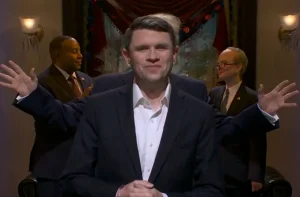


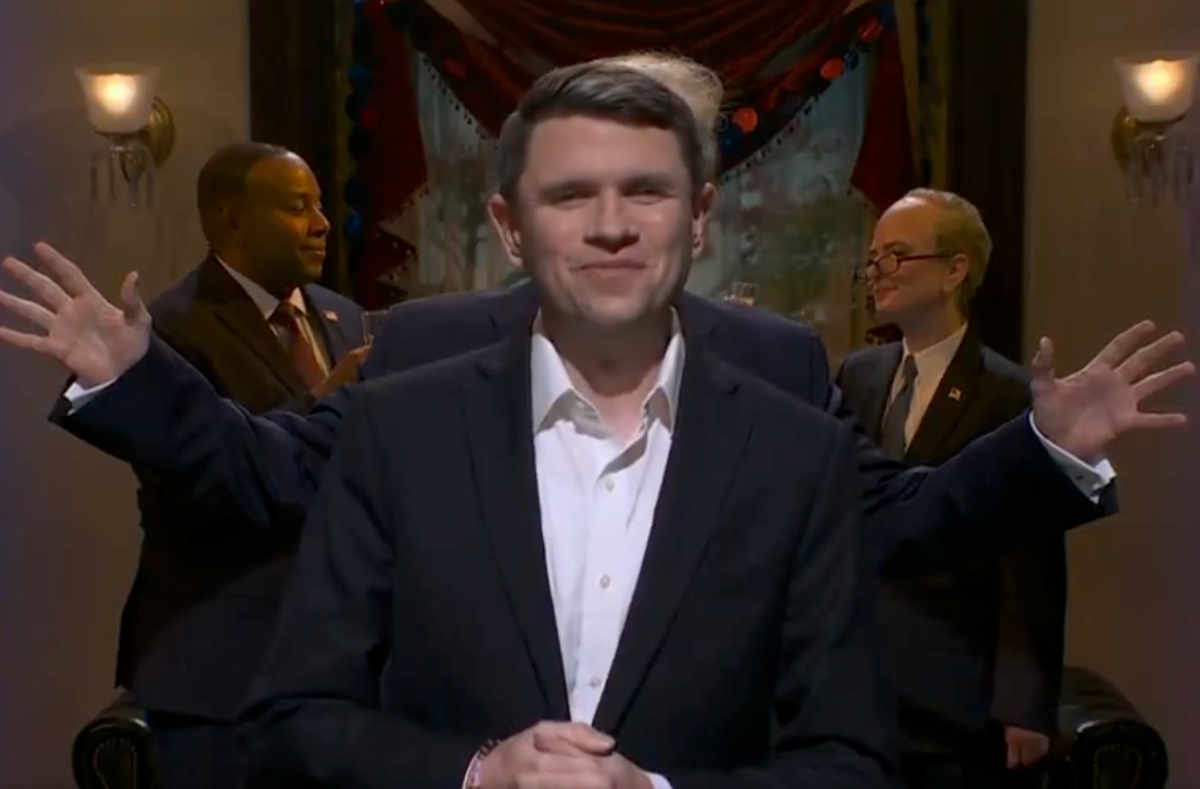
When the dust settled after the midterm elections, America did what it always does in the aftermath of political chaos: it switched on Saturday Night Live and prayed for a laugh. The show’s first post-election cold open delivered exactly that, opening with a familiar face for anyone who had been glued to campaign-season texts. Democratic Texas Senator-elect James Talarico appeared on screen, smiling and self-aware, introducing himself with a line that cut through the political noise. “Hi, I’m James Talarico, the guy who’s been texting you every day asking for $5,” he said. The joke landed because it was true, not just about him, but about every candidate who has ever flooded your phone with desperate, all-caps pleas for small-dollar donations. Even the fictional Donald Trump, played with uncanny rhythm by James Austin Johnson, couldn’t resist the joke. “In this economy, who can blame you?” Trump replied, offering a rare moment of bipartisan understanding over the shared pain of inflation and the even more shared pain of being constantly asked for money. Talarico then pivoted to something loftier, suggesting that maybe, just maybe, Democrats and Republicans could work together to make life better for everyday Americans. It was the kind of earnest, hopeful note that usually closes a campaign speech, but Talarico undercut it beautifully: what people really wanted, he said, was something new and different from SNL’s cold opens. “How many of these Trump freezes are they going to do?” he asked, breaking the fourth wall and speaking for exhausted viewers everywhere who have watched the same sketches repeat like election night itself.
That self-referential humor set the tone for the whole episode, which leaned heavily into the relief and exhaustion of a post-midterm America. Hosting the show was Druski, the comedian and digital content creator who made history as the first online personality to host in the show’s 52-season run. His presence felt like a deliberate acknowledgment that political comedy no longer belongs solely to the late-night establishment; it lives on TikTok, Instagram, and YouTube, where sketches are clipped, shared, and memed within seconds. Druski’s hosting slot was the show’s way of saying it understood that the audience has changed, even if the politics haven’t. His sketches painted a vivid picture of the aftermath, with the fictional Trump trapped in a state of post-midterm depression while Democrats floated around in something close to euphoria. The visual gag of Trump wandering through the White House construction site, obsessing over the ballroom, was a perfect metaphor for a presidency reduced to vanity projects and personal grievance. “That’s it. That’s all I care about,” Trump said, gazing at a beam and a slab of marble as though they were the only remaining proof of his relevance. “Look at that beam, big beam over there. Look at that and marble, the likes of which you’ve never seen.” Then came the punchline, delivered with a sigh that felt both funny and strangely human: “Oh my God, I hate my life. Next two years are going to be awful.” It was the sound of a man who had lost the control he once had, and who now had to face the terrifying prospect of working with people who were not just Democrats, but, worse, millennials. That final jab—dismissing an entire generation as the true obstacle—was the kind of petty, absurd complaint that made the sketch feel less like a political takedown and more like a portrait of a leader who simply cannot cope with a world that has moved past him.
The chaos deepened when Colin Jost appeared as Pete Hegseth, the Secretary of War, in a scene that perfectly captured the grim comedy of loyalty in a crumbling administration. Hegseth promised the president he would never leave him, but the promise came wrapped in a self-destructive energy that made it sound more like a threat than a vow. “Do I look like a person who gets less crazy when backed into a corner?” Hegseth asked, and the answer, of course, was no. He described himself as living a “YOLO lifestyle,” which in this context meant losing constantly and proudly, refusing to change course even when every sign pointed to disaster. “I’m gonna keep losing for you, sir, unless Congress impeaches me,” he said, and then added, with a childlike desperation, “But you won’t let that happen, right?” Trump’s response was both reassuring and terrifying: “Of course not. Unless I do, which I will.” That single exchange distilled the whole ethos of the modern political machine—the promise of loyalty, the inevitability of betrayal, and the strange comfort both parties find in knowing that nothing lasts. It was funny because it was absurd, but it was also funny because it was uncomfortably plausible. The joke worked because Jost played Hegseth not as a villain but as a true believer who has confused losing with winning, and Trump played himself as someone who will discard anyone the moment they stop being useful. It was a two-minute masterclass in how political satire can make you laugh at the same time it makes you wince.
Weekend Update kept the momentum going with a series of jokes that reminded everyone why SNL remains a cultural touchstone. Jost, sitting behind the desk with his usual half-smile of controlled chaos, delivered one of the night’s sharpest lines about the transition of power within the White House. Going from Chief of Staff Susie Wiles to Stephen Miller, he said, was like “trying to get through a dinner party by switching from wine to meth.” The comparison was absurd, yes, but it captured something real about the tonal whiplash of moving from a steady, professional presence to someone widely seen as a hardline ideologue. It was the kind of joke that works on multiple levels: it makes you laugh, it makes you think, and it makes you wonder how anyone survives a single day inside that building. The audience laughed, but there was probably a little unease underneath the laughter, because the line pointed at a deeper truth about the people who surround power and the strange chemistry that keeps an administration from imploding entirely. Jost didn’t stop there. He went on to note that with Democrats back in control of Congress, Trump was now free to spend the rest of his time in office doing what he does best: bejazzling the White House. The image of the president adding rhinestones and sequins to the People’s House was ridiculous, but it also fit the larger theme of the evening—that when politics becomes too much, the only sane response is to reduce it to glitter and nonsense.
What made the episode feel particularly resonant was how it leaned into the emotional reality of the moment rather than just the political one. The midterms had been tense, exhausting, and full of conflicting narratives, and the show seemed to understand that viewers weren’t looking for a victory lap or a doom spiral. They were looking for permission to breathe. Druski’s sketches, especially the ones portraying Democrats’ elation, gave voice to the giddy relief of a party that had feared the worst and ended up with reason to smile. But the show also gave Trump his own strange dignity, portraying him not as a monster but as a sad, frustrated man obsessed with ballroom beams and marble. That choice was humanizing in a way that might make some viewers uncomfortable, because it’s easier to laugh at someone you hate than someone you pity. By letting Trump be pathetic rather than purely evil, SNL made the sketch feel more like a collective exhale than an attack. It acknowledged that politics is not just about policies and elections; it’s about feelings, about the tiny absurdities of human behavior that make even the most powerful people look small. The cold open’s willingness to make fun of its own tropes—the Trump freezes, the endless calls for donations, the recycled sketches—was another sign that the show knows it exists in a media landscape where audiences are more savvy and more cynical than ever.
In the end, this episode of Saturday Night Live was more than just a collection of political jokes. It was a mirror held up to a nation trying to process the aftermath of an election cycle that had everyone on edge. The appearance of James Talarico, a real politician willing to laugh at himself, suggested that perhaps the line between politics and entertainment has become permanently blurred. Druski’s historic hosting slot signaled that the show is willing to evolve, opening its doors to the digital creators who have reshaped comedy for a new generation. And the jokes at Trump’s expense—whether about his ballroom, his staff, or his increasingly fragile grip on the political moment—reminded us that laughter is one of the few tools we have to make sense of chaos. The weekend update line about “bejazzling the White House” was funny because it was pure nonsense, but it also captured something true: when the big battles are over, what remains is the slow, strange work of living with the aftermath. We may not know what the next two years will bring, but if SNL has anything to say about it, at least we’ll be laughing. And in a world as divided and unpredictable as ours, that might be the most human response of all.