


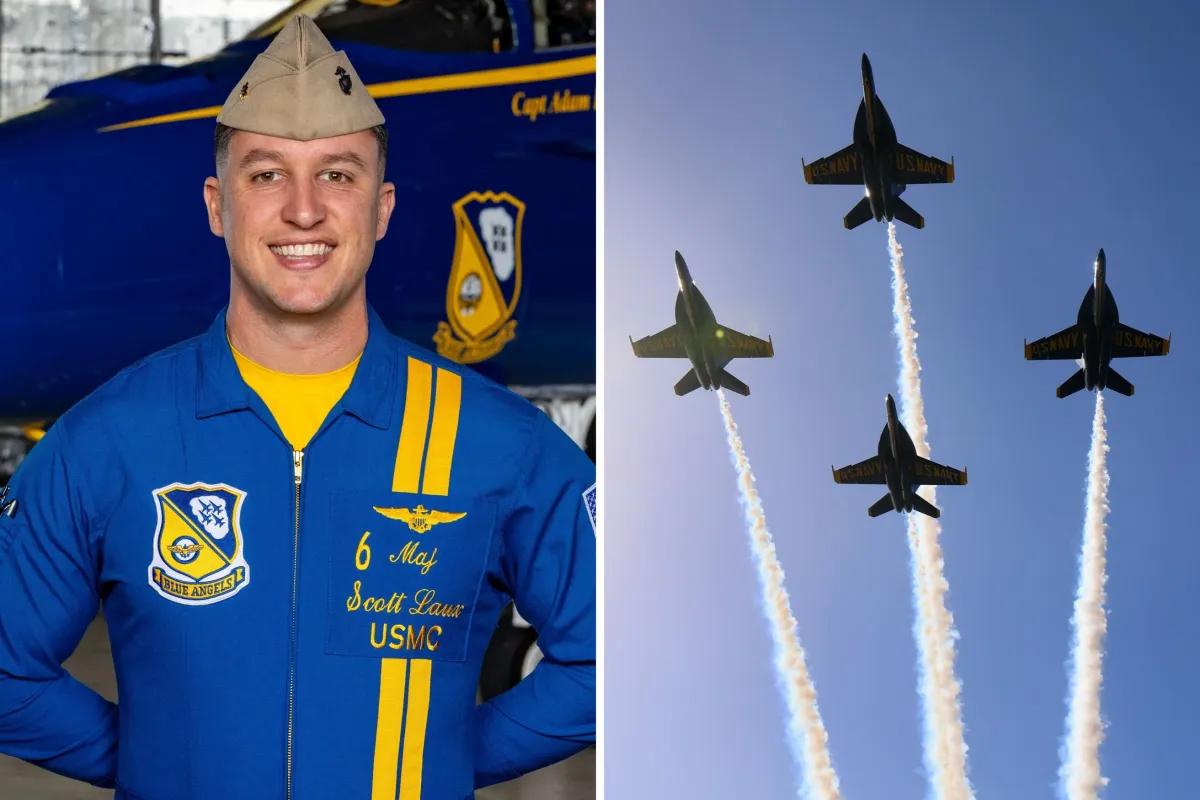
In the high-stakes world of naval aviation, there is no louder symbol of American skill, discipline, and daring than the Blue Angels. For decades, the Navy Flight Demonstration Squadron has turned the sky into a canvas of precision, painting it with the roar of F/A-18 Super Hornets and the unmistakable grace of pilots who seem to defy physics itself. So when news broke that one of those pilots had been removed from the team, the silence that followed spoke volumes. Marine Corps Major Scott Laux, the pilot assigned to the coveted No. 6 jet as the team’s opposing solo pilot, has been stripped of his place in the squadron for what the Navy described as “failing to uphold the standards expected of members of the Navy Flight Demonstration Squadron.” The statement, issued by the Chief of Naval Air Training public affairs office to the Pensacola News Journal, was short, formal, and conspicuously lacking in detail. There was no mention of a specific incident, no explanation of what went wrong, and no timeline given for when Laux was removed or when the decision was made. What remained was a quiet but seismic announcement: one of the most visible pilots in the United States military was no longer part of the team, and the reasons were locked away behind the same iron discipline that defines the Blue Angels themselves.
The removal came at a particularly poignant moment. The squadron was preparing for its Homecoming Air Show at Naval Air Station Pensacola in Florida, the annual event that marks the team’s final performance of the season and, this year, doubled as a celebration of the base’s 200th anniversary. It was supposed to be a weekend of triumph, nostalgia, and jaw-dropping aerial artistry. Instead, spectators on the first day noticed something unusual in the sky: the Blue Angels flew with only five jets, not the customary six. The missing aircraft was Laux’s. His photograph and biography had also vanished from the Blue Angels’ official website, a digital erasure that made the situation feel even more definitive. For those in the know, the sight of five planes flying in formation was a subtle but unmistakable signal that something was deeply wrong. The Blue Angels are a tightly choreographed machine, and every position matters. When one of the six pilots disappears, the entire performance shifts. The team pressed on, as military aviators always do, but the absence hung over the event like a quiet ghost. Visitors who had come to see perfection instead witnessed a reminder that even the most polished institutions are made of fallible human beings, and that the standards required to stand among the best can be as unforgiving as they are inspiring.
To understand the weight of this moment, it helps to understand what it means to be a Blue Angel. The team, formally known as the Navy Flight Demonstration Squadron, is based at NAS Pensacola and serves as the public face of naval aviation. Its pilots are not just exceptional fliers; they are ambassadors, role models, and living proof of what can be achieved through relentless training and unwavering focus. Every Blue Angel is handpicked from the top echelon of military aviators, and each one carries the burden of representing not only the Navy and Marine Corps but the entire nation. The standard is not merely excellence; it is perfection, or at least the relentless pursuit of it. There is no room for complacency, no tolerance for shortcuts, and no acceptance of behavior that might tarnish the reputation of the squadron. The phrase “failing to uphold the standards expected” is vague, but in the context of the Blue Angels, it is also devastating. It suggests a breach of trust or conduct serious enough to warrant removal from a team that prides itself on being beyond reproach. And because the Navy has not publicly disclosed the reason, the imagination fills in the gaps with rumors, speculation, and unease. What could a pilot do to lose such a prestigious position? The lack of answers only deepens the mystery and reminds us that the military’s internal code of honor operates far beyond the reach of public curiosity.
For those who have followed Laux’s career, the news is especially difficult to reconcile with the trajectory of his life. A native of Chantilly, Virginia, Laux graduated from the U.S. Naval Academy in 2012, a milestone that already placed him among the most driven and accomplished young people in the country. He earned his naval aviator wings in 2015 and spent years honing his craft, logging countless hours in the cockpit and proving himself in ways that most people will never fully appreciate. In 2024, he achieved the dream of so many aviators: he was selected to join the Blue Angels. He spent the 2025 season as the team’s narrator, the voice and face of the squadron during air shows, a role that requires charisma, composure, and the ability to connect with crowds of thousands. Then came the promotion to opposing solo pilot, a position that demands extraordinary skill and nerve. The No. 6 jet flies directly at the crowd and the rest of the formation, performing razor-thin passes and high-speed maneuvers that leave audiences breathless. It is one of the most thrilling and dangerous roles in all of aviation. To be chosen for it is to be trusted implicitly by the team. To lose it is to have that trust revoked in the most public and final way possible. Laux’s story, until now, was one of relentless ascent. This chapter, however, changes the narrative entirely, leaving a talented pilot’s future uncertain and his reputation tangled in questions that may never be answered.
The official silence is perhaps the most unsettling part of the story. No disciplinary allegation has been publicly identified, and no flight-safety incident has been linked to Laux’s removal. That absence of information creates a strange vacuum, one that invites speculation about everything from personal conduct to a breakdown in the tight-knit culture of the squadron. It is possible that the matter is serious enough to be handled privately, either through administrative channels or by the Marine Corps’ own disciplinary processes. It is also possible that the removal stems from something less dramatic but no less significant in the eyes of the Navy, like a failure to maintain the physical or mental readiness that the role demands. The military often shields the details of personnel actions to protect privacy and ensure fair treatment, and that is undoubtedly part of what is happening here. But for the public, which has been conditioned to see the Blue Angels as flawless, the ambiguity is hard to accept. We want heroes to be simple, their stories clean and uplifting. Laux’s removal reminds us that the line between triumph and fall can be thinner than we imagine, and that the institutions we admire are made up of humans who, despite extraordinary abilities, can still stumble. What matters now is not just what Laux did or failed to do, but how the team moves forward, how the Navy maintains its integrity, and how a promising career navigates the wreckage of an unexplained fall from grace.
In the end, this story is about more than one pilot or one air show. It is about the nature of standards and the cost of greatness. The Blue Angels have always represented the pinnacle of military aviation, a gleaming symbol of what happens when talent meets discipline. But symbols are maintained by people, and people are not infallible. The decision to remove Laux from the team was not made lightly, and it speaks to a culture that values the mission above the individual, even when the individual is exceptional. The Homecoming Air Show went on, as it always does, and the team flew on with five jets instead of six, proving that the show must continue even in the face of disappointment. For Laux, the road ahead is uncertain. He remains a Marine Corps major with years of experience and a resume that most pilots can only dream of, but the weight of this removal will follow him. The Blue Angels will also carry this moment, though they will likely never speak of it publicly. They will tighten their formation, sharpen their focus, and remind themselves why the standards exist in the first place. And the rest of us, watching from the ground, will be left with a complicated truth: that the cost of perfection is sometimes the very people who chase it, and that even the brightest stars can disappear from the sky without warning. This is a developing story, and more details may emerge in the days ahead. But for now, the silence from the Navy and the empty space where a sixth jet should have been say more than any official explanation could. The Blue Angels are still flying, but they are doing so with one fewer pilot, and that absence is felt not just in the formation, but in the hearts of everyone who understands what it means to wear the wings.