

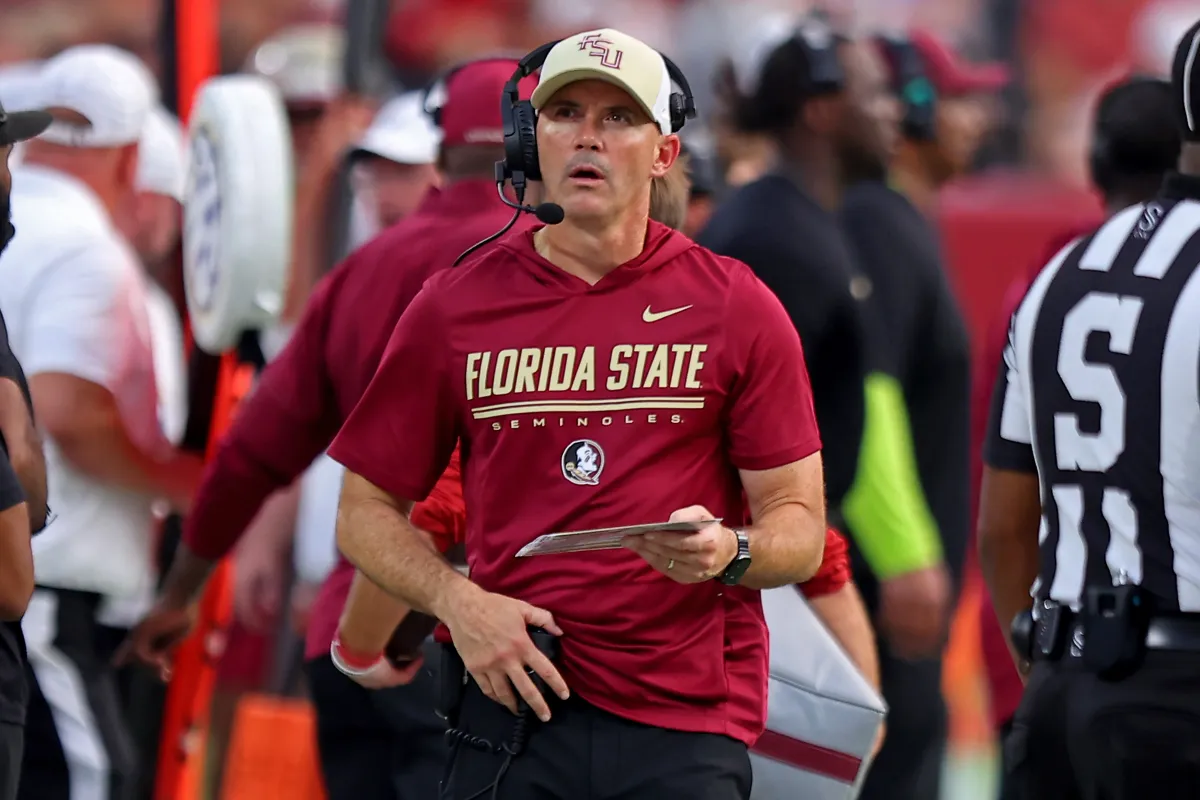
In the unforgiving, high-stakes theater of college football, Sunday brought a seismic shift to Tallahassee. Less than twenty-four hours after the Florida State Seminoles stumbled to a 36-24 home defeat against archrival Clemson, slipping to a despondent 3-5 record and suffering their third consecutive loss, the university made a decision that had been hanging over Doak Campbell Stadium like a storm cloud for months: head coach Mike Norvell was fired. The announcement didn’t just signal a change in leadership; it represented the end of an era that promised so much, only to crumble under the weight of unmet expectations. For the passionate Seminole faithful, it was a gut-wrenching mix of relief and sorrow—relief that the agony of a plummeting program might finally be addressed, and sorrow for a coach who once brought them to the mountaintop of the ACC just two years prior. The loss to Clemson wasn’t just a defeat; it was the final straw in a season that had spiraled out of control, a season where the team looked disjointed, unprepared, and utterly bereft of the magic that had characterized their 2023 run. The decision, swift and brutal, underscores the harsh reality of big-time college athletics where patience is a luxury no one can truly afford.
Beyond the emotional fallout, the firing triggered a financial earthquake that showcases the absurd economics of modern college sports. Florida State is now owing Norvell a staggering $50.3 million in buyout money, a figure that ranks among the largest in the history of the game. It is a profound amount of money, enough to fund entire athletic departments for years, yet here it is handed over for a coach who simply couldn’t replicate his success. While the university hopes that this monetary sacrifice is an investment in a brighter future, it also highlights a paradox: paying enormous sums to make someone go away while simultaneously needing to shell out even more to attract a replacement. In the meantime, the program has turned to Rick Stockstill, a familiar name in the coaching circles, to step in as the interim head coach. Stockstill, who recently stepped down as head coach at Middle Tennessee, inherits a fractured locker room and a schedule that offers little mercy. He must corral a group of players who are likely auditioning for their own futures, while the athletic director’s phone rings off the hook with agents touting their clients. The search for a permanent replacement has already begun in earnest, with names circulating among the fanbase and media, each candidate bringing their own baggage and potential. For now, the Seminoles are in a state of suspended animation, waiting for a savior to walk through the door.
Offering an outsider’s perspective that resonated deeply was Urban Meyer, the legendary former head coach of Ohio State and Florida. Meyer, never one to mince words, expressed a surprisingly human sentiment regarding Norvell’s plight. “I’m actually happy for the guy… Move on, go enjoy your family. You made some money there,” Meyer remarked. But his empathy was tinged with a brutal honesty that exposed the undercurrents of the situation. “I mean, it’s been coming for three years,” he said, pointing directly at the structural decay that had been plaguing the program. Meyer illuminated the harsh reality of roster management in the transfer portal era, noting the constant churn of players. “The culture just is constantly shifting when you’re having this many players come in every year. You know, you have 40 or 50 every year coming in. I can’t even fathom that.” He went on to emphasize the immense pressure on the coaching staff to not only recruit but to develop these newcomers, warning that “You better pick the right ones, man.” Meyer’s words echo the sentiment of many veteran coaches who feel that the traditional model of building a program through high school recruits and gradual development has been upended, replaced by a mercenary culture where loyalty is fleeting. For Norvell, the constant influx of new faces meant he never truly had a cohesive unit, just a collection of individual talents trying to mesh on the fly. Meyer’s interpretation strips away the jargon to get to a core truth: Norvell lost the battle against the chaotic modern landscape, and the shackles of that system ultimately proved too heavy to bear.
To truly understand the tragedy of Mike Norvell’s tenure, one must revisit the dizzying heights of 2023. Taking over a program mired in mediocrity in December 2019, Norvell painstakingly rebuilt the roster, installing a dynamic offense and a culture of accountability. That work culminated in a magical 13-1 season, an ACC championship, and a team that was tragically snubbed from the College Football Playoff despite an undefeated regular season. For a fleeting moment, Florida State was back among the nation’s elite, and Norvell was hailed as a genius, a coach who had resurrected a sleeping giant. But the fairy tale didn’t last. The snub seemed to have sapped the program’s energy, and Norvell never managed to recapture that lightning in a bottle. Over the next three seasons combined, the Seminoles won just ten games—a staggering collapse that rivals the rapidity of their rise. They never sniffed the playoffs again, and this season, they’ve been a shadow of their former selves, looking lost on both sides of the ball. The human toll of this precipitous fall is immense. Norvell poured his heart into that 2023 squad, and when they were denied their deserved playoff berth, something within the program broke. The subsequent failure to maintain that high standard led to a slow burn of disillusionment among the fanbase, and as the losses piled up this year, the whispers grew louder until they became a deafening roar. The decision on Sunday was not a rash one; it was the logical conclusion of years of decay, a clear acknowledgment that the magical season was an anomaly rather than a new baseline. Norvell’s story at Florida State is a poignant reminder that in sports, the line between triumph and tragedy is razor-thin, and the glory days can evaporate just as quickly as they arrived.
The root cause of Florida State’s precipitous decline can be traced to a deeply flawed roster construction strategy that prioritized short-term fixes over long-term stability. The program became overwhelmingly reliant on the transfer portal, viewing it as a quick hit to fill holes left by departing players. According to 247Sports’ transfer tracker, the numbers are damning: from 2022 to 2026, over 80 players transferred into the program, while a staggering 140 players transferred out. That’s a net loss of more than 50 players across five cycles, creating an environment of perpetual turnover and instability. Humanizing this data, imagine trying to build a cohesive family where a third of the members move out every year and a new batch of strangers moves in. Camaraderie becomes impossible; trust is hard to earn; and the all-important continuity that breeds success on the football field is shattered. The portal can certainly help a program patch a leak, but when it becomes the primary pipeline for talent, it exposes a fundamental failure to develop homegrown players. Furthermore, the Seminoles struggled to consistently land elite high school recruits, missing out on the blue-chip prospects who are the lifeblood of sustainable success. Without a solid foundation of four-year players who understand the system, the culture, and the pride of wearing the garnet and gold, the team was left as a hollow shell, susceptible to collapse at the first sign of adversity. Norvell and his staff were tasked with alchemically mixing these disparate parts into successful football, but it proved to be an impossible task. The identity of the team was never clear because the roster changed so dramatically year to year, leaving Florida State in a state of perpetual rebuilding mode, unable to ever truly take that next step toward championship contention.
As the sun sets on the Norvell era, the search for his successor begins with a clear mandate: restore stability, recruit and develop high school talent, and establish a winning culture that can withstand the chaos of the transfer portal. The next coach must be a master of the modern recruiting landscape, capable of selling a vision that brings in elite talent and then keeping it engaged and loyal. Several names have already floated to the surface as potential replacements, each offering a different skill set. Duke’s Manny Diaz, a defensive mastermind with Florida roots and an aggressive coaching style, has been prominently mentioned, representing a blend of experience and youthful energy. Missouri’s Eli Drinkwitz, known for his offensive acumen and ability to overachieve with his rosters, presents another intriguing option, while Wake Forest’s Jake Dickert and Arizona State’s Kenny Dillingham are considered up-and-coming minds who might relish the challenge of a massive rebuild. The ultimate wild card is the return of Jimbo Fisher, the former Florida State national championship coach whose own tenure at Texas A&M ended disastrously, yet whose legacy in Tallahassee remains golden. Whoever steps in will inherit a program with enormous resources and a passionate fanbase, but also one fractured by failed schemes and a disenchanted roster. They will need time, patience, and a believe-it-or-not, understanding that the constant turnover is the new normal. But they will also bring a renewed sense of hope, a blank slate for the 2026 season. For the fans, the firing of Norvell is a bitter pill to swallow, a painful admission that their dream of returning to national prominence is further away than they thought. Yet, it is also the necessary first step in a cyclical journey—a journey defined by high expectations, crushing disappointments, and the eternal, irrational optimism that the next coach might just be the one to bring the trophy home again. The chaos is part of the fabric of college football, and in the wreckage of a 3-5 season lies the fragile promise of a new beginning.