

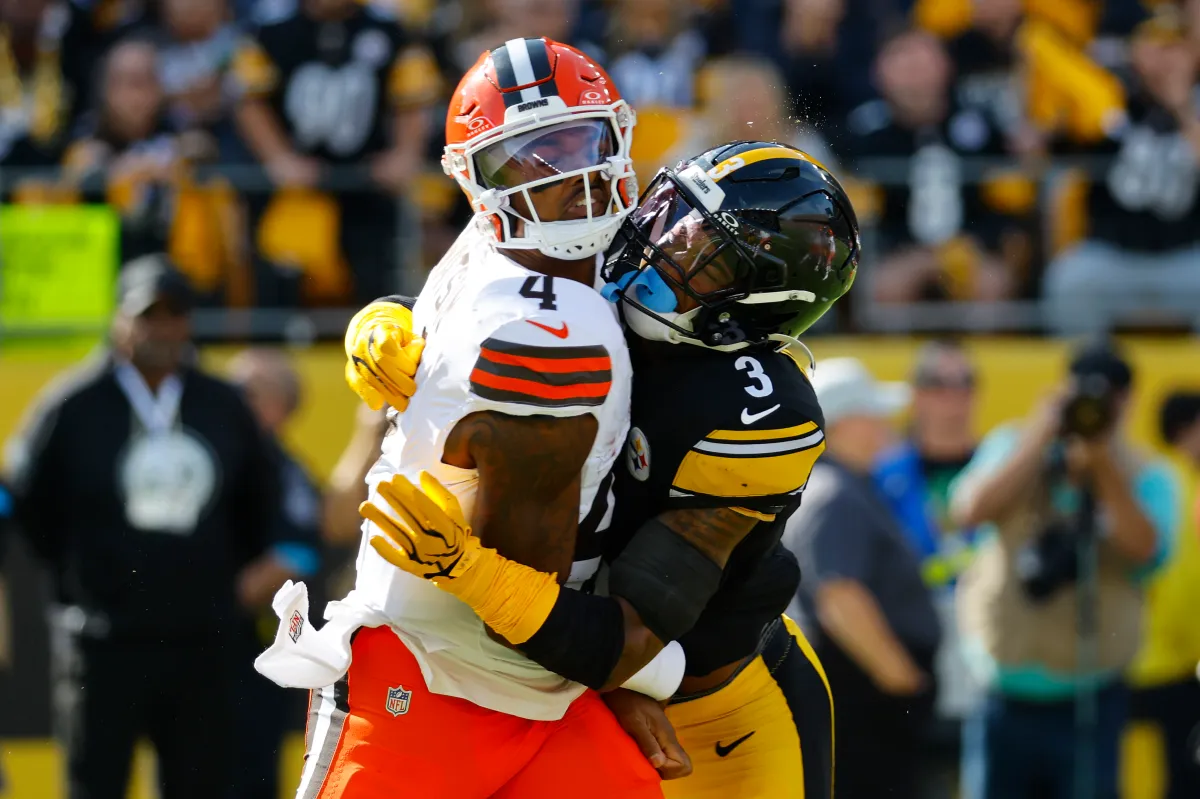
The Pittsburgh Steelers walked out of Acrisure Stadium last Sunday with more than just a victory—they seized control of the AFC North with a commanding 27–6 win over their bitter rivals, the Cleveland Browns. But even as the scoreboard told a story of domination, the real narrative of the afternoon unfolded in the opening minutes, when the game’s most pivotal moment sent shockwaves through both sidelines and the broader NFL conversation. Just three plays into the contest, Steelers safety Jaquan Brisker came screaming off the edge on a blitz, timing his arrival to perfection. He met Browns quarterback Deshaun Watson high, leading with his shoulder into the passer’s chest and neck area, and the referee’s flag immediately fluttered to the turf. The call was roughing the passer, a penalty that has become the sport’s most contentious and carefully policed infraction. Watson lay on the grass for a moment, slow to rise, and then made his way toward the medical tent, leaving the Browns’ offense in limbo. In his absence, rookie Shedeur Sanders stepped in and completed a pair of passes before Watson returned to the field and finished the game. Yet the damage was done—not just to the scoreboard, but to the deeper tensions simmering beneath the surface of this hard-hitting rivalry.
Brisker did not hide his frustration after the whistle, nor in the locker room afterward. He argued with the officials on the field, his helmet still on, his voice amplified by adrenaline and conviction. He insisted that the collision was clean, a textbook football play, and that Watson had embellished the contact by appealing to the referees. In his postgame comments, Brisker did not hold back, poking fun at Watson for complaining and suggesting that the quarterback’s theatrics were part of a larger attempt to manipulate the game’s rules. Watson, for his part, did not make accusations in the moment, but the situation took a serious turn on Saturday when the Browns announced that he had reported concussion symptoms after the game. He entered the league’s concussion protocol, casting doubt on his availability for the upcoming matchup against the New Orleans Saints. And so, with the clouds of uncertainty gathering over Cleveland, the team turned to Sanders once again, preparing him to start on Sunday in the hostile Superdome. The irony was not lost on anyone: a hit that Brisker believed to be a legitimate football play had not only changed the course of a game but also disrupted a season.
The financial consequences of that split-second decision arrived with the cold efficiency of a league office press release: Brisker was fined $17,911, the standard first-offense amount for roughing the passer. It was a modest sum relative to his contract, but its symbolic weight was heavier. The NFL has spent the past decade redefining the boundaries of legal defense, and protecting the quarterback has become the league’s highest priority. In Week 8 alone, the league handed out 31 fines, the second-highest total in a single week this season, bringing the season-long count to 223. Those numbers are not arbitrary; they represent a deliberate, systemic effort to change behavior through the pocketbook. Brisker was far from alone. Rashan Gary of the Cowboys, K’Lavon Chaisson of Washington, and Odafe Oweh all received similar fines for hits on quarterbacks in the same week. The league is making an unmistakable statement: no matter the context, no matter the rivalry, no matter the intensity of competition, the quarterback will be protected, and those who violate that sacred trust will pay.
For decades, the AFC North has built its identity on the kind of football that makes a referee’s arm tired. The Steelers, Browns, Bengals, and Ravens are franchises rooted in a tradition of grit, punishing defense, and a belief that football should be played with a certain menace. The Steel Curtain, the Dawg Pound, the tough, blue-collar ethos that defines the region—these are not marketing slogans but lived realities. When Pittsburgh and Cleveland meet, the games are often more street fight than chess match, and the crowd feeds on every bone-jarring hit. Yet the NFL’s recent emphasis on player safety has placed that very culture in the crosshairs. The league has made it clear that even in the most heated rivalry, the health and well-being of the quarterback—the sport’s most important and most exposed position—cannot be sacrificed for entertainment. The tension is not lost on players like Brisker, who grew up idolizing the very hits that now earn fines and suspensions. They are caught between the game they love and the rules designed to preserve it. And on any given Sunday, a single moment can transform a celebrated physical play into a cautionary tale.
Beyond the drama at the quarterback position, the standings tell the story of a division that remains refreshingly open. The Steelers, now 6–2, sit atop the AFC North and appear to have found their rhythm on both sides of the ball. But the Bengals are breathing down their necks at 5–2, and the Browns, despite their injury concerns, are only a game behind at 5–3. The margin for error is razor thin, and every matchup carries outsized significance. After a welcome bye week, Pittsburgh will travel to Cincinnati for a Sunday night showdown that could decide the early trajectory of the division race. From there, the road gets no easier: Philadelphia, then home games against Denver and Houston. The Browns, meanwhile, face a brutal stretch against Houston, Las Vegas, and Cincinnati, all while navigating the uncertainty of Watson’s health and the possibility that Sanders will be under center for more than just one start. The division is wide open, and both teams are firmly in the playoff picture, but the path to January is paved with treacherous games and unforgiving physical tolls.
In the end, Sunday’s victory may be remembered not for the score, but for the moment that changed the conversation. Brisker’s hit was a flashpoint, a collision between the league’s institutional priorities and the visceral, instinctive violence of football. He will appeal the fine, perhaps futilely, and the debate will rage on in barrooms and talk shows across the region. But for the Steelers and the Browns, the focus must shift forward. Pittsburgh has legitimate Super Bowl aspirations, and their defense, even without the bravado of that early blitz, has proven it can alter games. Cleveland, battered and bruised, must find a way to stay relevant in a division that grants no quarter. As the NFL continues to expand its protective umbrella over quarterbacks, players must adapt, coaches must adjust, and fans must reconcile their love of the sport with the growing list of rules that temper its chaos. The rivalry between Pittsburgh and Cleveland is as alive as ever, but the boundary between legal and illegal has never been more blurred. And while the fines pile up and the protocol sheets multiply, the game marches on, carrying with it all the passion, controversy, and stubborn spirit that have always defined football in the AFC North.