



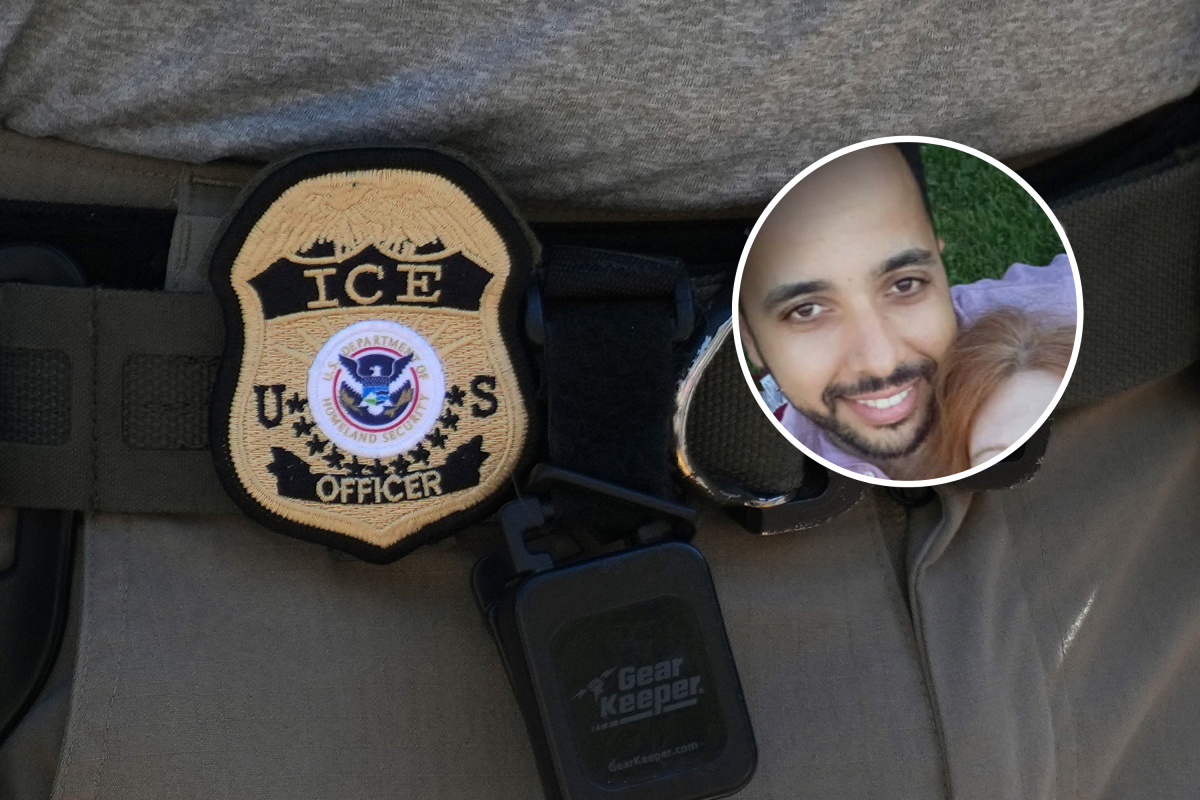
Marcos Gaspar-Da Silva’s story begins long before his arrest, rooted in the dangerous reality of his work as a civil attorney in Brazil. After taking on a contentious land dispute case in 2019 involving competing ownership claims, he became the target of serious threats that he believed were linked to the individuals connected to the case. The danger escalated to the point where he feared for his life, and he later described in a sworn affidavit that he was terrified his enemies would finally carry out their threats and kill him. His fears were not abstract—after he fled the country, his family members back in Brazil suffered violent attacks, including one relative who was shot in the face and another who was killed. These events reinforced his conviction that returning to Brazil was not an option, and they formed the foundation of his asylum claim when he arrived in the United States in 2021.
Gaspar-Da Silva’s life in the U.S. took a hopeful turn when he met and married Alessia, a U.S. citizen. By 2023, the couple was married, and in 2024 they filed an I-130 petition, the first step in the process for him to obtain a green card through marriage. This path to legal permanent residency is a common one, used by hundreds of thousands of spouses of American citizens each year. In fact, data from the Department of Homeland Security shows that in fiscal year 2024 alone, approximately 343,000 spouses of U.S. citizens obtained lawful permanent residence, making up about half of all green cards issued to immediate relatives. For Gaspar-Da Silva, this legal process was moving forward, and it seemed like he was on track to build a stable life with his wife and his 11-year-old daughter. But that progress came to a sudden and jarring halt in early January, when his life was upended by an immigration enforcement operation.
The arrest happened on the morning of January 6, while Gaspar-Da Silva was driving to work in Portland, Maine. He had stopped to pick up a coworker when federal agents pulled over his vehicle and took both men into custody. The timing was significant—this was part of a broader enforcement push that the Department of Homeland Security had announced, an operation aimed at arresting individuals in the country without legal status, with a focus on those with criminal histories. While Gaspar-Da Silva had no criminal record, and Newsweek was unable to locate any evidence of one, he was still swept up in the operation. His arrest was part of a wave of enforcement actions that took place in the Portland area, part of a national effort under the Trump administration to ramp up deportations. The operation drew criticism from local Democratic leaders, including Maine Governor Janet Mills, who called for greater transparency from federal authorities about how these enforcement actions were being carried out.
What followed for Gaspar-Da Silva was a harrowing seven-month ordeal inside the immigration detention system. He was first held locally before being transferred between facilities in different states, eventually ending up at the Florence Correctional Complex in Arizona, and later at a short-term holding facility at the Phoenix-Mesa Gateway Airport known as the AROCC. Throughout his detention, he and his wife raised alarms about the conditions he was enduring. Alessia detailed on a GoFundMe page and in interviews with local media that her husband developed a fungal rash that spread across his body, which she attributed to the unsanitary environment. He also suffered from a dental infection that he reported in February, but was told he would have to wait two to three months for treatment, and he was never given antibiotics for the abscess. Gaspar-Da Silva himself described the conditions in interviews after his release, saying he was denied access to a shower and clean clothes, that he slept on the floor, and that an overflowing toilet left fecal matter on the ground. He said he lost about 26 pounds during his time in custody, though he later regained the weight.
The emotional and psychological toll of his detention was perhaps even more devastating than the physical conditions. When he was finally released, Gaspar-Da Silva described feeling emotionally numb, a stark contrast to the tearful reunion he had imagined during his months in custody. He told the Portland Press Herald that he expected to cry when he saw his wife at the airport and again when he was reunited with his 11-year-old daughter, but instead, he felt nothing. “I was waiting for some emotions, but I don’t have emotions,” he said. “I’m happy, but I don’t feel happy.” His wife echoed this concern in interviews, noting that he was struggling to readjust to normal life and had begun seeing a Portuguese-speaking therapist to help him process the trauma. The family’s joy at his release was tempered by the reality that he was coming home a changed man, carrying the weight of what he had endured.
Gaspar-Da Silva’s release came about through a combination of legal persistence and the intervention of elected officials. His wife and legal team filed a habeas corpus petition in federal court in Massachusetts, challenging the legality of his continued detention. His case also drew the attention of Representative Chellie Pingree, a Maine Democrat, whose staff worked to pressure detention officials and advocate for his release. In August, an immigration judge granted Gaspar-Da Silva an adjustment of status, approving his green card application and ordering his release. He was freed on August 13, though his release was not without complications—ICE agents reportedly dropped him off without his phone or driver’s license, leaving him to navigate the first moments of his freedom with little more than the clothes on his back. A DHS spokesperson disputed the conditions he described, insisting that ICE facilities meet national standards and that detainees receive adequate food, medical care, and hygiene resources. But for Gaspar-Da Silva, the official denials ring hollow against the months of suffering he experienced.
His case has become a flashpoint in the broader debate over immigration enforcement in the United States, particularly under the Trump administration’s pledge to carry out the largest mass deportation operation in American history. The enforcement actions that swept up Gaspar-Da Silva were part of that larger push, and they have raised questions about how far the government will go in detaining and deporting people who are in the country without status, even those with no criminal record and with pending legal pathways to residency. The fatal shooting of Joan Sebastian Durán Guerrero, another immigrant who was killed during an ICE operation in Maine in July, added another layer of scrutiny to federal enforcement tactics in the state. Senator Angus King said that DHS officials confirmed Durán Guerrero was not the target of the operation, a statement that did little to quell concerns among immigrant communities and their advocates. For Gaspar-Da Silva and his family, the ordeal is over, but its scars remain. His story is a reminder of the human cost of immigration policy, and of the fragile line between hope and despair for those navigating the system.