

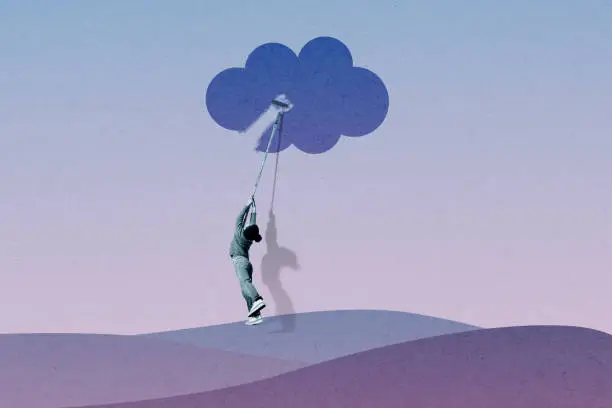
It is two o’clock on a still, golden Indian summer afternoon, and I am ten years old. The day stretches out lazily before me, a vast and unclaimed territory of hours. I have already completed half of my homework at school, a feat that leaves the rest of the day feeling wonderfully unburdened. My mother is in the kitchen preparing lunch, the clatter of pots and the aroma of spices drifting into the living room where I sit. I eat a bowl of deep red pomegranate seeds, savoring each one as they burst with sweetness, while I flip through the pages of a storybook lying on the table. I doodle aimlessly on my whiteboard, my mind wandering from one half-formed idea to the next, and sip on a glass of Rasna, the artificially flavored drink powder that was the staple of my childhood. I suppose I never quite grew out of that state of being, that gentle, undirected drift. This, though I did not know it at the time, is what people now label “whimsy.” It wasn’t a concept or a practice then; it was simply the texture of life itself.
Now, at 29, the contrast between that afternoon and my present existence is stark and almost jarring. My work keeps me tethered to a screen for much of the day, my eyes scanning a ceaseless stream of information, my attention fragmented by constant notifications. My physical needs are met with alarming efficiency: if I want food, I can have it delivered to my door in minutes, no effort required; if I want to talk to someone, I can send a message without ever leaving my room; if I want entertainment, I don’t even have to choose it, as an algorithm will offer me a suggestion before I’ve had time to wonder what I actually desire. This hyper-efficiency, this frictionless digital existence, has somehow eroded the very thing it promised to enhance. We are constantly connected, yet increasingly disconnected from the simple, authentic pleasures that once filled our time. Across the culture, there seems to be a reaction to this sterility, with people seeking out “whimsy” in small, tangible ways. They are taking up crafts like knitting or pottery, reviving analogue hobbies like film photography, or bedazzling their plastic water bottles and declaring that act a small rebellion against the purely functional. The search for this elusive quality has become a quiet trend, a collective attempt to stitch a little playfulness back into the fabric of our meticulously optimized lives.
Part of the appeal, I suspect, is that no one can quite agree on what whimsy actually is. The dictionary defines it as “fanciful” or “excessively playful,” but that feels more like a dismissal than a definition. Dr. Connie McReynolds, a psychologist and researcher, offers a more insightful perspective. She points out that somewhere between childhood and adulthood, we internalize the belief that every single thing we do must have a purpose, a measurable outcome, a point. Play becomes a waste of time, and leisure becomes a scheduled activity to be optimized. Whimsy, she argues, acts as a “permission slip to let go of expectations and embrace the joy of curiosity, imagination and spontaneity.” It is the antithesis of the productivity gospel we are taught to worship. This resonates with me because, as a child, I never needed a word for this kind of freedom. The TV might be playing in the background, but I was barely paying attention to it. I wasn’t theorizing about the nature of childhood or the value of unstructured time. There was just a pure, uncomplicated freedom in not yet believing that every empty patch of time had to be captured and put to some productive use. The whimsy was not in the activity itself—the pomegranate seeds, the doodles, the stories—but in the unfettered state of my own mind.
The scientific and psychological community seems to agree that this playful spirit isn’t just a childish indulgence; it’s a vital component of a healthy adult life. Dr. Matthew Leahy, a licensed clinical psychologist, notes that as the stresses of adulthood accumulate, we naturally tend to focus more on responsibility, problem-solving, and future planning. We become so accustomed to this mode that we can struggle to shut it off. But he doesn’t see these two states—playfulness and responsibility—as being mutually exclusive. He suggests that you can be playful and responsible at the same time, that it doesn’t have to be a zero-sum game. It might mean doing something spontaneous on a Sunday afternoon, revisiting a long-forgotten hobby, or simply enjoying an activity that leads to no particular accomplishment or career advancement. For Leahy, even reading fiction, a genre entirely unrelated to his professional field, offers a way to step outside his usual concerns and gives his brain a much-needed break from the constant pressure to analyze and solve. When I was a child, if there was nothing to do, I would simply conjure something. I would assemble my friends and invent elaborate games with intricate rules, turning our bicycles, the swings, and the entire house and garden into a vast playground for our collective imagination. In between these bursts of activity, I would trail back to the kitchen for another bowl of pomegranate. I would try something, lose interest, and move on to something else, and yet, somehow, I still felt I had time for everything. Perhaps that is the core of what has become so difficult to find in adulthood: the sheer luxury of time that feels spacious rather than scarce.
This loss isn’t merely a personal nostalgia; it is a systemic feature of modern life and work. Adult life, with its infinite to-do lists and constant obligations, leaves very little room for doing things just because we feel like it. Even our leisure has been co-opted by the culture of measurement. Our hobbies have become things to document and track, from logging every film we watch on Letterboxd to meticulously recording our runs on Strava or staging aesthetic photos of our meals for social media. We’ve turned play into another performance. Catherine Thomas, managing director of Art Acumen, sees this same tension reflected in the professional world, where we constantly talk about wanting people to be creative and curious, yet we simultaneously design working cultures that are rigidly focused on efficiency and measurable outcomes. These two impulses, she argues, don’t sit comfortably together. Whimsy, however, offers a way out of that narrow, results-driven mindset. It allows us to experiment, to make unexpected connections, or to experience something simply because it delights or intrigues us, without demanding it be useful. She suggests whimsy is like a pressure valve for the mind, allowing fresh air in. We see the cost of not having this valve in popular culture, such as in Pixar’s Inside Out 2, where the character of Anxiety is so busy preparing for every potential catastrophe that she completely misses the joy of the present moment. It’s a painfully recognizable portrait of modern stress, this constant vigilance that suffocates the very life it’s trying to protect.
Perhaps the greatest enemy of whimsy is stress itself. Katherine Hosie, an executive leadership coach, describes a powerful metaphor from Aldous Huxley’s The Doors of Perception, where he described the brain as a “reducing valve,” filtering out the vast majority of what we perceive so we can focus on what is immediately useful for survival. Hosie argues that the constant demands of adulthood can tighten this filter further. When stress becomes a chronic condition, our attention narrows relentlessly, directing us only toward the immediate task or perceived threat. The things that don’t serve an obvious purpose, the things that are simply beautiful, playful, or interesting, are the first to be filtered out. Viewed through this lens, whimsy isn’t frivolous at all. It is a sign that the valve is open a little wider, that we are seeing more options and recovering our own broader perspective. It is an act of cognitive liberation. In our digital world, imagination is often a passive event. The endless stream of content doesn’t require much from me; it simply requires my attention. My phone offers an infinite supply of things competing for that attention, and I find myself feeling stuck in a loop of consumption. In an effort to recalibrate, I’ve started to find small ways to change the pattern. My most reliable method is also probably my most contrarian one: instead of scrolling through social media, I read. I painted the other day for the first time in years, and I’m objectively bad at it. But that, I’ve realized, is not the point. There is a constant, insidious pressure to experience something, to make sure I’m maximizing my time and living up to my full potential. I’ve somehow been sentenced to a lifetime of having fun, and it’s exhausting. I miss the pure, unselfconscious joy of not knowing I was doing any of it at all.
Maybe whimsy doesn’t return because you manage to schedule it into your calendar. It can’t be accomplished or optimized. For McReynolds, it doesn’t require a dramatic overhaul of one’s routine; it can be as simple as “dancing around the kitchen, putting on your favorite song and singing loudly” or calling an old friend just because the thought makes you happy. “Not everything in life needs to be useful to be valuable,” she says. “There is so much to be gained from being in the moment and light-hearted.” This is the quiet wisdom I have been circling back to. It is a reminder that the value of an experience lies not in its productive output, but in its intrinsic quality. As I type this, there is a bowl of pomegranate beside me, a small, tangible connection to that ten-year-old who was so effortlessly embodied in the present. I eat one seed, then another, letting the juices flow in my mouth, tasting the sweetness and the tartness. It is not a task to be completed or a habit to be tracked. It is just a simple, sensory pleasure, a small act of whimsy that needs no word and no justification. It’s not a bad way to spend an afternoon, and in this simple act, I feel a flicker of that old, expansive freedom, even if only for a moment.