

For nearly two decades, fans have listened to Justin Timberlake’s 2006 hit “What Goes Around… Comes Around” with a very specific story in mind. The song, with its sweeping strings, aching vocals, and cinematic music video, seemed to be the sequel to “Cry Me a River,” the 2002 single that everyone already believed was about his highly publicized breakup with Britney Spears. The lyrics were just too pointed: “Should have known better when you came around / That you were gonna make me cry / It’s breaking my heart to watch you run around / ‘Cause I know that you’re living a lie.” To millions of listeners, this wasn’t just a pop song—it was a confession, a bitter parting shot, and a warning to the woman who broke his heart. The rumor became so entrenched that it followed Timberlake for years, resurfacing every time he talked about his past, every time Spears’s name came up, and every time the song played on the radio. But in a recent interview with Complex’s Re-Rank, Timberlake finally addressed the speculation directly, and his answer surprised many people. He didn’t confirm the long-held assumption. Instead, he gently pushed back on it, suggesting that the song’s origins were not as personal as fans believed. “Maybe I should dispel a rumor at this point,” he teased, before explaining that the track was not actually about his own romantic history. It was, he claimed, about a friend’s experience—a story he was told, not a story he lived.
Timberlake’s explanation was characteristically casual, but it carried a lot of weight for fans who had built an entire narrative around the song. According to him, a close friend was going through a painful breakup and confided in him about the details of the relationship’s collapse. The friend was hurt, frustrated, and looking for someone to validate his anger. Timberlake, ever the songwriter, saw a story worth telling and asked if he could turn his friend’s pain into music. The friend’s response, as Timberlake recalled it, was blunt and memorable: “Yeah, torch that bitch. What goes around comes around.” Timberlake laughed as he recounted the moment, adding that he essentially thanked his friend and left immediately to start writing. He said the lyrics poured out of him in what felt like “damn near 20 minutes,” and he ranked the song as one of the best things he has ever made—perhaps number one or two in his entire discography. He also pointed to the song’s extended interlude and the ten-minute music video as evidence that the project was a complete artistic vision, one that “hit on all cylinders” for him. It was a moment of clarity, he suggested, where everything came together: the melody, the production, the visual storytelling, and the emotional weight. But even with his explanation, it’s hard for fans to completely separate the song from its context, especially because “What Goes Around… Comes Around” felt like a direct continuation of the narrative Timberlake had already established with “Cry Me a River.”
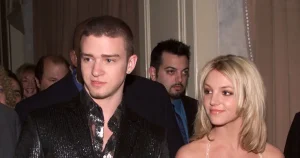
To understand why the rumor has persisted for so long, you have to go back to the early 2000s, when Timberlake and Spears were one of pop culture’s most famous couples. They were young, beautiful, wildly successful, and seemingly in love—the kind of couple that dominated magazine covers and fueled endless speculation. When they broke up in 2002, the split was messy, public, and emotionally charged. Timberlake released “Cry Me a River” shortly afterward, and the song’s lyrics, combined with a music video featuring a woman who looked unmistakably like Spears, made it clear that he was processing something deeply personal. The public read it as his side of the story, a carefully crafted narrative of betrayal and heartbreak. Spears, for her part, rarely addressed the song directly for years, but the implication hung over both of their careers. When Timberlake later released “What Goes Around… Comes Around,” with its themes of infidelity, karma, and regret, it felt like the second chapter of that story—a more mature, more cinematic exploration of the same wounds. The fact that the song’s video starred Scarlett Johansson and told a dramatic story of love and betrayal only added to the sense that Timberlake was working through something real. So when he now says the song was about a friend, it’s understandable that some fans are skeptical. But it’s also possible that Timberlake, as a songwriter, drew on the emotions of his own past while telling someone else’s story, blurring the line between autobiography and fiction in a way that is common in pop music.
The conversation around Timberlake and Spears has shifted dramatically in recent years, largely because of Spears’s own voice. In her 2023 memoir, The Woman in Me, Spears opened up about her relationship with Timberlake in ways she never had before. She acknowledged that she had cheated on him with choreographer Wade Robson during their relationship, but she also alleged that Timberlake had been unfaithful to her as well. The memoir painted a complicated picture of two young people navigating fame, pressure, and heartbreak, and it reignited public interest in their history. Fans began revisiting old interviews, analyzing lyrics, and reexamining the power dynamics of their relationship. Timberlake faced renewed criticism for the way he had handled the breakup publicly, especially given that “Cry Me a River” had effectively cast him as the wronged party while Spears was left to deal with the fallout. In the wake of the memoir, Timberlake seemed to offer a partial apology, saying he was sorry for “some of the things” he had done and acknowledging that his behavior had contributed to a narrative that was unfair to Spears. But then, in a confusing twist, he walked back that apology just days later, posting a defiant Instagram message in which he wrote, “Someeone told me someone was talking s*** about me on the streets !!! Do you want to bring it to the court or will you go home crying to your mom like you did last time ??? I’m not sorry.” The message was cryptic, defensive, and seemed to undo whatever goodwill his earlier statement had generated. It was a reminder that public apologies, especially between two people with such a complicated history, are never simple.
The back-and-forth between Timberlake and Spears has become a cultural touchstone, not just because of the music, but because it reflects how we talk about celebrity, accountability, and the messy reality of human relationships. In January 2024, Timberlake told a New York City concert crowd that he was going to “apologize to absolutely f***ing nobody,” a statement that was met with mixed reactions. Some fans appreciated his refusal to be dragged into a public reckoning; others saw it as a dismissal of the very real pain that Spears had shared in her memoir. The truth is that both Timberlake and Spears were young when their relationship fell apart, and both have spent years being defined, at least in part, by a breakup that happened more than two decades ago. Timberlake has grown, married actress Jessica Biel, and built a family. Spears has fought for control over her own life and career, and her memoir was a powerful act of reclaiming her narrative. But the public still wants closure, still wants someone to be right and someone to be wrong, still wants the songs to mean something specific and the rumors to be resolved. Timberlake’s recent explanation about “What Goes Around… Comes Around” is an attempt to do that—to close the door on at least one part of the story. Whether fans accept it or not, his version of events is a reminder that we rarely know the full truth behind the art we love. Songs are born from imagination, from observation, from empathy, and from the lives of people we will never meet. Sometimes they are confessions. Sometimes they are just stories.
Looking ahead, Timberlake is set to be the subject of an upcoming four-part Apple TV+ docuseries about his life and career, scheduled to debut in December. The project, directed by acclaimed filmmaker Fisher Stevens, promises to be an in-depth look at Timberlake’s rise from boy-band star to solo icon, and it reportedly includes an interview with Janet Jackson about their controversial 2004 Super Bowl performance—a moment that has haunted both of their careers and has been revisited many times in the context of accountability and public shaming. The docuseries will likely address many of the rumors and controversies that have followed Timberlake for years, including his relationship with Spears. It will also give him a platform to tell his own story, on his own terms, in a way that he has rarely been able to do. Whether that will change anyone’s mind about the songs, the breakup, or the man himself remains to be seen. But perhaps the most human way to look at all of this is to recognize that we are all complicated, all flawed, all capable of hurting and being hurt. Timberlake’s music, like Spears’s memoir, is a piece of a larger puzzle—a life that has been lived publicly, dissected endlessly, and reduced to a few familiar narratives. The truth, as always, is probably somewhere in between: in the quiet moments no one saw, in the conversations that were never recorded, in the feelings that couldn’t fit into a three-minute song. What goes around comes around, as the song says. But sometimes, it just comes around as a story—one that changes every time it is told, and one that belongs to the teller, not to the listener.