


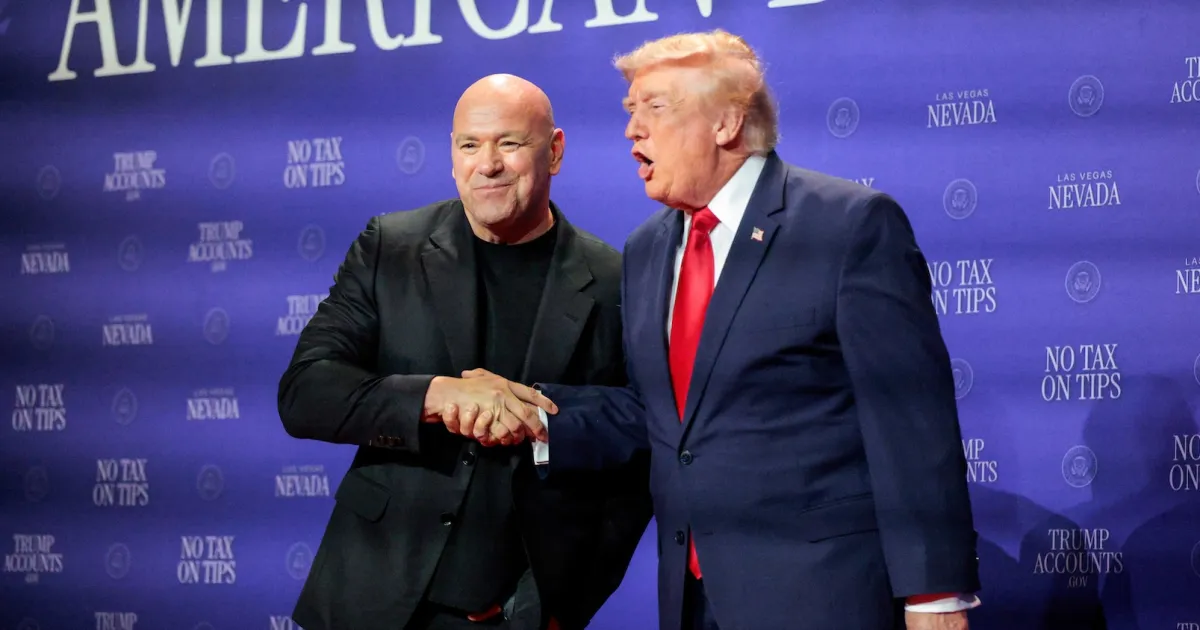
There are moments in American political life when the pageantry of power collides with the raw reality of defeat, and the aftermath of the 2026 midterm elections was one of those moments. President Donald Trump, still processing a historic shellacking at the ballot box, did not turn to a seasoned political operative or a veteran communications strategist to help him steady the ship. Instead, he turned to a man who has spent his life selling violence, adrenaline, and loyalty: Dana White, the president and CEO of the Ultimate Fighting Championship. In a Truth Social post that felt less like an official personnel announcement and more like a casting call for a buddy movie, Trump, 80, declared that he was “pleased to announce” he had offered White the job of White House press secretary. He called White a “violent Fighter and Warrior” and asked him to bring along an entourage of UFC legends, including Islam Makhachev, Khabib Nurmagomedov, Justin Gaethje, Daniel Cormier, Amanda Nunes, and Kayla Harris. The president framed the move as necessary for self-defense against the “Lunatic Left,” and ended with a desperate, almost plaintive plea: “Dana, please take the job!” It was a strange, surreal pitch, but it was also deeply, unmistakably Trump—a mix of bravado, personal friendship, and an instinct to turn even the most serious institution in Washington into an extension of his own celebrity universe.
White, 57, responded in a way that sent the political world into a quiet frenzy. He shared a photograph of himself standing behind the iconic press secretary’s lectern inside the White House briefing room, the same podium where so many administration officials have faced the unforgiving glare of the press corps. His caption was brief and cinematic: “On to the next chapter.” There was no confirmation, no official acceptance, just a photograph that seemed to say everything and nothing at once. The image was carefully staged, almost theatrical, and it captured the strange symbiosis between Trump and White—two men who built empires on the power of personality, confrontation, and the ability to command attention. The fact that White would even step behind that lectern, even as a symbolic gesture, suggested that he was not merely flattered by the offer but genuinely intrigued by the idea of crossing from the octagon into the political arena. For Trump, White represents something that traditional press secretaries rarely possess: an unbreakable bond of friendship, a talent for controlling a narrative, and an immunity to the kind of criticism that would destroy a more conventional appointee. The president was not looking for someone who could recite talking points; he was looking for someone who could fight.
The timing of the offer was no accident. The press secretary job had just devoured yet another occupant. Katie Zacharia, who had been handed the role just five days earlier, was reportedly relieved of her duties before she could even fully settle into the office. Trump claimed that he had warned her on the morning of her dismissal, telling her, “Honestly, if I were you, I’d reconsider. Katie, do you need this? I don’t think you need this.” It was a strange, almost paternalistic way to fire someone, but it was also vintage Trump—rewriting the narrative in real time, turning a termination into a gesture of kindness. Zacharia, 41, took the high road in her public statement, describing Trump as “a kind, wonderful, gracious, thoughtful, enthusiastic, and hardworking man” and expressing gratitude for the opportunity to work with him. She wrote that she wished more Americans appreciated him, and that no one would ever make America great the way he had and continued to do. It was a gracious exit, but it also underscored the revolving-door nature of the administration’s communications operation. The job of White House press secretary has always been difficult, requiring a delicate balance of honesty, loyalty, and strategic ambiguity. But in the Trump era, it has become nearly impossible—a position where one wrong word can get you fired, where the briefing room is not a place to inform the public but a battlefield in a larger culture war.
But the real context behind the Dana White offer is the midterm election disaster that shook the Republican Party to its core. Democrats took control of both the House and the Senate, flipping a series of historically red states that had long been considered safe territory for the GOP. Texas, Kansas, Ohio, and South Carolina all slipped through Republican fingers, and Florida Governor Ron DeSantis described the outcome as “close to an extinction-level event” for the party. The scale of the loss was almost unprecedented, and it sent shockwaves through the conservative movement. Yet Trump, in the late hours of election night, refused to accept any responsibility. In a Truth Social post, he insisted, “I wasn’t on the ballot and if I was, we would have won IN A LANDSLIDE! Thank you for your attention to this matter.” The post was vintage Trump—defiant, unrepentant, and oblivious to the fact that he had spent months urging his supporters to vote as if he were on the ballot. In fact, he had reportedly made that plea at least 63 times on the campaign trail, casting the midterms as a referendum on his own leadership. But when the returns came in, he abruptly changed the story, insisting that the election was never about him at all. It was a stunning display of cognitive dissonance, but for Trump, it was simply survival.
The numbers, however, told a different story. Before the 2026 midterms, Trump’s approval rating had sunk to a reported 34 percent, a grim figure for any president and a sign that his once-unshakable grip on the American electorate was loosening. He had previously claimed, during a call into Fox & Friends, that if people ever got tired of him in the United States, he would move to Israel and become prime minister. It was a throwaway line, delivered with the kind of offhand bravado that Trump has perfected over decades in the public eye, but it also revealed something deeper about his psychology. Beneath the confidence and the bluster, there is a man who fears irrelevance, who measures his worth in applause lines and approval ratings, and who cannot imagine a world in which he is not the center of attention. The idea of being “tired of” by the American people is, for Trump, a kind of existential threat. And so, in the wake of the midterm disaster, he did not retreat or reflect. He did not surround himself with policy experts or political strategists. Instead, he reached out to Dana White, a man who has built a career on the idea that the fight is never over, that you can always come back stronger, that the only thing that matters is the next match.
What would Dana White as press secretary actually mean for the country? It would be, without question, the most unconventional appointment in the history of the White House. White has no political experience, no background in government, and no obvious familiarity with the nuances of public policy. What he does have is an extraordinary gift for promotion, a deep understanding of media dynamics, and a personal loyalty to Trump that has only grown stronger over the years. He built the UFC from a niche, controversial organization into a global powerhouse, and he did it by embracing the same kind of combative, anti-establishment ethos that defines Trump’s political brand. The idea of White standing at that podium, flanked by fighters like Khabib Nurmagomedov and Amanda Nunes, is almost absurd—but it is also strangely logical for a president who has always treated the press as an enemy rather than an institution. Trump is not looking for someone to explain his policies to the American people; he is looking for someone to defend him, to attack his critics, and to turn every press briefing into a spectacle. The fact that White’s potential entourage would include people who are not from this country, as Trump himself noted with a wink, only adds to the surreal nature of the proposal. It is a vision of the White House as a locker room, with the president as the coach and the press secretary as the heavyweight champion. Whether that vision will become reality remains unclear; neither the White House nor White’s representatives responded to requests for comment, and White’s photo at the lectern was not a formal acceptance. But the very fact that this conversation is happening says something profound about the state of American politics in 2026.
In the end, the offer to Dana White is less about press secretary qualifications and more about Trump’s fundamental understanding of power. The midterms were a devastating repudiation of his leadership, and the Republican Party is now grappling with the possibility of a future without him at the helm. But Trump, at 80 years old, is not interested in going gently into that good night. He is doubling down on the politics of spectacle, choosing a man who has made a career out of selling fights to be the face of his administration’s communications. It is a gamble that could either reinvigorate his base or accelerate the decline of his political influence. If White accepts the job, the press briefing room will never be the same. Instead of careful, measured answers, we might see a press secretary who treats reporters like challengers in the octagon, who turns questions into confrontations, and who approaches every exchange with the energy of a championship bout. That would be a radical departure from the norm, and it would almost certainly be a disaster for the institution of the White House press corps. But for Trump, that may be the point. He has always believed that the best defense is a good offense, and in Dana White he sees the ultimate offensive weapon. The country will be watching to see whether White says yes, whether the photo at the lectern becomes a permanent fixture, and whether the man who built the UFC can survive the brutal, unforgiving world of Washington politics. One thing is certain: in Trump’s White House, the press secretary is no longer just a spokesperson. They are a warrior. And he wants the greatest warrior he knows by his side.