





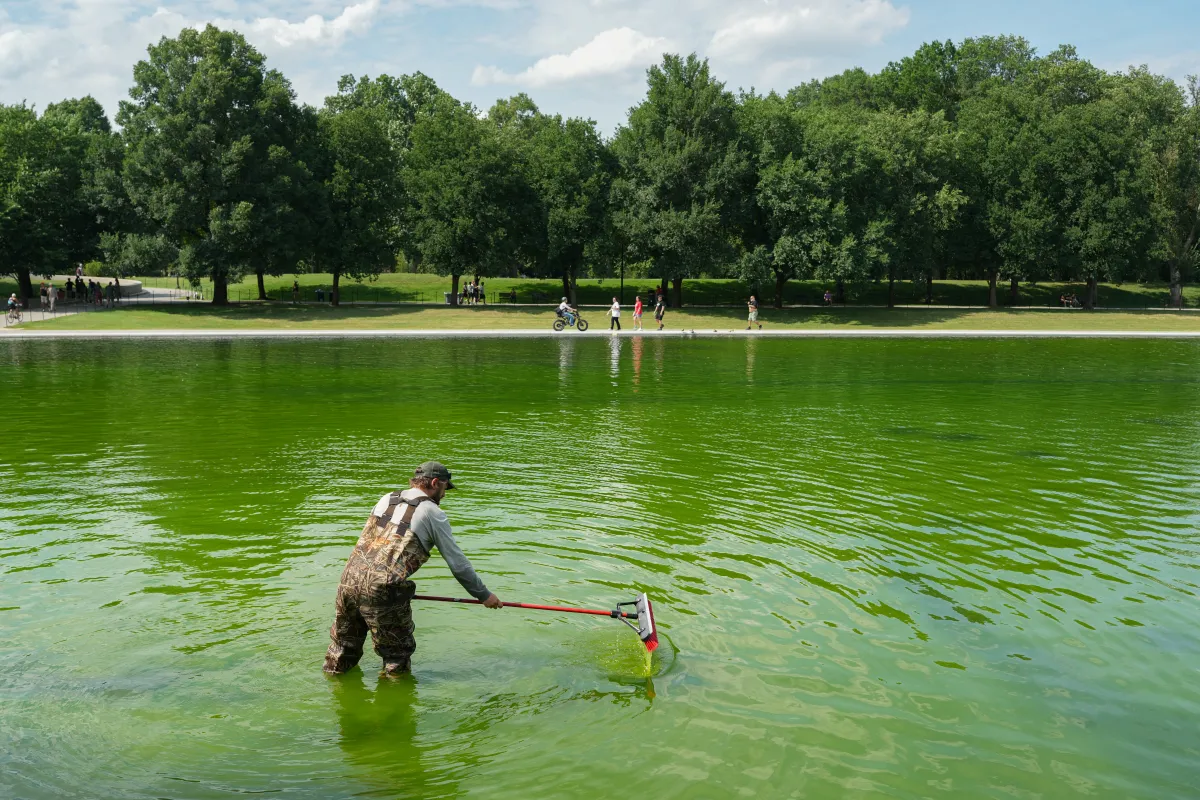
For generations, the Lincoln Memorial Reflecting Pool has stood as a solemn, liquid mirror at the heart of the American capital, a monumental canvas designed to double the image of Abraham Lincoln’s marble temple and the towering obelisk of the Washington Monument. However, just days after a highly publicized, multimillion-dollar structural and aesthetic overhaul designed to bestow a deep, patriotic “American flag blue” finish to its basin, visitors and locals alike were instead greeted by a jarring sight: the pristine water had morphed into a brilliant, soup-like shade of viridian green. Instead of a majestic, crystal-clear blue reflection, the historic waterway had become a sprawling petri dish of rapidly multiplying algae. The sudden ecological rebellion triggered an immediate, high-profile cleanup effort, capturing the attention of onlookers who filmed National Park Service workers walking the pool’s long stone borders, manually emptying large plastic jugs of clear liquid directly into the water. This mysterious additive was later confirmed to be hydrogen peroxide, a household chemical deployed in industrial quantities alongside high-tech filtration systems in a desperate race against the midsummer heat to restore the pool’s celebrated clarity. This dramatic visual of low-tech pouring against a grand neoclassical backdrop instantly ignited a flurry of public curiosity, skepticism, and debate, laying bare the fundamental tensions between human engineering and the irrepressible forces of the natural world. It raised urgent questions not only about the structural efficacy of the recent expensive renovations, but also about the wisdom, safety, and long-term viability of using chemical shock treatments to maintain an artificial oasis in the middle of a bustling, biodiverse urban parkland.
To understand how this iconic landmark transformed so rapidly from a pristine blue jewel into a murky emerald marsh, one must look closely at the delicate and easily disrupted biology of freshwater ecosystems. Algae blooms are not a novel phenomenon on the National Mall; the shallow, historic basin has historically struggled with stagnation and nutrient accumulation, drawing its water in part from the closely linked Tidal Basin. But what caught both environmental scientists and park authorities off guard was the sheer, explosive velocity of this particular outbreak, occurring almost immediately after the pool was drained, scrubbed, repainted, and refilled. Experts point out that the compressed, hurried timeline of the recent renovation itself likely sowed the seeds of the current crisis, as rushing the refilling process amidst early summer heat waves left stubborn, residual algal spores clinging to the specialized plumbing and filtration pipes. Once the freshly pumped, nutrient-rich water was introduced under the baking Washington sun, these microscopic organisms found themselves in an absolute paradise. Marine biologists, including Christopher Lowe from Swansea University, emphasize that a single, microscopic algal cell possesses the reproductive capability to spawn millions of offspring within a matter of days under ideal conditions. In an outdoor, open-air environment like the National Mall, two of the three primary ingredients for an ecological bloom—boundless, direct sunlight and warm water temperatures—are entirely beyond human control. When you combine these atmospheric conditions with the inevitable influx of organic nutrients carried in by rain runoff, decomposing organic debris, and local wildlife, you create a perfect biological storm that easily defies even the most meticulous preventative engineering.
Confronted with a rapidly deteriorating public spectacle, park management turned to hydrogen peroxide as their primary chemical weapon, choosing it for its unique properties as an oxidizer and its relatively gentle environmental footprint compared to harsher industrial alternatives. Unlike chlorine, which can leave persistent, toxic residues that endanger local wildlife and emit a pungent, swimming-pool-like odor that ruins the solemn atmosphere of the memorial, hydrogen peroxide acts as a rapid, self-neutralizing sterilizer. When poured into the water, the chemical compound ($H_2O_2$) aggressively reacts with the organic matter, breaking down the cell walls of the floating algae through oxidation and effectively bleaching the organisms to strip away their green chlorophyll pigment. Almost simultaneously, the pool’s newly upgraded “nanobubble” ozone filtration systems work in tandem with the chemical treatment, injecting microscopic bubbles of ozone gas deep into the water column to destroy pathogens and organic pollutants from the bottom up. As the hydrogen peroxide completes its destructive mission against the algae, it rapidly and cleanly decomposes into nothing more than pure water and dissolved oxygen molecules, leaving behind no harmful chemical legacy. This makes it an incredibly attractive option for municipal and park managers who must balance the aesthetic demands of millions of camera-wielding tourists with the moral and legal obligations to protect the migratory birds and local urban wildlife that utilize the reflecting pool as a vital watering hole. However, while the chemistry behind this process is elegant and highly effective in controlled laboratory settings or small backyard ponds, attempting to scale this reaction up to match the giant proportions of a national monument introduces a grueling set of real-world challenges.
The most glaring obstacle in this chemical campaign is the sheer, mind-boggling scale of the Lincoln Memorial Reflecting Pool, which contains an estimated 6.5 million gallons of water spanning an area equivalent to several football fields. For seasoned water-treatment experts, the sight of workers manually pouring 12 percent concentration hydrogen peroxide from handheld containers along the sprawling concrete banks highlighted a profound logistical disconnect. To truly remediate a body of water of this volume, chemical dosing must be meticulously calibrated based on uniform concentration rather than localized volume, a task that is nearly impossible to achieve through manual, localized pouring without the aid of powerful, integrated circulation systems. Because hydrogen peroxide is a highly volatile compound that degrades almost instantly upon contact with organic matter and sunlight, it offers absolutely no residual sanitizing protection; once the initial chemical reaction occurs and the compound converts back into water and oxygen, the pool is left entirely defenseless against the next wave of algal invaders. This creates an incredibly costly and unsustainable cycle of treatment, where park authorities must repeatedly purchase, transport, and manually distribute massive quantities of chemical agents just to keep the green tide at bay for a few days at a time. This temporary band-aid methodology raises serious questions about the long-term fiscal responsibility of the pool’s maintenance program, as public funds are continually funneled into fleeting chemical fixes rather than addressing the systemic, structural root causes of nutrient accumulation and poor water circulation within the historic basin.
At the absolute core of this chronic environmental struggle lies a fundamental, unyielding design paradox that has plagued the reflecting pool ever since its construction over a century ago: the inherent conflict between aesthetic stillness and biological health. The primary architectural purpose of the pool is to act as a flawless, mirror-like canvas, capturing the shifting colors of the sky and the grand facades of the surrounding monuments in a state of perfect, undisturbed tranquility. To achieve this breathtaking glass-like reflection, the water must remain almost entirely motionless, free from the ripples, bubbles, and aggressive currents that active circulation and aeration systems would naturally produce. Yet, in the realm of freshwater biology, warm, shallow, and stagnant water is the ultimate breeding ground for harmful algal blooms, as the lack of movement prevents oxygenation and allows nutrients to settle and concentrate in the sun-baked upper layers of the pool. Over the decades, successive multimillion-dollar renovations have attempted to walk this tightrope, installing complex under-water filters, ozone generators, and subtle circulation loops in a bid to keep the water moving just enough to prevent stagnation without ruining the famous reflections. The most recent overhaul, which sought to optimize the basin’s depth and shade to create that deep, rich “American flag blue” finish, may have inadvertently altered the way the water absorbs and distributes solar heat, potentially compounding the thermal conditions that algae find so irresistible. This leaves administrators trapped in a permanent balancing act, forced to choose between a sparkling, biologically dead mirror that satisfies public expectation and a natural, living ecosystem that inevitably trends toward a murky, vegetative green.
Ultimately, the vibrant green state of the Reflecting Pool serving as a backdrop to the Lincoln Memorial reminds us of the limits of human authority when confronted with the stubborn persistence of the natural world. No matter how many millions of dollars are poured into structural renovations, and no matter how many gallons of hydrogen peroxide are dumped into the basin, the pool is not an isolated, sterile laboratory; it is an open, breathing component of the wider Washington, D.C. ecosystem. Everyday pressures—from the wind carrying nutrient-rich dust and leaf litter, to the hundreds of migratory ducks, geese, and gulls that alight on the water, carrying fresh algal spores on their feathers and legs—ensure that biology will always find a way back in. While the current combination of hydrogen peroxide and ozone nanobubbles is carefully calculated to remain non-toxic to these visiting birds and the humans who walk the perimeter, the long-term ecological consequences of maintaining a chemically sterilized basin are quietly profound. If park officials succeed in chemically suppressing all organic life to preserve a manufactured, “American flag blue” aesthetic, they will essentially transform this historic waterway into what scientists refer to as an ecological desert, a biological void where no aquatic plants, beneficial microbes, or small organisms can survive. This ongoing struggle teaches us a humbling lesson about our relationship with urban design: in our obsessive, modern pursuit of manicured perfection and photographic symmetry, we must occasionally confront the reality that nature refuses to be entirely tamed, constantly asserting its wild, untidy presence even upon the most sacred monuments of our national heritage.