






Welcoming a brand-new puppy into your home is a beautiful, chaotic whirlwind of soft paws, puppy breath, and the gentle realization that your life is no longer entirely your own. For a dedicated pet parent named Heber, this journey of companionship reached a major milestone when she faced the universal, anxiety-inducing task of leaving her beloved three-month-old Pomeranian, Marky, home alone for the very first time. Marky, a tiny, cloud-like ball of fluff, had quickly become the absolute center of Heber’s universe, making the prospect of stepping out the door feel like a monumental emotional hurdle. Like many modern pet owners who strive to follow established training guidelines, Heber decided to utilize a crate to keep her precious pup safe, secure, and out of trouble while she ran a seemingly quick, thirty-minute errand. Despite her meticulous preparation, Heber confessed to feeling an overwhelming sense of hesitation and guilt about locking Marky away, even for such a brief window of time, but she recognized that building independence is a necessary step in a puppy’s development. Clutching her keys and offering a string of quiet reassurances, she stepped across the threshold, closed the heavy front door, and ventured out into the world, desperately hoping that the cozy enclosure she had prepared would serve as a soothing sanctuary for her pint-sized companion while she was away.
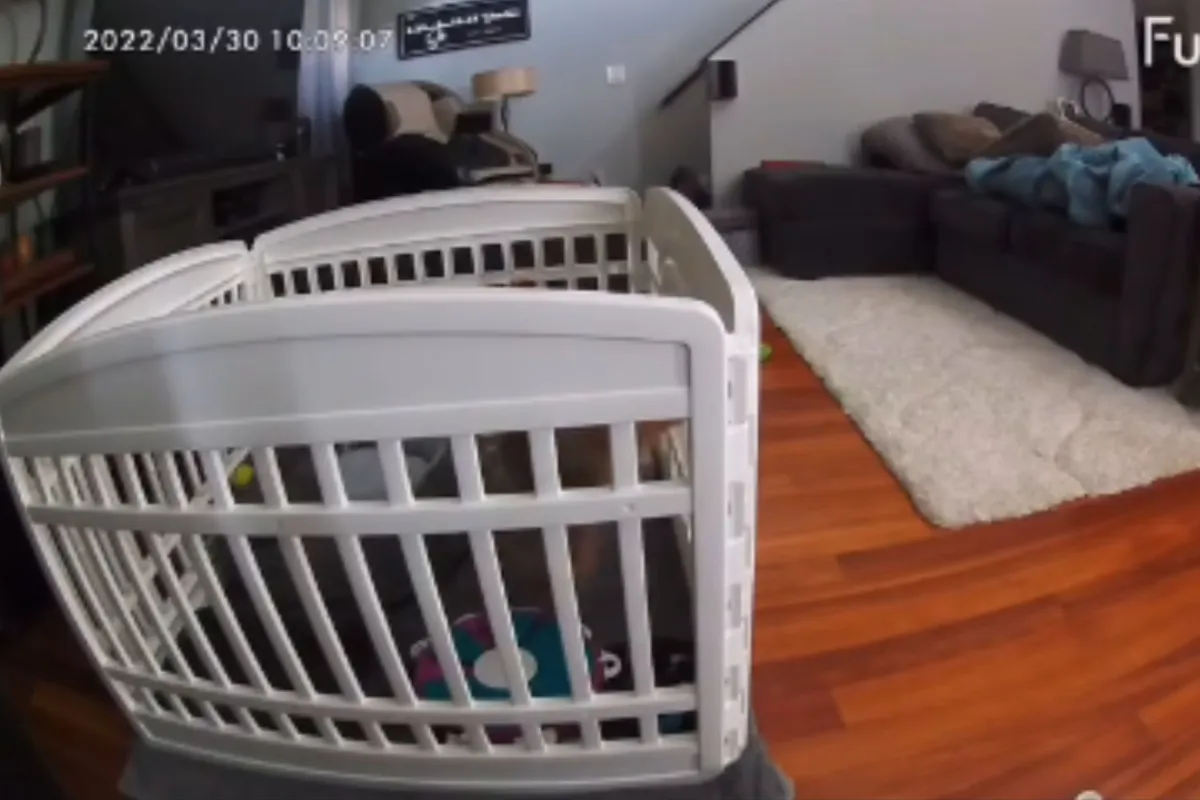
Unfortunately, the comforting illusion of a peaceful, sleeping puppy was shattered the very moment Heber opened her smartphone to check the pet camera feed, initiating a wave of immediate, chest-tightening regret that she still vivaciously recalls years later. Expecting to see a curled-up, snoozing Pomeranian, she was instead greeted by the heartbreaking spectacle of a dramatic, single-dog protest against her departure. Marky was not merely mildly upset; he was absolutely inconsolable, unleasing a continuous, high-pitched symphony of theatrical wails, whimpers, and cries that seemed to pierce right through the digital screen and straight into Heber’s heart. It was a visceral, highly vocal plea demanding the immediate return of his human family, demonstrating a stubborn determination to make his profound displeasure known to anyone who would listen. Heber later shared this painfully relatable footage on the Instagram account she dedicated to her pets, @markyandmilly, revealing that the heartbreaking vocal performance had commenced the absolute second her foot slipped out the front door and the latch clicked shut. Watching that tiny, innocent face crumpled in distress on a digital monitor is a modern form of torture that many pet parents know all too well, serving as an instant trigger for parental guilt and leaving Heber questioning her choices as she rushed home to comfort her dramatic little king.
Yet, it was not just the loud, ear-piercing cries echoing through the empty house that shocked Heber when she reviewed the camera footage; it was the tiny puppy’s sheer physical defiance and remarkable problem-solving skills in the face of confinement. In an impressive display of athletic rebellion that defied his minuscule size, Marky managed to scale the steep walls of his wire enclosure, scrambling and hopping directly over the top of the crate to secure his own freedom. It was a classic, real-life prison break executed by a fluffy three-month-old rebel who refused to accept the boundaries of his silver cage. Confronted with the undeniable evidence of Marky’s acrobatic escape and his clear aversion to being enclosed, Heber realized that her original training blueprint was completely incompatible with her puppy’s willful personality. Recognizing that continuing to force the issue would only cause unnecessary stress and potential physical danger to her leaping pup, Heber made the executive decision to permanently retire the crate altogether. Instead of fighting against his natural instincts, she chose to trust him, transitioning Marky to a lifestyle of free-roaming around the house, a bold decision that paid off tremendously as he quickly transformed into a much happier, calmer ruler of his domain who no longer felt the desperate urge to plan dramatic jailbreaks.
As the months rolled by and the natural rhythms of life shifted, Heber’s daily routine evolved, bringing new challenges that required creative solutions to maintain Marky’s newfound peace and happiness. When the time came for Heber to return to her regular, out-of-the-house work schedule, she worried that the long hours of solitude might reignite Marky’s deep-seated separation anxiety and leave the pampered pup feeling lonely in his spacious kingdom. To prevent any backsliding into distress, Heber decided that the ultimate solution to keeping her free-roaming king happy was to expand her furry family and welcome a second dog into their lives. Soon, a tiny “little sister” entered the picture, providing Marky with constant companionship, a playmate for his energetic zoomies, and a comforting presence to snuggle with during the quiet afternoon hours when their humans were away. This thoughtful addition to the household successfully banished the lingering ghosts of Marky’s initial isolation, proving that sometimes the best remedy for a pet’s separation anxiety is not rigid confinement or human intervention, but the unconditional warmth of a canine sibling who understands their silent language.
The dramatic saga of Marky’s great escape highlights a long-standing, often highly polarized debate within the global pet-owning community: to crate or not to crate? Crate training is widely championed by veterinary professionals, breeders, and dog trainers alike, particularly during the chaotic puppy stage when destructive chewing and housebreaking accidents are at their peak. Proponents of the practice, supported by organizations like the American Kennel Club (AKC), argue that dogs are evolutionary den animals who naturally seek out small, dark, enclosed spaces where they can feel safe, insulated from the overwhelming stimuli of the busy human world. When introduced masterfully and gradually, a crate can transcend its metal bars and transform into a cozy bedroom, a personal haven of security where a dog can peacefully retreat to decompress, sleep, and enjoy high-value treats without interruption. Furthermore, it serves as an invaluable safety tool, preventing curious, teething puppies from chewing dangerous household electrical cords, swallowing toxic items, or destroying expensive furniture when their owners are asleep or momentarily distracted.
However, as Marky so loudly demonstrated, canine behavior is never a one-size-fits-all equation, and forcing a highly sensitive, claustrophobic, or highly energetic dog into a crate can yield disastrous psychological results. Experts emphasize that a crate must never be used as a tool for punishment or as a convenient holding cell for extended periods, as this negative association can quickly transform a potential safe haven into a source of severe trauma, panic, and behavioral regression. The key to successful crate training lies in patience, employing positive reinforcement, and allowing the animal to explore the space entirely on their own terms, building associations of safety and pleasure rather than confinement and abandonment. Ultimately, Heber’s heartwarming journey with Marky teaches us that true pet parenthood requires the humility to throw away the training manuals when our animals communicate their boundaries. By listening to the unique, expressive voices of our pets, adapting to their fears, and choosing compassion over conformity, we can co-create a world where our beloved companions can thrive as the happy, free-roaming royalty they were always meant to be.