


It’s supposed to be the most electric time of the baseball calendar, the kind of October nights that turn ordinary players into legends and legends into immortals. But for Shohei Ohtani, the brightest star in the sport’s modern galaxy, this postseason has felt less like a coronation and more like a quiet, grinding struggle. The Los Angeles Dodgers’ designated hitter, who spent the entire regular season rewriting what seemed possible at the plate, found himself staring at an unfamiliar and uncomfortable reality as Game 3 of the National League Championship Series approached. When the lineup card was posted, the baseball world did a double take: Ohtani had been dropped to sixth in the batting order, the lowest spot he had occupied as a Dodger and a stunning visual symbol of how far his October production had fallen. It wasn’t a benching—he was still in the lineup, still trusted enough to take his hacks—but it was a message, whether intended or not, that the Dodgers could no longer afford to wait for their superstar to snap out of it while keeping him in a premium spot. The move sparked heated conversations across every pregame show, every social media platform, and every barstool argument from Los Angeles to Milwaukee, because when a player of Ohtani’s magnitude is moved down, it isn’t merely a tactical adjustment. It’s a story about form, confidence, injury, expectation, and the harsh, unforgiving nature of postseason baseball.
The numbers were impossible to ignore, and they painted a portrait of a player stuck in quicksand. Over six postseason games, Ohtani had gone just 3-for-20, a batting average of .150 that looked jarring next to his regular-season brilliance. He had struck out seven times, drawn only three walks, and managed one stolen base—a theft that felt more like an attempt to manufacture a spark than a reflection of his usual dominance. There were no home runs. There were no RBIs. His OPS, which had been astronomical all summer, had collapsed to a meager .411. For a hitter who had made a career out of making the impossible look routine, the numbers were almost unfathomable. The strikeouts were not the ugly, flailing kind that suggested mechanical collapse; they were often quiet, confused-looking swings and takes, as if he were fighting a war against himself between pitches. He wasn’t chasing egregiously, and he wasn’t necessarily getting fooled by junk. He simply looked like a man whose timing was a fraction of a second off, whose understanding of the strike zone had become blurred by the weight of the moment, and whose body—still recovering from whatever injuries had been nagging him—refused to cooperate with the extraordinary instincts that had carried him to superstardom. Whenever he walked back to the dugout after another fruitless at-bat, the camera would find him staring straight ahead, jaw clenched, expression unreadable. He insisted he was ready, telling reporters and staff that he trusted the process, that the results would come. But baseball is not a sport that rewards good intentions; it rewards the barrel of the bat meeting the ball, and for six consecutive games, that connection had evaded him at the worst possible time.
It was against that backdrop that Dodgers manager Dave Roberts made the kind of decision that defines a manager’s postseason guts. Rather than leave his superstar in the heart of the order and pray for a breakthrough, Roberts slid Ohtani down to the sixth spot, taking the bold step of rearranging his lineup in a desperate attempt to ignite a stalled offense. “Shohei’s all on board,” Roberts said before the game, trying to frame the move as collaborative and positive. He stressed that Ohtani understood the decision, that no ego was involved, that the team was simply trying to find the right combination. In a way, that made it even more painful for those who adore Ohtani. It wasn’t a punishment, and it wasn’t a wake-up call in the traditional sense. It was the baseball equivalent of a coach telling a slumping shooter to come off the bench and run with the second unit: the confidence remains, but the urgency has changed. There is something deeply human about watching a generational talent be treated like a regular struggling mortal, especially when that talent has spent years making the game look effortless. Ohtani’s regular season had been the stuff of fantasy—a blur of towering home runs, scorching line drives, and historic baserunning—so seeing his name in the sixth spot on a championship-stage lineup felt less like strategy and more like theater, a reminder that nobody, not even the most gifted player on the planet, is immune to October’s cruel randomness. Roberts, to his credit, didn’t sugarcoat the reality of the numbers, but he also refused to entertain the idea of benching him entirely. He knew that even a struggling Ohtani commands respect from opposing pitchers, and that the threat of a breakout—the ever-present possibility that the very next pitch could send a baseball into the stratosphere—was still a weapon in the Dodgers’ arsenal.
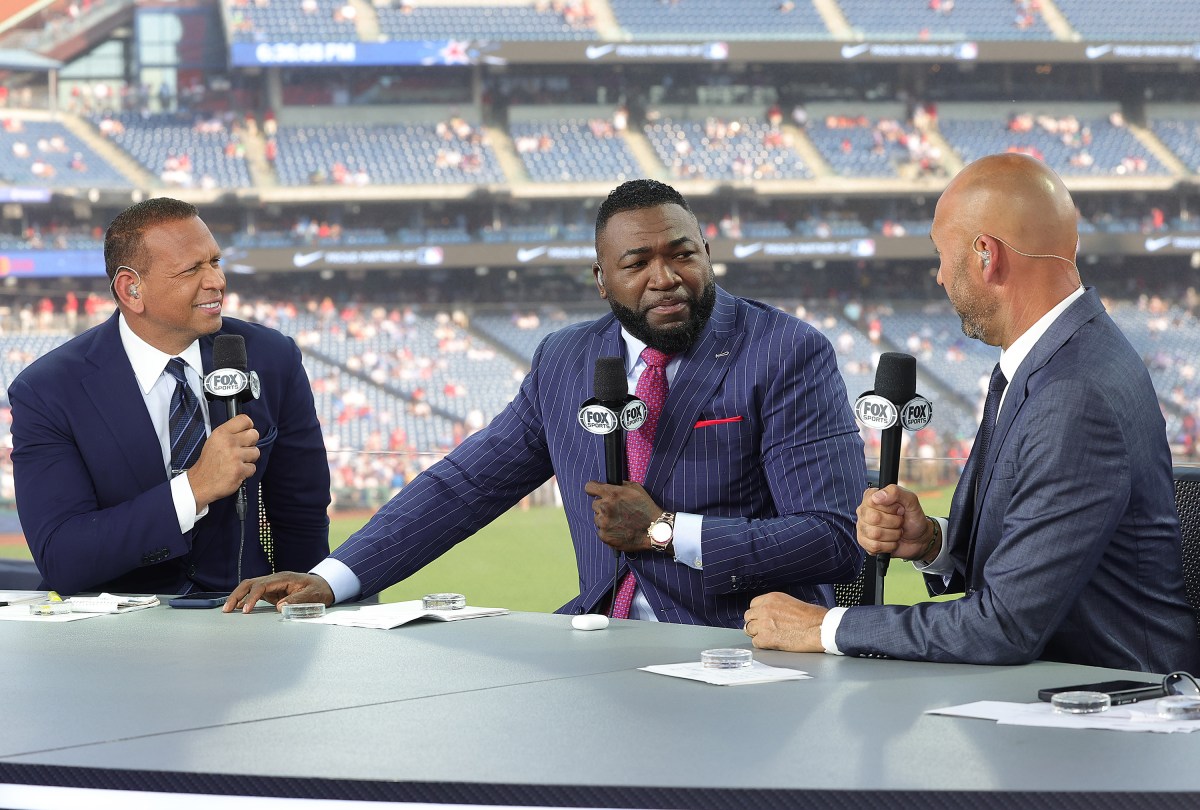
Perhaps no one articulated the conflicting emotions surrounding Ohtani better than Boston Red Sox legend David Ortiz, whose Hall of Fame cred gave his words an instant weight that no studio analyst could match. Appearing on Fox Sports’ pregame program, Ortiz did not hold back, even as he made clear that his comments came from a place of deep admiration. “Look, I love Ohtani,” Big Papi said, his voice carrying the unmistakable warmth of a man who knows exactly what it means to carry a lineup in October. “Ohtani is the one guy that everyone comes to the field to see. I don’t know how bad his injuries are, but I would not play him—let me tell you why.” The statement hung in the air for a moment, because it was startling to hear anyone suggest that the most electrifying player in baseball should be sitting out the biggest games of the year. But Ortiz quickly explained his thinking, and his reasoning was grounded in the kind of practical Experience that few people in baseball possess. He pointed out that Ohtani is not just any hitter; he is a caliber of hitter whose mere presence changes the dynamics of a lineup and the psychology of a pitcher. But in his current slump, Ortiz argued, he was not that hitter. “That’s why I would not play him at this moment,” he continued. “And remember, the team needs his presence, but the same time get affected because the rest of the squad is expecting him to come through.” It was a nuanced and surprisingly candid take. Ortiz wasn’t saying Ohtani was washed up or beyond saving. He was saying that a struggling superstar can become an emotional anchor—not because he isn’t trying, but because everyone else in the clubhouse looks at him as the savior. When that savior is failing, the energy in the dugout changes. Pitchers on the mound feel less pressure. Hitters in other spots press a little harder, trying to pick up the slack. In a strange, almost counterintuitive way, the greatest player in the world can, at his worst, become a burden simply because the expectations around him are so immense.
Still, there is another side to the argument, and it is one that the Dodgers seem to be clinging to as they balance the risk of keeping Ohtani in the lineup against the risk of sitting a player who can change a game in a single swing. For all his struggles, Ohtani remains one of the most dangerous hitters on the planet, and baseball, more than any other major sport, is defined by small sample sizes and high variance. A hitter who is 3-for-20 can just as easily go 4-for-5 the very next night, and the same swing that produced a harmless fly ball yesterday can produce a game-winning home run today. The postseason is a world of small moments, and the difference between a sweep and a collapse is often just a handful of pitches. That is why managers are often reluctant to completely bench a star, especially one with Ohtani’s track record of carrying his team on his back. His bat may be cold, but his presence alone changes the way opposing pitchers approach the lineup. They cannot simply ignore him, and even in a slump, he has the discipline to work counts, draw walks, and create pressure. Moreover, there is the emotional component: benching a player of Ohtani’s stature could fracture the clubhouse, sparking questions about trust and loyalty that would linger far beyond a single game. Players know that everyone struggles; they also know that great players recover. By moving him down in the order rather than removing him, the Dodgers are betting that Ohtani can find himself in the lower half of the lineup, away from the brightest spotlight, and gradually rebuild the rhythm that has abandoned him. They are also aware, as Ortiz pointed out, that the rest of the team is watching. The same teammates who might feel extra pressure watching Ohtani fail are also the ones who have seen him do miraculous things all season long. They know better than anyone that he is one adjustment away from being the best hitter in the world again. Choosing to support him, to keep him in the fight, is not just an act of faith. It is a statement about the kind of team they want to be.
In the end, the story of Shohei Ohtani’s postseason struggle is not really about batting averages or lineup positions. It is about the brutal, unrelenting humanity of sports—the way mental strength can leak into physical mechanics, the way doubt can nestle into the mind of even the greatest competitor, the way a single hit can shatter a thousand whispers of criticism. Ohtani has built his career on doing things nobody thought possible, from his breathtaking two-way dominance to his record-breaking regular season in Dodger blue. But that past brilliance does not buy him immunity from the present. He stands in the batter’s box alone, just like every other hitter, carrying the weight of an entire franchise’s hopes on his shoulders. The fans who came to see him are not angry; they are anxious, desperate for the familiar crack of the bat and the sight of him rounding the bases with that graceful, effortless stride. His teammates are not blaming him; they know how hard he works, how much he cares, how badly he wants to deliver. And his manager, for now, has made the difficult choice to keep faith in him while changing the circumstances around him. Whether that faith is rewarded in the coming hours, or whether the struggles continue, is a question that will be answered not by analysis or opinion, but by the game itself. Baseball has a way of humbling its greatest stars, but it also has a way of redemption, offering a new day and a new at-bat. For Shohei Ohtani, that is all he can ask for—one more chance, one more pitch, one more opportunity to remember who he is. And for everyone watching, from Big Papi to the nervous fans in the stands, there is only one thing left to do: wait, watch, and hope that the star who shines so brightly in the summer can find his way back to the light in the October fall.