

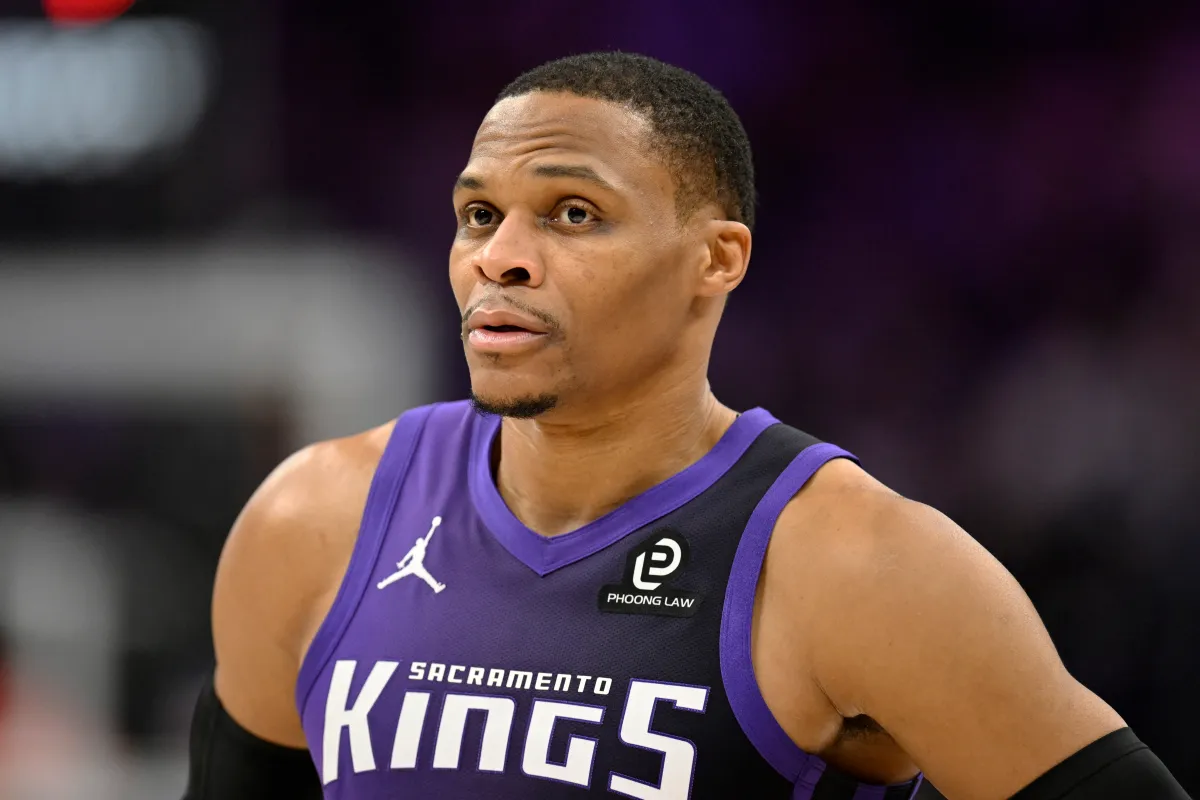
On Wednesday, the basketball world paused to absorb a piece of news that felt both inevitable and impossible: Russell Westbrook had announced his retirement after eighteen seasons in the NBA. For nearly two decades, Westbrook was not simply a player; he was a force of nature, a storm in sneakers who played every possession as if it were the last moment of a championship game. He was loud, aggressive, unfiltered, and unapologetic. He played with a ferocity that often made him polarizing, but it also made him impossible to ignore. Westbrook leaves the game with a staggering collection of accolades, including an MVP award, nine All-Star selections, two scoring titles, three assists crowns, and a place on the NBA’s 75th Anniversary Team. Yet to reduce him to a list of honors is to miss the point entirely. He was a throwback in an era of floor spacing and analytical efficiency, a man who believed in the power of sheer will, relentless energy, and the defiant refusal to back down. His retirement marks the end of an era not just because of the numbers, but because the NBA will no longer have a player who seems to be auditioning for a role in an opera, a war film, and a street fight all at once. The news sent a ripple through the league, with teams and former teammates paying tribute, including the Los Angeles Clippers, who issued a heartfelt message on X congratulating him on a legendary career. Westbrook’s farewell is a moment for players, fans, and even his critics to reflect on what he meant to the sport—and what he gave to everyone who watched him play, suit up in bold fashion, and speak with unguarded honesty. The game will feel quieter without him.
Westbrook’s journey began with the Oklahoma City Thunder, where he formed one of the most thrilling young trios in NBA history alongside Kevin Durant and James Harden. They were three gifted, hungry players ascending at the same time, and together they turned Oklahoma City into a championship contender faster than anyone expected. In 2012, they reached the NBA Finals, a breakthrough that felt like the beginning of a dynasty. But they ran into the Miami Heat, a superteam led by LeBron James, Dwyane Wade, and Chris Bosh, and the Thunder fell in five games. It was heartbreaking but promising; it seemed as if Westbrook and Durant would spend years challenging for titles. That, of course, is not how the story unfolded. Harden was traded, Durant eventually left, and Westbrook was left alone in Oklahoma City—but it was in that solitude that he truly became something iconic. When Durant departed, Westbrook did not sulk; he went supernova. He delivered one of the most astonishing single-season performances in basketball history, averaging a triple-double and winning the 2017 MVP award. His style was chaotic by design, an unyielding attack on the rim, pull-up threes with no hesitation, and full-speed rebounds that looked more like celebrations than plays. He wore his pain and pride on his sleeve. His relationship with Oklahoma City fans became something deeper than sport; they saw in him a reflection of their own stubbornness and heart. Even as the team changed and he moved on, the Westbrook era in Oklahoma City remained the great, passionate before-and-after story of that franchise.
The statistical legacy Westbrook leaves behind is extraordinary and perhaps unmatched in its combination of volume, versatility, and durability. He retired as the NBA’s all-time leader in triple-doubles, a record that once belonged to Oscar Robertson and was thought to be practically untouchable. Westbrook didn’t just break it; he shredded it, piling up triple-doubles with a regularity that made the feat feel almost ordinary. He is also one of only three players in NBA history to average a triple-double for an entire season, and he accomplished that feat four times. The last time he did it was with the Washington Wizards in 2021, a season in which he willed a struggling team into the playoffs with a string of monstrous performances. The Wizards season was vintage Westbrook: bruised, battered, emotionally raw, and unrelenting. He did not look for sympathy or praise; he looked for another rebound, another assist, another way to affect the game. His MVP season with the Thunder, when he averaged a triple-double after Durant left, was not just about numbers. It was about defiance. He was proving that loyalty and heart still meant something, that a player can carry a franchise on his back even when the world says it cannot be done. Westbrook’s career totals in points, assists, and rebounds place him among the greatest all-around players the league has ever seen. He changed how point guards were evaluated, forcing the world to realize that a floor general could dominate the glass and run a one-man fast break. His defensive intensity was inconsistent at times, but his thefts and crashing boards were signatures of a player who refused to be boxed into conventional roles.
The later chapters of Westbrook’s career were more nomadic, as he traded the spotlight of a franchise cornerstone for the complicated role of a veteran star searching for the right fit. He played for the Houston Rockets, Washington Wizards, Los Angeles Lakers, Los Angeles Clippers, Denver Nuggets, and finally the Sacramento Kings. Some of those stops were uneasy, and he experienced sharp criticism, too often becoming the scapegoat when teams fell short. But in Los Angeles, he found a measure of peace and appreciation. He signed with the Clippers in 2023, reuniting with James Harden and Paul George, both former Thunder teammates, and the chemistry felt poetic, like a reunion of an old group that had never gotten the chance to finish what it started. In 89 games with the Clippers, Westbrook averaged 12.2 points, 5.2 assists, and five rebounds in 24.3 minutes a night, proving he could adapt to a smaller role and still provide meaningful production. The Clippers’ official message celebrating his retirement was warm and respectful, acknowledging that they were honored to have been part of his legendary career. That gesture meant a great deal, because for a player of Westbrook’s stature, respect at the end matters more than numbers. He followed that with a season in Denver, serving as a mentor for younger players and bringing his trademark energy off the bench, then closed his career in Sacramento, where he played his final season. By then, the minutes and averages had decreased, but the passion never disappeared. He still celebrated every basket like a game-winner, still talked to the crowd, still gave every ounce of himself until the horn sounded. He accepted those shifting roles with more grace than many expected from a man known for his stubborn pride. That evolution may ultimately be as defining as his triple-doubles.
For all his achievements, Westbrook never won an NBA championship, and that fact will hang over his legacy like a ghost. But it is a legacy that does not need a ring to shine. Westbrook’s impact was never fully measured in parades or trophies; it was measured in the way he made the game feel urgent and alive. He connected with fans who appreciated his authenticity, his refusal to be polished, his willingness to be mocked for fashion, for his emotional responses, for his perceived flaws, and yet he continued to be himself. His “Why Not?” attitude became a manifesto for a generation. He encouraged young players to believe that size, history, and expectation do not determine destiny. He proved that a point guard could be a one-man wrecking crew, that rebounding is about want, not height, and that playing with anger can be channeled into artistry. He had his infamous triple-double quests and his critics who claimed his numbers were hollow, but he also had the unwavering admiration of his peers, coaches, and teammates who saw the work behind the highlights. He changed the culture of basketball, not just in Oklahoma City, but everywhere he went, from his trademark “brodie” persona to his fearless fashion on the runway to his charitable efforts and his outspoken support of community causes. Westbrook is undoubtedly a future Hall of Famer, but his enshrinement will not be about a perfect resume. It will be about a player who believed that playing basketball meant leaving everything on the floor, even when there is nothing left of yourself. The title he never won has become, in a strange way, a testament to how much he carried, because no matter which uniform he wore, he gave his teams a chance to believe in the impossible.
Now, at 37, Westbrook is moving on, and the basketball world must learn to imagine a league without him. In his retirement announcement, there was a sense of peace, a quiet acceptance that he had done everything he could and given everything he had. He could have signed with another team, perhaps chased a ring as a veteran reserve, but he chose to walk away on his own terms—something that has always mattered to him. The next chapter of his life is unwritten, but if his career has taught us anything, it is that he will not approach it cautiously. He will bring the same unrelenting intensity to whatever he does, whether it is broadcasting, business, fashion, philanthropy, or simply spending time with his family. He has nothing left to prove, but that was never what drove him. He was driven by the pure joy of competition, by the love of a game that took him from a kid with a dream to one of the greatest to ever play. The NBA will miss his thunderous dunks, his lightning-fast crossovers, his impossible rebounds, and his raw, unfiltered emotional outbursts. But more than the highlight reels, the league will miss his presence—the sense that every game was a battle, every opponent was worthy of total effort, and every fan deserved his full heart. Westbrook didn’t just retire; he closed the book on a chapter of basketball that will never be written again. He was flawed, he was fierce, he was ridiculed, and he was adored, but above all, he was real. And that, more than any stat, is the legacy of Russell Westbrook.