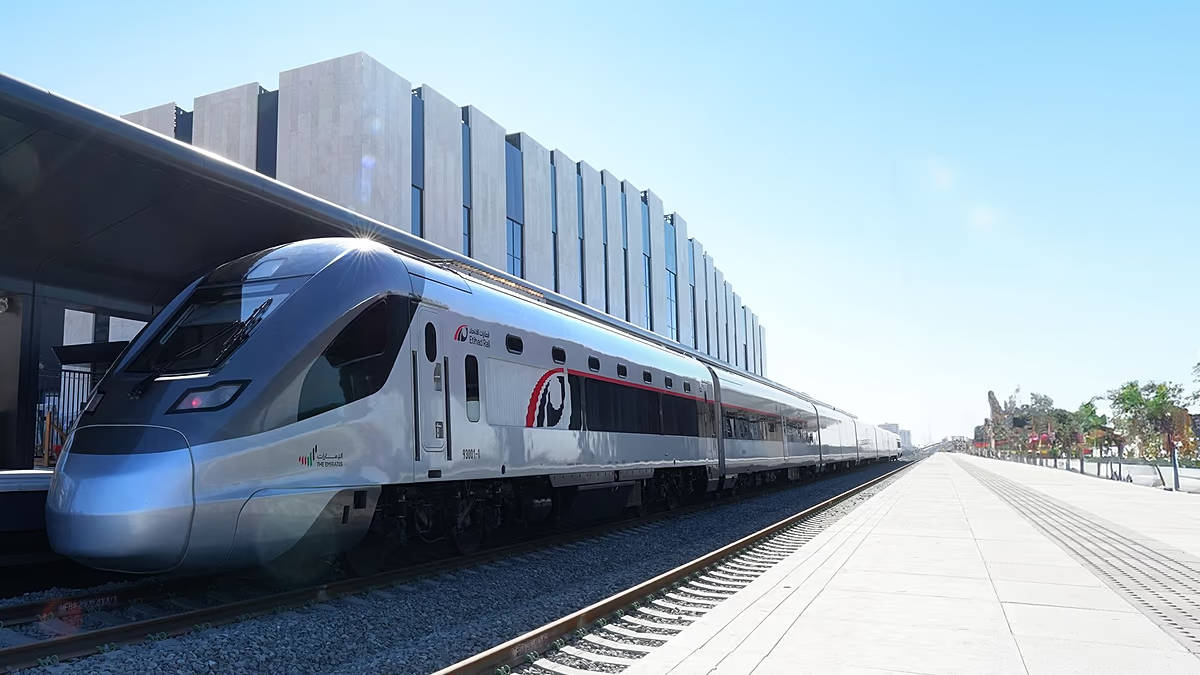





There are certain travel announcements that feel less like logistics and more like history being made. Etihad Rail has officially launched its passenger route between Abu Dhabi and Dubai, marking the first time the two emirates have ever been connected by train. For anyone who has ever sat in the long, slow crawl of traffic on the E11 motorway, this is not just a small convenience; it is a transformation. The journey between the UAE’s capital and its most vibrant tourist hub now takes just over an hour. That is roughly the time it might take to drink a coffee, answer a few emails, and watch the desert glide past the window. Tickets are priced at AED39, which is about €9.35, for comfort class, and AED109, or €26.13, for premium seats. For travelers used to the cost and unpredictability of taxis, this makes rail an affordable and relaxing alternative. There is something quietly thrilling about boarding a train in one city and stepping out in another less than seventy minutes later. For decades, the UAE’s cities have been built around the car. Highways, interchanges, parking lots, and endless horizons of asphalt have shaped how people live, commute, and plan their days. The arrival of passenger rail changes that rhythm. It offers a way to travel that is not just practical, but also human. You can look out the window, read a book, doze off, or simply enjoy the sensation of moving through a landscape that was once only visible through a windshield. This launch is the first of its kind in the country, and it signals a future where trains are as much a part of the UAE’s identity as its skyscrapers and highway interchanges. It also carries a deeper message: that connectivity is not just about roads and bridges, but about bringing people closer together. The route was inaugurated after years of planning and construction, and its significance is difficult to overstate. Abu Dhabi, the political and cultural capital, and Dubai, the global business and tourism hub, have grown at astonishing speed, and yet until now, the only practical ways to travel between them were car and plane. The new train offers a third way, one that is perhaps more civilized. Whether for a day trip, a business meeting, or a weekend away, passengers can simply show up, buy a ticket, and let the railway do the rest.
But the Abu Dhabi–Dubai line is only one piece of a much larger puzzle. Etihad Rail’s passenger service first got going in late June, with trains running from Abu Dhabi to Fujairah, an emirate on the country’s east coast. That initial route was a taste of what was to come. Now, with Dubai connected, the network is beginning to look like a real rail system rather than a single novelty line. And the expansion is far from over. On 30 December, the Al Dhafra station in Abu Dhabi will open its doors, and on 30 March next year, Sharjah train station will begin welcoming passengers. Each new stop brings the railway closer to the lives of ordinary residents and opens up new possibilities for travel within the UAE. However, there is a practical note for anyone planning to use the trains: the stations are not located in the heart of the cities. In Abu Dhabi, the station is at Mohamed Bin Zayed City, a little outside the central downtown area. But Etihad Rail has thought carefully about this. The company will offer shuttle services to and from key points in downtown Abu Dhabi, including the Corniche, Reem Mall, and ADNEC Centre. The shuttle costs just AED10, around €2.40, which makes it easy for passengers to connect from the city to the station without needing a private car. In Dubai, the train station sits at Jumeirah Golf Estates, and from there passengers can transfer directly onto the Dubai Metro. Dubai remains the only emirate in the country with a metro system, which gives it a natural role as a hub for integrated public transport. This combination of train and metro is important because it means travelers are not left stranded at an out-of-town station with no way to reach their final destination. Instead, they can move seamlessly from one mode of transport to another. It is a reminder that a railway is not just about tracks and engines; it is about creating connections that make the entire journey easier, more comfortable, and more enjoyable. The shuttle services and metro links are proof that the railway has been designed with real passengers in mind, not just as an engineering showcase.
Looking further ahead, the railway’s potential becomes even more interesting. Several additional stations are planned in Abu Dhabi, though no official opening dates have been announced yet. One will be at Al Mirfa, a place near the waterfront mangrove destination Al Mugheirah Bay. This is the kind of stop that invites nature lovers and weekend explorers. Imagine stepping off a train and, within minutes, finding yourself among quiet mangroves, with calm waters, birdlife, and a slower pace of life. Another future station is in Liwa, a region famous for its vast desert landscapes and the annual motorsports festival held on the dunes every winter. Liwa is one of the most evocative names in the UAE, associated with towering sand dunes and the kind of golden emptiness that makes people fall in love with the Arabian Peninsula. A train to Liwa could open up this area to a much wider audience, drawing visitors who might never have considered making the long drive. Then there is Al Sila, a town located right next to the Saudi Arabian border. This stop could one day become a gateway for cross-border travel, especially if the wider Gulf rail network ever becomes a reality. The diversity of these future destinations matters. The UAE is often seen as a country of two or three glittering cities, but it is far more varied than that. The new railway has the chance to reveal the quieter, wilder, more traditional side of the nation. It could encourage residents to explore their own country and open the door for tourists to venture beyond the familiar landmarks. Trains have always had a way of turning travel into an experience rather than a chore. The planned stops suggest that Etihad Rail is thinking not only about commuters, but also about explorers, families, and adventurers. For now, the dates remain uncertain, but the route map already hints at a future where the railway is woven into the fabric of daily life and leisure. It is a powerful reminder that rail is not just about getting somewhere; it is about the feeling of the journey itself, the anticipation of a new place, and the joy of watching the landscape change outside the window.
At the same time, the UAE’s rail network is part of a wider vision that stretches far beyond its borders. For years, there have been plans to connect the Gulf states—the UAE, Saudi Arabia, Oman, Qatar, Bahrain, and Kuwait—through a shared rail network. The idea is compelling: a traveler could board a train in Dubai and eventually continue to Riyadh, Doha, or even Kuwait City. But despite decades of discussion, there are still no exact dates for when such a network would become a reality. The challenges are considerable. Building cross-border rail requires coordination between countries with different regulations, security concerns, and economic priorities. Still, the UAE’s progress is significant in itself. Among the Gulf nations, Saudi Arabia is the only other country that currently operates passenger trains. Its rail history is deep and fascinating. In the early twentieth century, the region was part of the Ottoman railway network, with trains connecting Damascus in Syria to Medina. That line, known as the Hejaz Railway, was an extraordinary engineering achievement, but it was shut down during the Arab Revolt and never fully restored. Today, Saudi Arabia has a new generation of passenger rail. Trains connect Riyadh to Quruyyat, which is near the border with Jordan, as well as Riyadh to the port city of Dammam. There is also a popular route between the holy cities of Medina and Mecca. These lines serve a wide variety of travelers, from pilgrims performing religious journeys to ordinary citizens who simply need to move between cities for work or family. The contrast between the old Ottoman tracks and the modern high-speed services is a powerful reminder of how much has changed in a century. It also suggests that, while a fully connected Gulf network may still be a dream, the building blocks are already in place. Each new national system brings the region closer to the moment when those separate pieces can be joined together into something bigger.
Beyond national rail systems, metro networks are also transforming the Gulf’s urban landscapes. Riyadh opened its metro in 2024, a massive system built to serve one of the largest cities in the Arab world. Dubai has had its metro since 2009, and it has become a lifeline for millions of residents and tourists, with its driverless trains and distinctive stations. Doha opened its metro in 2019, just in time for the city to host the World Cup, and it continues to be an efficient way to move around the Qatari capital. Each of these systems is a statement of intent: the Gulf is no longer exclusively a region of cars and highways. Public transport is being taken seriously, and the benefits are clear. Metro systems reduce congestion, cut emissions, and make cities more livable. But there is more good news on the horizon. Late last year, Qatar announced that it had signed an agreement with Saudi Arabia to construct a high-speed railway linking Riyadh and Doha. The journey between the two capitals would take around two hours, and the project is set for completion in 2031. If that happens, it will be a breakthrough. A high-speed connection between two Gulf countries would prove that cross-border rail is not just a theoretical idea. It could serve as the first piece of a truly integrated regional network. Imagine taking a train from Riyadh to Doha for a weekend away, or traveling from Dubai to Riyadh through a series of connected rail links. The distances are not enormous by global standards. With the right infrastructure, these journeys could become as routine as taking a domestic flight. The Qatar–Saudi project, if completed on schedule, would be a significant step toward the kind of connectivity that the Gulf has long talked about but never quite achieved. It would also send a signal to the rest of the world that the region is serious about building a future beyond oil, one that includes people moving freely and sustainably across borders.
What makes all of this genuinely meaningful, though, is not just the technology or the timetables. It is the human experience. For years, the default way to travel in the UAE has been by car. The train offers something different: a chance to relax, to watch the world go by, and to arrive without the exhaustion of navigating traffic and searching for parking. A AED39 ticket is cheaper than most meals, let alone a taxi ride between two cities. It democratizes travel. It also has an environmental story. Rail is one of the most sustainable ways to move people, and a shift from private cars to trains could help reduce the carbon footprint of a country known for its energy consumption. But perhaps the deepest impact is emotional. The train connects communities. It reminds residents that the UAE is not just a collection of separate emirates, but a single country with shared ambitions. It makes travel easier for everyone—students, workers, families, tourists. It may even change where people choose to live, because a one-hour commute from Abu Dhabi to Dubai becomes quite reasonable. And for visitors, the train is a way to see the landscape as it actually is: the shifting sands, the flat expanses, the occasional flashes of green, the cities rising out of the desert. There is something romantic and hopeful about a train journey. It is not simply a way to get from A to B; it is a way to feel the distance and the movement, to understand the scale of a place. With the launch of the Abu Dhabi–Dubai route, the UAE has taken a bold step into a future where the journey itself matters. And if the broader plans come together, that future may one day include the entire Gulf. For now, passengers can simply enjoy the novelty and comfort of sitting on a train, watching two great cities grow closer in every sense. There is a quiet magic in that, and it is just the beginning.